Most ebook files are in PDF format, so you can easily read them using various software such as Foxit Reader or directly on the Google Chrome browser.
Some ebook files are released by publishers in other formats such as .awz, .mobi, .epub, .fb2, etc. You may need to install specific software to read these formats on mobile/PC, such as Calibre.
Please read the tutorial at this link. https://ebooknice.com/page/post?id=faq
We offer FREE conversion to the popular formats you request; however, this may take some time. Therefore, right after payment, please email us, and we will try to provide the service as quickly as possible.
For some exceptional file formats or broken links (if any), please refrain from opening any disputes. Instead, email us first, and we will try to assist within a maximum of 6 hours.
EbookNice Team
Status:
Available5.0
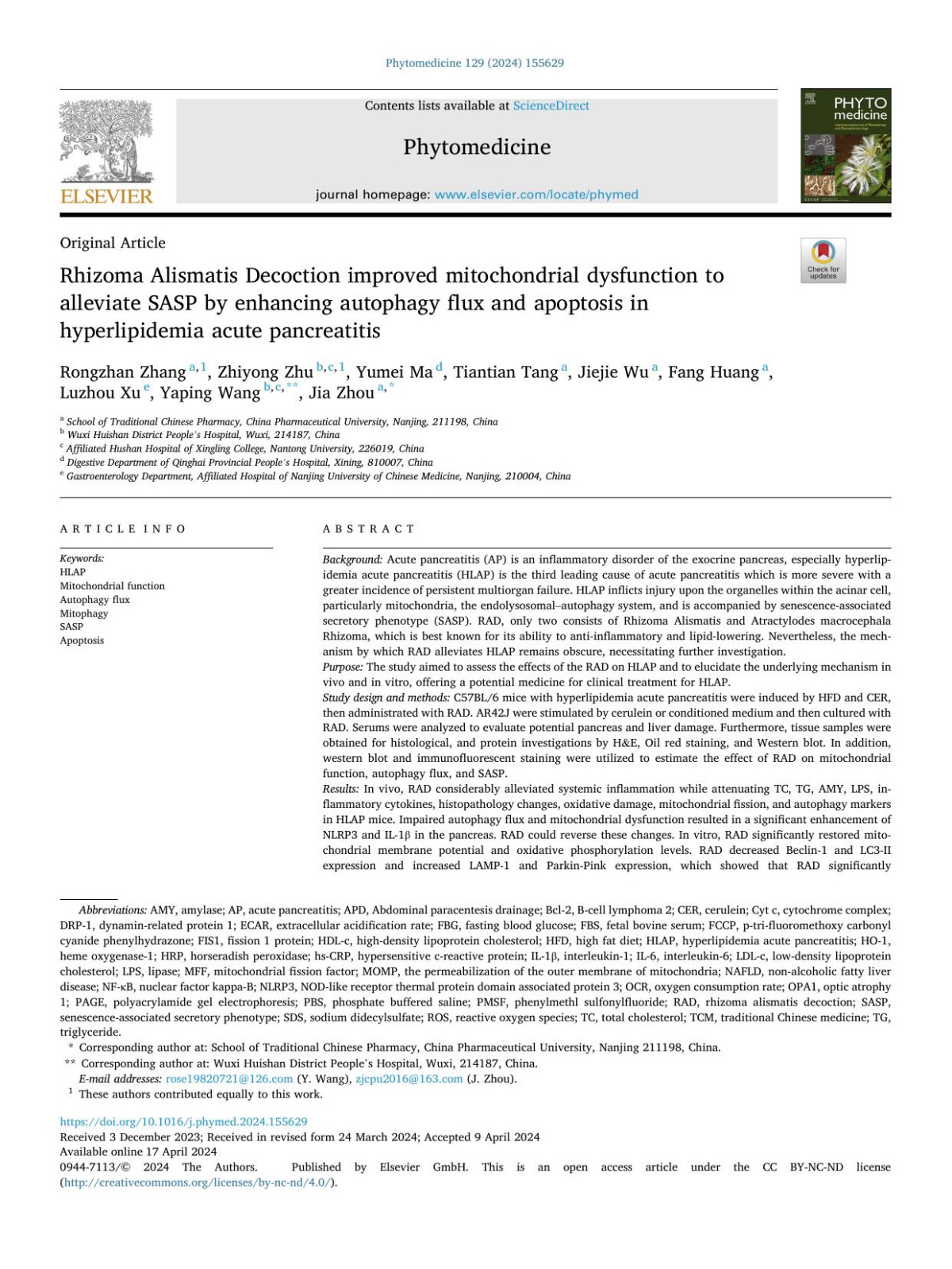
26 reviewsgreater incidence of persistent multiorgan failure. HLAP inflicts injury upon the organelles within the acinar cell,
particularly mitochondria, the endolysosomal–autophagy system, and is accompanied by senescence-associated
secretory phenotype (SASP). RAD, only two consists of Rhizoma Alismatis and Atractylodes macrocephala
Rhizoma, which is best known for its ability to anti-inflammatory and lipid-lowering. Nevertheless, the mechanism by which RAD alleviates HLAP remains obscure, necessitating further investigation.
Purpose: The study aimed to assess the effects of the RAD on HLAP and to elucidate the underlying mechanism in
vivo and in vitro, offering a potential medicine for clinical treatment for HLAP.
Study design and methods: C57BL/6 mice with hyperlipidemia acute pancreatitis were induced by HFD and CER,
then administrated with RAD. AR42J were stimulated by cerulein or conditioned medium and then cultured with
RAD. Serums were analyzed to evaluate potential pancreas and liver damage. Furthermore, tissue samples were
obtained for histological, and protein investigations by H&E, Oil red staining, and Western blot. In addition,
western blot and immunofluorescent staining were utilized to estimate the effect of RAD on mitochondrial
function, autophagy flux, and SASP.
Results: In vivo, RAD considerably alleviated systemic inflammation while attenuating TC, TG, AMY, LPS, inflammatory cytokines, histopathology changes, oxidative damage, mitochondrial fission, and autophagy markers
in HLAP mice. Impaired autophagy flux and mitochondrial dysfunction resulted in a significant enhancement of
NLRP3 and IL-1β in the pancreas. RAD could reverse these changes. In vitro, RAD significantly restored mitochondrial membrane potential and oxida
…
4.3
9 reviews
4.7
19 reviews
4.8
13 reviews
4.6
15 reviews
4.3
31 reviews
4.9
37 reviews