Most ebook files are in PDF format, so you can easily read them using various software such as Foxit Reader or directly on the Google Chrome browser.
Some ebook files are released by publishers in other formats such as .awz, .mobi, .epub, .fb2, etc. You may need to install specific software to read these formats on mobile/PC, such as Calibre.
Please read the tutorial at this link. https://ebooknice.com/page/post?id=faq
We offer FREE conversion to the popular formats you request; however, this may take some time. Therefore, right after payment, please email us, and we will try to provide the service as quickly as possible.
For some exceptional file formats or broken links (if any), please refrain from opening any disputes. Instead, email us first, and we will try to assist within a maximum of 6 hours.
EbookNice Team
Status:
Available4.9
37 reviewsDOI: 10.1002/advs.202509509
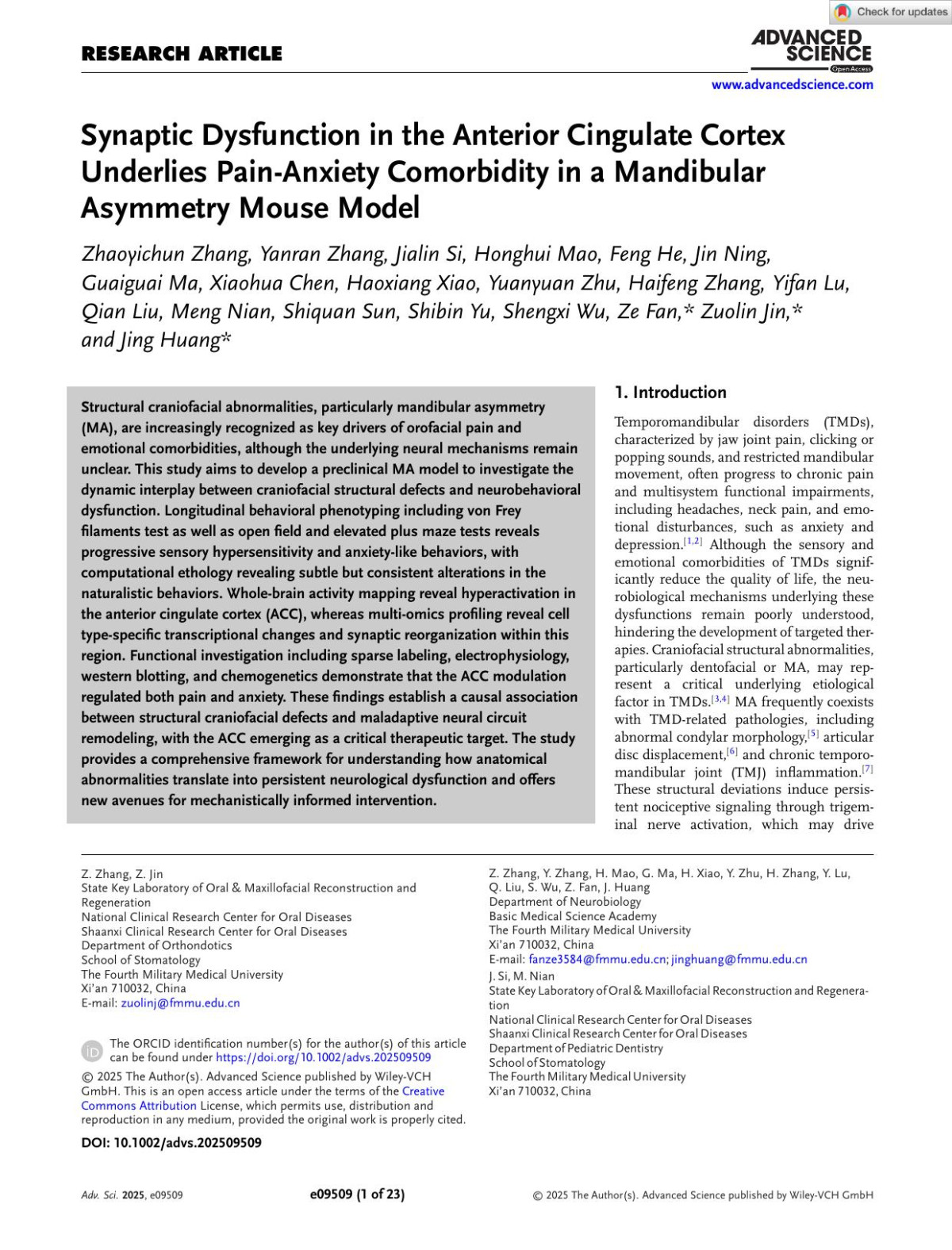
Structural craniofacial abnormalities, particularly mandibular asymmetry (MA), are increasingly recognized as key drivers of orofacial pain and emotional comorbidities, although the underlying neural mechanisms remain unclear. This study aims to develop a preclinical MA model to investigate the dynamic interplay between craniofacial structural defects and neurobehavioral dysfunction. Longitudinal behavioral phenotyping including von Frey filaments test as well as open field and elevated plus maze tests reveals progressive sensory hypersensitivity and anxiety-like behaviors, with computational ethology revealing subtle but consistent alterations in the naturalistic behaviors. Whole-brain activity mapping reveal hyperactivation in the anterior cingulate cortex (ACC), whereas multi-omics profiling reveal cell type-specific transcriptional changes and synaptic reorganization within this region. Functional investigation including sparse labeling, electrophysiology, western blotting, and chemogenetics demonstrate that the ACC modulation regulated both pain and anxiety. These findings establish a causal association between structural craniofacial defects and maladaptive neural circuit remodeling, with the ACC emerging as a critical therapeutic target. The study provides a comprehensive framework for understanding how anatomical abnormalities translate into persistent neurological dysfunction and offers new avenues for mechanistically informed intervention.
4.4
7 reviews
5.0
11 reviews
4.5
13 reviews
4.4
31 reviews
4.5
14 reviews
4.8
16 reviews
4.8
30 reviews
4.7
36 reviews