Most ebook files are in PDF format, so you can easily read them using various software such as Foxit Reader or directly on the Google Chrome browser.
Some ebook files are released by publishers in other formats such as .awz, .mobi, .epub, .fb2, etc. You may need to install specific software to read these formats on mobile/PC, such as Calibre.
Please read the tutorial at this link. https://ebooknice.com/page/post?id=faq
We offer FREE conversion to the popular formats you request; however, this may take some time. Therefore, right after payment, please email us, and we will try to provide the service as quickly as possible.
For some exceptional file formats or broken links (if any), please refrain from opening any disputes. Instead, email us first, and we will try to assist within a maximum of 6 hours.
EbookNice Team
Status:
Available0.0
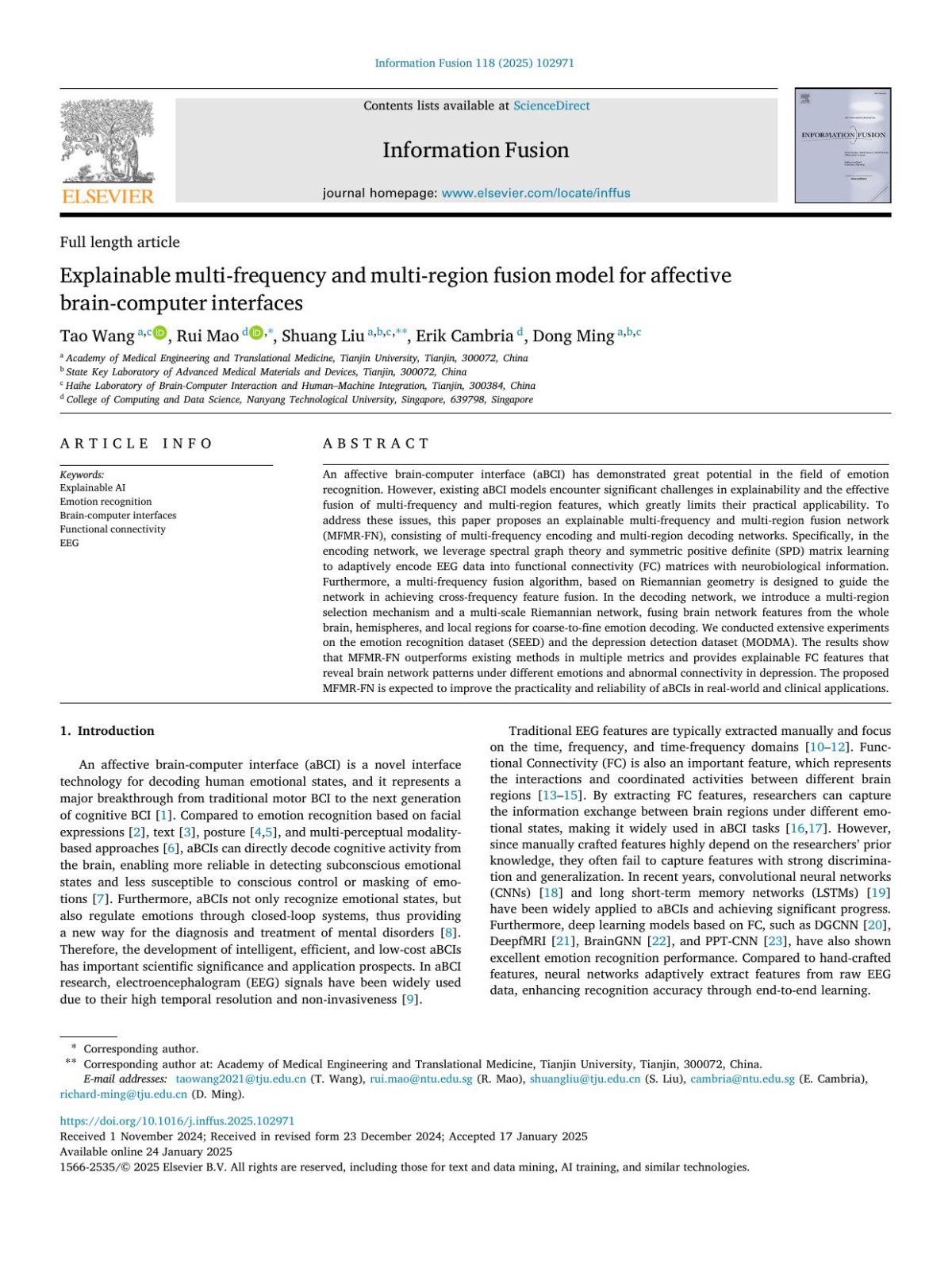
0 reviewsAn affective brain-computer interface (aBCI) has demonstrated great potential in the field of emotionrecognition. However, existing aBCI models encounter significant challenges in explainability and the effectivefusion of multi-frequency and multi-region features, which greatly limits their practical applicability. Toaddress these issues, this paper proposes an explainable multi-frequency and multi-region fusion network(MFMR-FN), consisting of multi-frequency encoding and multi-region decoding networks. Specifically, in theencoding network, we leverage spectral graph theory and symmetric positive definite (SPD) matrix learningto adaptively encode EEG data into functional connectivity (FC) matrices with neurobiological information.Furthermore, a multi-frequency fusion algorithm, based on Riemannian geometry is designed to guide thenetwork in achieving cross-frequency feature fusion. In the decoding network, we introduce a multi-regionselection mechanism and a multi-scale Riemannian network, fusing brain network features from the wholebrain, hemispheres, and local regions for coarse-to-fine emotion decoding. We conducted extensive experimentson the emotion recognition dataset (SEED) and the depression detection dataset (MODMA). The results showthat MFMR-FN outperforms existing methods in multiple metrics and provides explainable FC features thatreveal brain network patterns under different emotions and abnormal connectivity in depression. The proposedMFMR-FN is expected to improve the practicality and reliability of aBCIs in real-world and clinical application
4.8
6 reviews
4.7
39 reviews
4.6
12 reviews
4.9
23 reviews