logo
Product categories

EbookNice.com

Most ebook files are in PDF format, so you can easily read them using various software such as Foxit Reader or directly on the Google Chrome browser.
Some ebook files are released by publishers in other formats such as .awz, .mobi, .epub, .fb2, etc. You may need to install specific software to read these formats on mobile/PC, such as Calibre.

Please read the tutorial at this link.  https://ebooknice.com/page/post?id=faq


We offer FREE conversion to the popular formats you request; however, this may take some time. Therefore, right after payment, please email us, and we will try to provide the service as quickly as possible.


For some exceptional file formats or broken links (if any), please refrain from opening any disputes. Instead, email us first, and we will try to assist within a maximum of 6 hours.

EbookNice Team
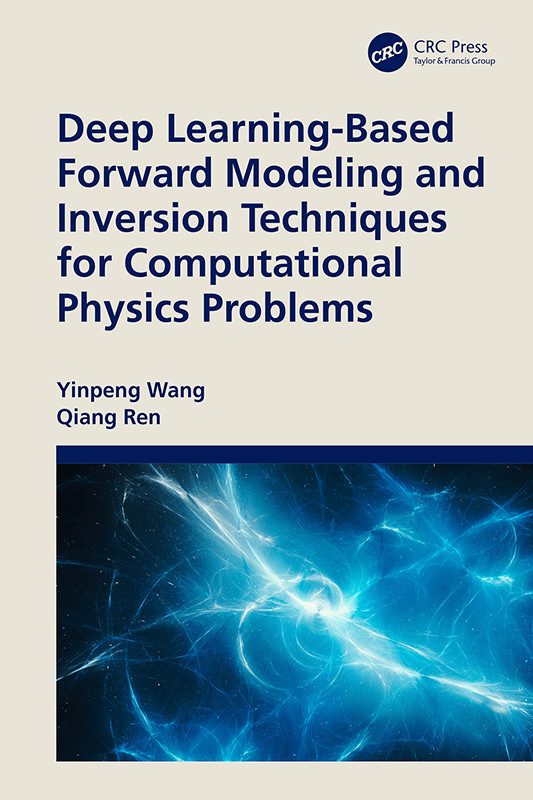
Deep Learning-Based Forward Modeling and Inversion Techniques for Computational Physics Problems by Wang, Yinpeng & Ren, Qiang instant download

  • SKU: EBN-237354220
Zoomable Image
$ 32 $ 40 (-20%)

Status:

Available

0.0

0 reviews
Instant download (eBook) Deep Learning-Based Forward Modeling and Inversion Techniques for Computational Physics Problems after payment.
Authors:Wang, Yinpeng & Ren, Qiang
Pages:updating ...
Year:2023
Publisher:CRC Press
Language:english
File Size:7.28 MB
Format:epub
Categories: Ebooks

Product desciption

Deep Learning-Based Forward Modeling and Inversion Techniques for Computational Physics Problems by Wang, Yinpeng & Ren, Qiang instant download

This book investigates in detail the emerging deep learning (DL) technique in computational physics, assessing its promising potential to substitute conventional numerical solvers for calculating the fields in real-time. After good training, the proposed architecture can resolve both the forward computing and the inverse retrieve problems. Pursuing a holistic perspective, the book includes the following areas. The first chapter discusses the basic DL frameworks. Then, the steady heat conduction problem is solved by the classical U-net in Chapter 2, involving both the passive and active cases. Afterwards, the sophisticated heat flux on a curved surface is reconstructed by the presented Conv-LSTM, exhibiting high accuracy and efficiency. Additionally, a physics-informed DL structure along with a nonlinear mapping module are employed to obtain the space/temperature/time-related thermal conductivity via the transient temperature in Chapter 4. Finally, in Chapter 5, a series of the latest advanced frameworks and the corresponding physics applications are introduced. As deep learning techniques are experiencing vigorous development in computational physics, more people desire related reading materials. This book is intended for graduate students, professional practitioners, and researchers who are interested in DL for computational physics.
*Free conversion of into popular formats such as PDF, DOCX, DOC, AZW, EPUB, and MOBI after payment.

Related Products