Most ebook files are in PDF format, so you can easily read them using various software such as Foxit Reader or directly on the Google Chrome browser.
Some ebook files are released by publishers in other formats such as .awz, .mobi, .epub, .fb2, etc. You may need to install specific software to read these formats on mobile/PC, such as Calibre.
Please read the tutorial at this link. https://ebooknice.com/page/post?id=faq
We offer FREE conversion to the popular formats you request; however, this may take some time. Therefore, right after payment, please email us, and we will try to provide the service as quickly as possible.
For some exceptional file formats or broken links (if any), please refrain from opening any disputes. Instead, email us first, and we will try to assist within a maximum of 6 hours.
EbookNice Team
Status:
Available4.4
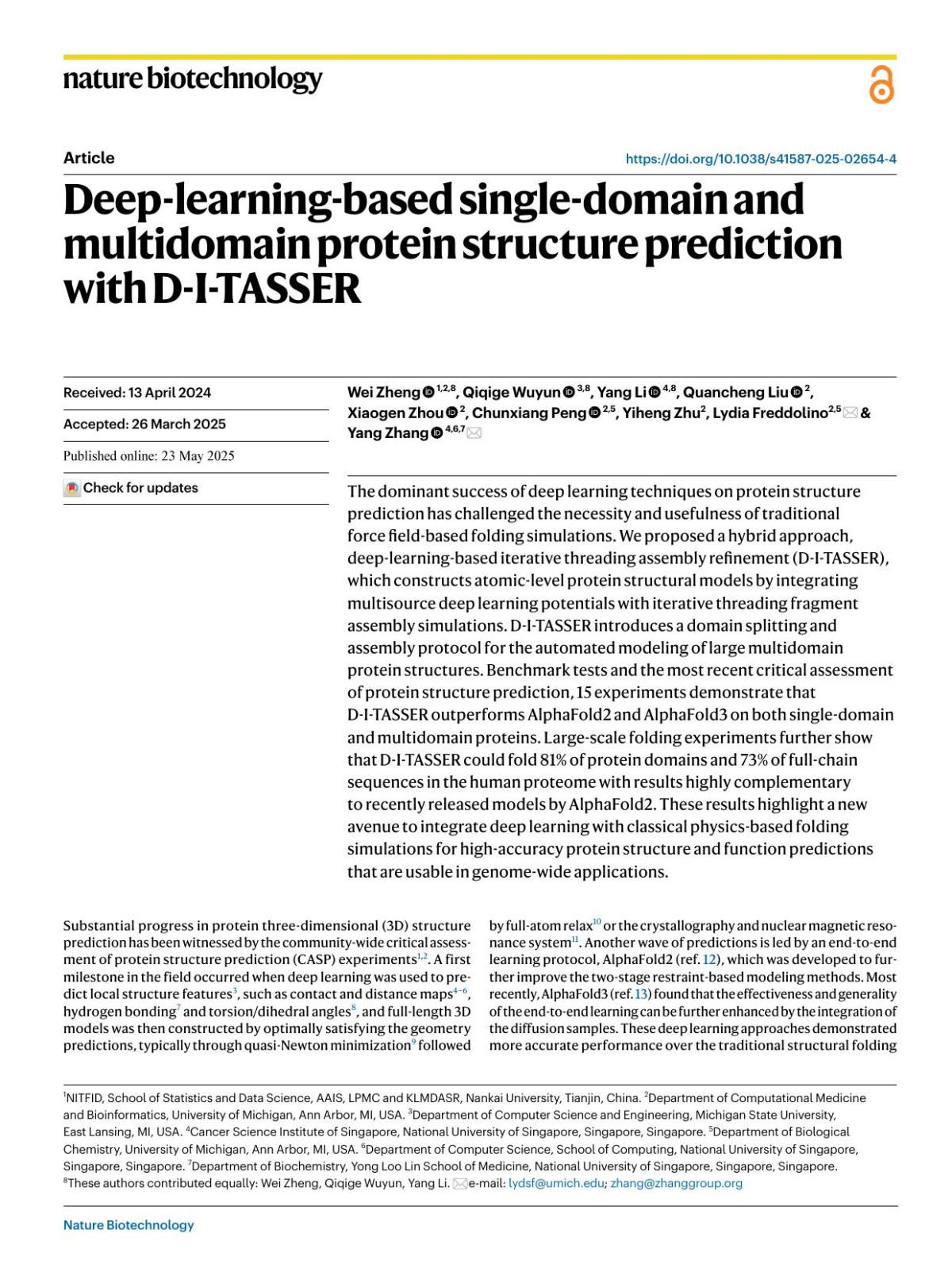
23 reviewsThe dominant success of deep learning techniques on protein structure prediction has challenged the necessity and usefulness of traditional force feld-based folding simulations. We proposed a hybrid approach, deep-learning-based iterative threading assembly refnement (D-I-TASSER), which constructs atomic-level protein structural models by integrating multisource deep learning potentials with iterative threading fragment assembly simulations. D-I-TASSER introduces a domain splitting and assembly protocol for the automated modeling of large multidomain protein structures. Benchmark tests and the most recent critical assessment of protein structure prediction, 15 experiments demonstrate that D-I-TASSER outperforms AlphaFold2 and AlphaFold3 on both single-domain and multidomain proteins. Large-scale folding experiments further show that D-I-TASSER could fold 81% of protein domains and 73% of full-chain sequences in the human proteome with results highly complementary to recently released models by AlphaFold2. These results highlight a new avenue to integrate deep learning with classical physics-based folding simulations for high-accuracy protein structure and function predictions that are usable in genome-wide applications.
4.5
14 reviews
4.5
14 reviews
4.7
40 reviews
4.5
36 reviews
4.9
40 reviews
4.3
19 reviews