
Most ebook files are in PDF format, so you can easily read them using various software such as Foxit Reader or directly on the Google Chrome browser.
Some ebook files are released by publishers in other formats such as .awz, .mobi, .epub, .fb2, etc. You may need to install specific software to read these formats on mobile/PC, such as Calibre.
Please read the tutorial at this link. https://ebooknice.com/page/post?id=faq
We offer FREE conversion to the popular formats you request; however, this may take some time. Therefore, right after payment, please email us, and we will try to provide the service as quickly as possible.
For some exceptional file formats or broken links (if any), please refrain from opening any disputes. Instead, email us first, and we will try to assist within a maximum of 6 hours.
EbookNice Team
Status:
Available0.0
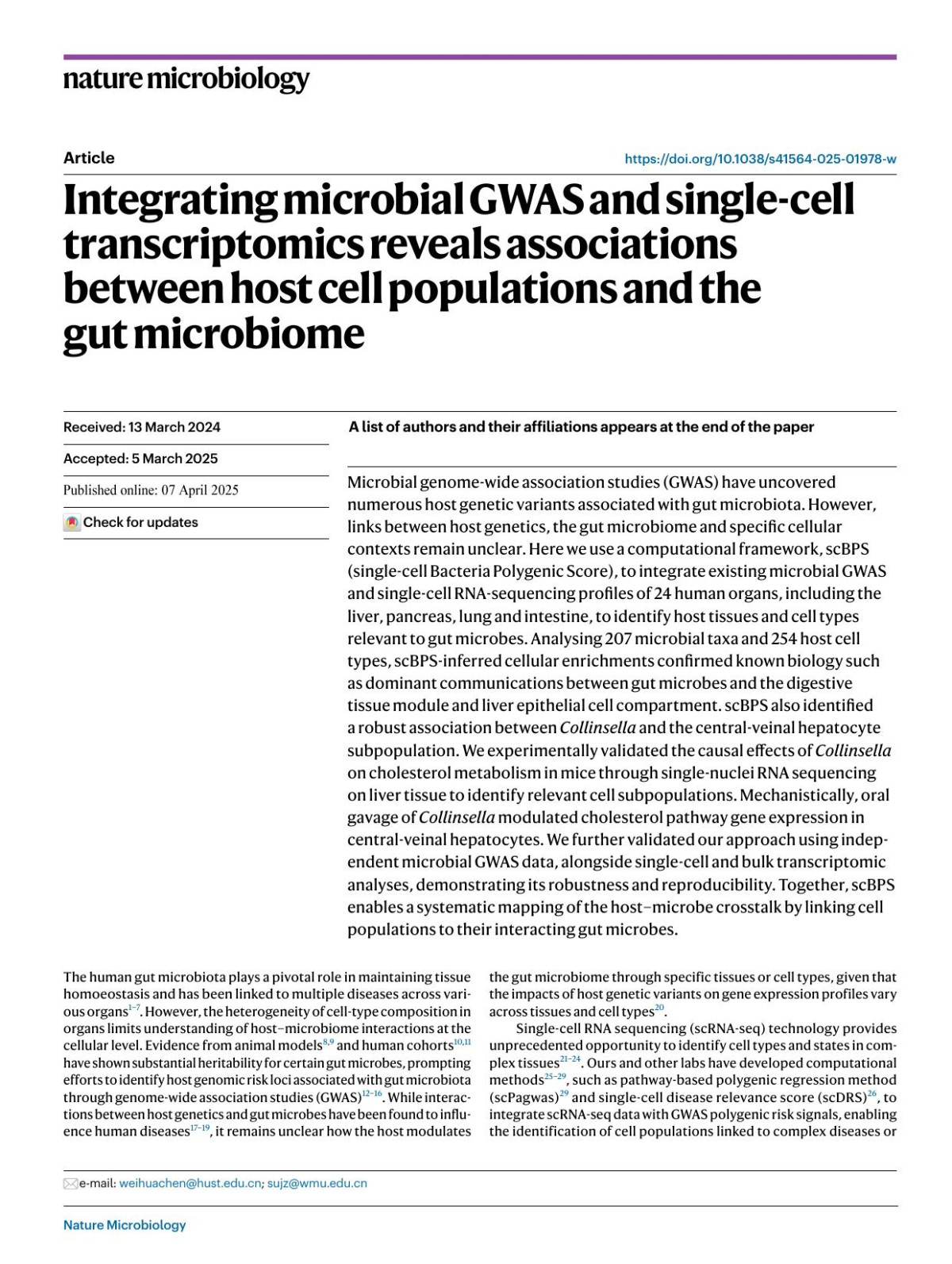
0 reviewsMicrobial genome-wide association studies (GWAS) have uncovered numerous host genetic variants associated with gut microbiota. However, links between host genetics, the gut microbiome and specifc cellular contexts remain unclear. Here we use a computational framework, scBPS (single-cell Bacteria Polygenic Score), to integrate existing microbial GWAS and single-cell RNA-sequencing profles of 24 human organs, including the liver, pancreas, lung and intestine, to identify host tissues and cell types relevant to gut microbes. Analysing 207 microbial taxa and 254 host cell types, scBPS-inferred cellular enrichments confrmed known biology such as dominant communications between gut microbes and the digestive tissue module and liver epithelial cell compartment. scBPS also identifed a robust association between Collinsella and the central-veinal hepatocyte subpopulation. We experimentally validated the causal efects of Collinsellaon cholesterol metabolism in mice through single-nuclei RNA sequencing on liver tissue to identify relevant cell subpopulations. Mechanistically, oral gavage of Collinsella modulated cholesterol pathway gene expression in central-veinal hepatocytes. We further validated our approach using indep -endent microbial GWAS data, alongside single-cell and bulk transcriptomic analyses, demonstrating its robustness and reproducibility. Together, scBPS enables a systematic mapping of the host–microbe crosstalk by linking cell populations to their interacting gut microbes.