
Most ebook files are in PDF format, so you can easily read them using various software such as Foxit Reader or directly on the Google Chrome browser.
Some ebook files are released by publishers in other formats such as .awz, .mobi, .epub, .fb2, etc. You may need to install specific software to read these formats on mobile/PC, such as Calibre.
Please read the tutorial at this link. https://ebooknice.com/page/post?id=faq
We offer FREE conversion to the popular formats you request; however, this may take some time. Therefore, right after payment, please email us, and we will try to provide the service as quickly as possible.
For some exceptional file formats or broken links (if any), please refrain from opening any disputes. Instead, email us first, and we will try to assist within a maximum of 6 hours.
EbookNice Team
Status:
Available0.0
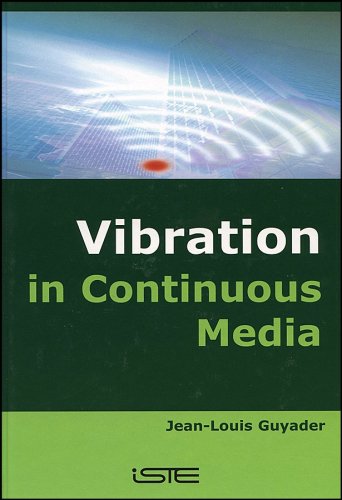
0 reviews(Ebook) Vibration in Continuous Media 1st Edition by Jean Louis Guyader - Ebook PDF Instant Download/Delivery: 9781905209279 ,1905209274
Full download (Ebook) Vibration in Continuous Media 1st Edition after payment
Product details:
ISBN 10: 1905209274
ISBN 13: 9781905209279
Author: Jean Louis Guyader
(Ebook) Vibration in Continuous Media 1st Edition Table of contents:
Chapter 1: Vibrations of Continuous Elastic Solid Media
1.1 Objective of the chapter
1.2 Equations of motion and boundary conditions of continuous media
1.3 Study of the vibrations: small movements around a position of static, stable equilibrium
1.4 Conclusion
Chapter 2: Variational Formulation for Vibrations of Elastic Continuous Media
2.1 Objective of the chapter
2.2 Concept of the functional, bases of the variational method
2.3 Reissner’s functional
2.4 Hamilton’s functional
2.5 Approximate solutions
2.6 Euler equations associated with the extremum of a functional
2.7 Conclusion
Chapter 3: Equation of Motion for Beams
3.1 Objective of the chapter
3.2 Hypotheses of condensation of straight beams
3.3 Equations of longitudinal vibrations of straight beams
3.4 Equations of torsional vibrations of straight beams
3.5 Equations of bending vibrations of straight beams
3.6 Complex vibratory movements: sandwich beam with a flexible inside
3.7 Conclusion
Chapter 4: Equation of Vibration for Plates
4.1 Objective of the chapter
4.2 Thin plate hypotheses
4.3 Equations of motion and boundary conditions of in‑plane vibrations
4.4 Equations of motion and boundary conditions of transverse vibrations
4.5 Coupled movements
4.6 Equations with polar coordinates
4.7 Conclusion
Chapter 5: Vibratory Phenomena Described by the Wave Equation
5.1 Introduction
5.2 Wave equation: presentation and uniqueness of the solution
5.3 Solution via propagation method (d’Alembert’s method)
5.4 Solution via separation of variables
5.5 Applications
5.6 Conclusion
Chapter 6: Free Bending Vibration of Beams
6.1 Introduction
6.2 The problem
6.3 Solution for homogeneous beam with constant cross‑section
6.4 Propagation in infinite beams
6.5 Introduction of boundary conditions: vibration modes
6.6 Stress‑displacement relationship
6.7 Influence of secondary effects
6.8 Conclusion
Chapter 7: Bending Vibration of Plates
7.1 Introduction
7.2 Setting up the problem: writing boundary conditions
7.3 Solution of equation via separation of variables
7.4 Vibration modes of plates supported at two opposite edges
7.5 Vibration modes of rectangular plates: approximation by edge‑effect method
7.6 Calculation of free vibratory response following initial conditions
7.7 Circular plates
7.8 Conclusion
Chapter 8: Introduction to Damping: Example of the Wave Equation
8.1 Introduction
8.2 Wave equation with viscous damping
8.3 Damping via dissipative boundary conditions
8.4 Viscoelastic beam
8.5 Orthogonality properties of damped systems
8.6 Conclusion
Chapter 9: Calculation of Forced Vibrations by Modal Expansion
9.1 Objective of the chapter
9.2 Steps for calculating response via modal decomposition
9.3 Examples: generalized mass and stiffness
9.4 Solution of modal equation
9.5 Example of response calculation
9.6 Convergence of modal series
9.7 Conclusion
Chapter 10: Calculation of Forced Vibrations by Forced Wave Decomposition
10.1 Introduction
10.2 Method illustrated with torsional vibration of a beam
10.3 Resolution of bending problems
10.4 Damped media (longitudinal beam vibrations)
10.5 Generalization: distributed excitations and non‑harmonic excitations
10.6 Forced vibrations of rectangular plates
10.7 Conclusion
Chapter 11: The Rayleigh‑Ritz Method based on Reissner’s Functional
11.1 Introduction
11.2 Variational formulation for bending vibrations of beams
11.3 Generation of functional spaces
11.4 Approximation of the vibratory response
11.5 Method formulation
11.6 Application to a clamped‑free beam
11.7 Conclusion
Chapter 12: The Rayleigh‑Ritz Method based on Hamilton’s Functional
12.1 Introduction
12.2 Reference example: bending vibrations of beams
12.3 Finite-element–type functional basis: applied to longitudinal beam vibrations
12.4 Modal-type functional basis: applied to plates with heterogeneities
12.5 Elastic boundary conditions
12.6 Convergence of Rayleigh‑Ritz method
12.7 Conclusion
People also search for (Ebook) Vibration in Continuous Media 1st Edition:
e/c vibration
elastic vibration of continuous media
electromagnetic vibration
frequency vibrations for inflammation
frequency of vibrations
Tags: Jean Louis Guyader, Vibration, Continuous Media
4.7
13 reviews
5.0
32 reviews
5.0
11 reviews


5.0
39 reviews

4.4
16 reviews