
Most ebook files are in PDF format, so you can easily read them using various software such as Foxit Reader or directly on the Google Chrome browser.
Some ebook files are released by publishers in other formats such as .awz, .mobi, .epub, .fb2, etc. You may need to install specific software to read these formats on mobile/PC, such as Calibre.
Please read the tutorial at this link. https://ebooknice.com/page/post?id=faq
We offer FREE conversion to the popular formats you request; however, this may take some time. Therefore, right after payment, please email us, and we will try to provide the service as quickly as possible.
For some exceptional file formats or broken links (if any), please refrain from opening any disputes. Instead, email us first, and we will try to assist within a maximum of 6 hours.
EbookNice Team
Status:
Available4.9
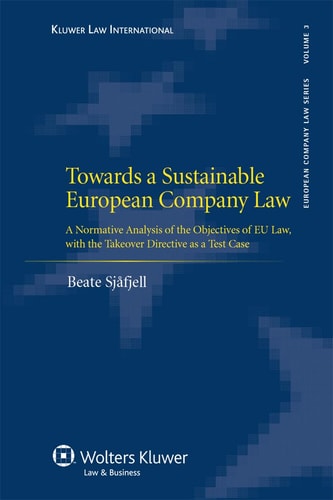
32 reviewsNo one doubts any longer that sustainable development is a normative imperative. Yet there is unmistakably a great reluctance to acknowledge any legal basis upon which companies are obliged to forgo ‘shareholder value’ when such a policy clearly dilutes responsibility for company action in the face of continuing environmental degradation.
Here is a book that boldly says: ‘Shareholder primacy’ is wrong. Such a narrow, short-term focus, the author shows, works against the achievement of the overarching societal goals of European law itself. The core role of EU company and securities law is to promote economic development, notably through the facilitation of market integration, while its contributory role is to further sustainable development through facilitation of the integration of economic and social development and environmental protection. There is a clear legal basis in European law to overturn the poorly substantiated theory of a ‘market for corporate control’ as a theoretical and ideological basis when enacting company law.
With rigorous and persuasive research and analysis, this book demonstrates that:
As a test case, the author offers an in-depth analysis of the Takeover Directive, showing that it neither promotes economic development nor furthers the integration of the economic, social and environmental interests that the principle of sustainable development requires.
This book goes to the very core of the ongoing debate on the function and future of European company law. Surprisingly, it does not make an argument in favour of changing EU law, but shows that we can take a great leap…
4.9
41 reviews
4.8
7 reviews
4.3
36 reviews

4.9
41 reviews


5.0
7 reviews