
Most ebook files are in PDF format, so you can easily read them using various software such as Foxit Reader or directly on the Google Chrome browser.
Some ebook files are released by publishers in other formats such as .awz, .mobi, .epub, .fb2, etc. You may need to install specific software to read these formats on mobile/PC, such as Calibre.
Please read the tutorial at this link. https://ebooknice.com/page/post?id=faq
We offer FREE conversion to the popular formats you request; however, this may take some time. Therefore, right after payment, please email us, and we will try to provide the service as quickly as possible.
For some exceptional file formats or broken links (if any), please refrain from opening any disputes. Instead, email us first, and we will try to assist within a maximum of 6 hours.
EbookNice Team
Status:
Available5.0
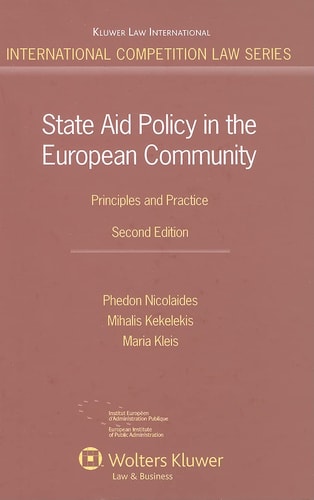
7 reviewsFollowing directly on from the completion of the European Commissionâs State Aid Action Plan, this thorough guide provides a concise review of the current state aid policy of the European Community. Certain kinds of state aid are no longer allowed, some other kinds are now possible, while certain types and amounts of aid are now subject to more detailed and rigorous assessment. Increasingly, Member States tend to shift emphasis from supporting individual companies or sectors, towards pursuing horizontal policy objectives.
The book not only explains the principles on which European state aid policy is based and how it is applied in practice, but also highlights recent legislation adopted with the ultimate aim of directing Member States towards meeting the Lisbon objectives and responding to successive European Council calls for âless and better targeted aidâ. The authors identify the most recent sources of EC law on state aid, and analyse the latest landmark European Commission decisions and judgements of EU Courts. They also offer useful guidance on how to design state aid measures.
Among the many specific topics covered are the following:
⢠the balancing test for compatibility with the common market;
⢠exceptions for transport and âservices of general economic interestâ;
⢠the Commissionâs supervisory control; and
⢠state aid monitoring procedures.
Numerous revealing case studies are presented, and useful appendices offer legislative texts and insights into defined areas of practice such as de minimise aid, the SME definition, risk capital for SMEs, aid for research and development and innovation, aid for rescue and restructuring, regional aid, or finally aid for agricultural, environmental or transport purposes.
The guide has developed from seminars on EC state aid law and policy organised during the past decade by the European Institute of Public Administration (EIPA). In line with those…
4.9
24 reviews
4.6
26 reviews
4.5
31 reviews
4.3
33 reviews
4.3
13 reviews
4.6
16 reviews
4.8
37 reviews
4.3
25 reviews
4.7
24 reviews
4.7
22 reviews