logo
Product categories

EbookNice.com

Most ebook files are in PDF format, so you can easily read them using various software such as Foxit Reader or directly on the Google Chrome browser.
Some ebook files are released by publishers in other formats such as .awz, .mobi, .epub, .fb2, etc. You may need to install specific software to read these formats on mobile/PC, such as Calibre.

Please read the tutorial at this link.  https://ebooknice.com/page/post?id=faq


We offer FREE conversion to the popular formats you request; however, this may take some time. Therefore, right after payment, please email us, and we will try to provide the service as quickly as possible.


For some exceptional file formats or broken links (if any), please refrain from opening any disputes. Instead, email us first, and we will try to assist within a maximum of 6 hours.

EbookNice Team
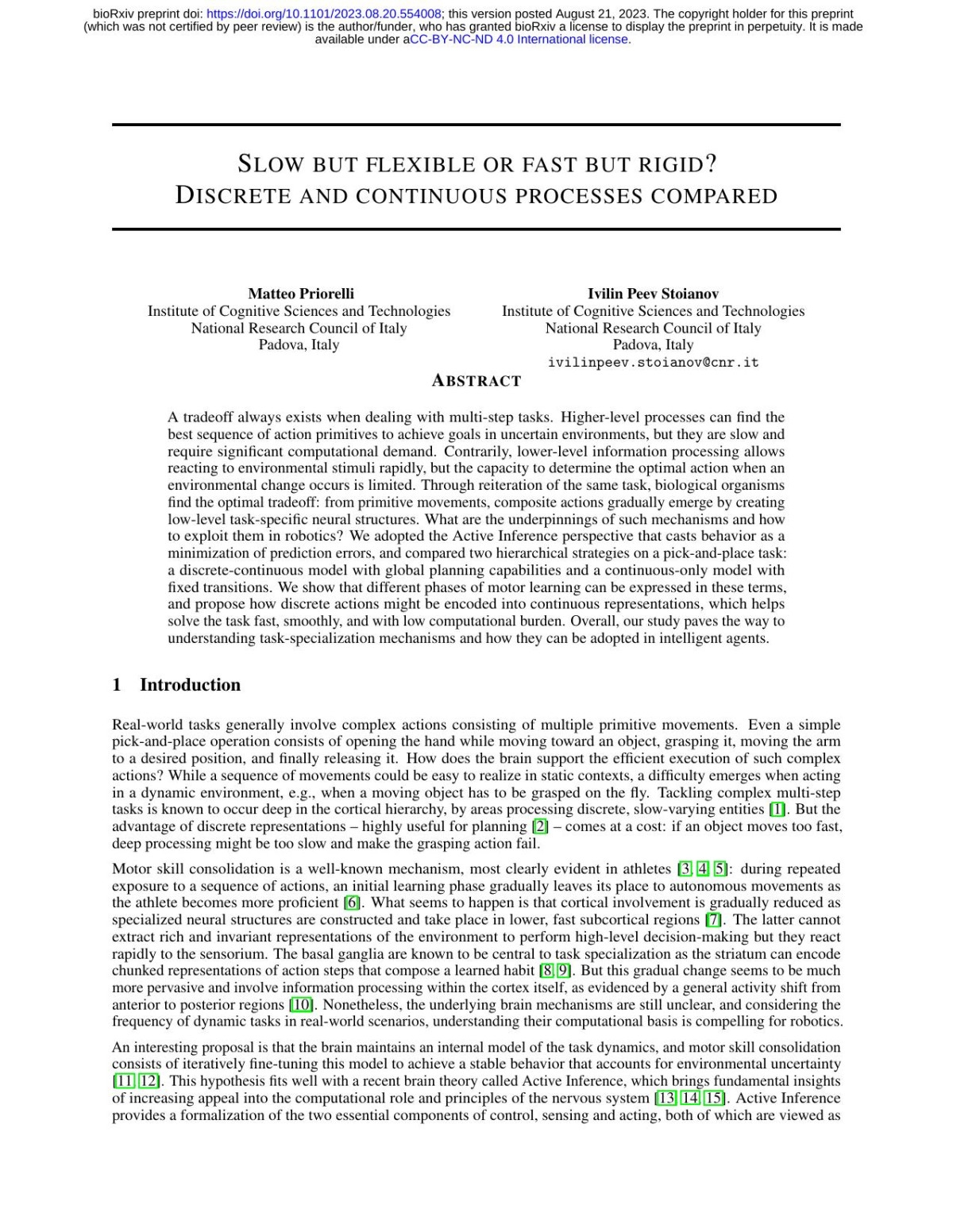
Slow But Flexible Or Fast But Rigid? Discrete And Continuous Processes Compared by Matteo Priorelli, Ivilin Peev Stioianov instant download

  • SKU: EBN-239629020
Zoomable Image
$ 32 $ 40 (-20%)

Status:

Available

0.0

0 reviews
Instant download (eBook) Slow But Flexible Or Fast But Rigid? Discrete And Continuous Processes Compared after payment.
Authors:Matteo Priorelli, Ivilin Peev Stioianov
Pages:updating ...
Year:2023
Publisher:x
Language:english
File Size:2.01 MB
Format:pdf
Categories: Ebooks

Product desciption

Slow But Flexible Or Fast But Rigid? Discrete And Continuous Processes Compared by Matteo Priorelli, Ivilin Peev Stioianov instant download

A tradeoff always exists when dealing with multi-step tasks. Higher-level processes can find theA tradeoff always exists when dealing with multi-step tasks. Higher-level processes can find thebest sequence of action primitives to achieve goals in uncertain environments, but they are slow andrequire significant computational demand. Contrarily, lower-level information processing allowsreacting to environmental stimuli rapidly, but the capacity to determine the optimal action when anenvironmental change occurs is limited. Through reiteration of the same task, biological organismsfind the optimal tradeoff: from primitive movements, composite actions gradually emerge by creatinglow-level task-specific neural structures. What are the underpinnings of such mechanisms and howto exploit them in robotics? We adopted the Active Inference perspective that casts behavior as aminimization of prediction errors, and compared two hierarchical strategies on a pick-and-place task:a discrete-continuous model with global planning capabilities and a continuous-only model withfixed transitions. We show that different phases of motor learning can be expressed in these terms,and propose how discrete actions might be encoded into continuous representations, which helpssolve the task fast, smoothly, and with low computational burden. Overall, our study paves the way tounderstanding task-specialization mechanisms and how they can be adopted in intelligent agents.1 IntroductionReal-world tasks generally involve complex actions consisting of multiple primitive movements. Even a simplepick-and-place operation consists of opening the hand while moving toward an object, grasping it, moving the armto a desired position, and finally releasing it. How does the brain support the efficient execution of such complexactions? While a sequence of movements could be easy to realize in static contexts, a difficulty emerges when actingin a dynamic environment, e.g., when a moving object has to be grasped on t
*Free conversion of into popular formats such as PDF, DOCX, DOC, AZW, EPUB, and MOBI after payment.

Related Products