
Most ebook files are in PDF format, so you can easily read them using various software such as Foxit Reader or directly on the Google Chrome browser.
Some ebook files are released by publishers in other formats such as .awz, .mobi, .epub, .fb2, etc. You may need to install specific software to read these formats on mobile/PC, such as Calibre.
Please read the tutorial at this link. https://ebooknice.com/page/post?id=faq
We offer FREE conversion to the popular formats you request; however, this may take some time. Therefore, right after payment, please email us, and we will try to provide the service as quickly as possible.
For some exceptional file formats or broken links (if any), please refrain from opening any disputes. Instead, email us first, and we will try to assist within a maximum of 6 hours.
EbookNice Team
Status:
Available4.7
17 reviews
ISBN 10: 1848210124
ISBN 13: 9781848210127
Author: Constantin Cristescu
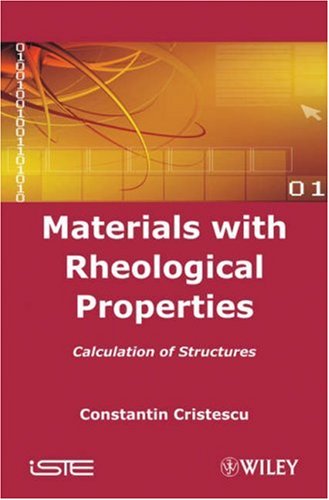
Materials with Rheological Properties presents the evolution of the mathematical models used to calculate the resistance structures and the conditions which enable progress to be made in this field. The author presents equations describing the behavior of each possible type of resistance structure (with discrete collaboration, continuous collaboration and complex composition). These equations are then redefined in the particular concrete form for each type of structure, by using the notions and known parameters from the construction's statics. The mathematical models are then tested using practical case studies.
Chapter 1. Introduction 1
1.1. Historical background 1
1.2. Considering the plastic and rheological properties of materials in calculating and designing resistance structures for constructions 3
1.3. The basis of the mathematical model for calculating resistance structures by taking into account the rheological properties of the materials 4
Chapter 2. The Rheological Behavior of Building Materials 9
2.1. Preamble 9
2.2. Structural steel for construction 19
2.2.1. Structural steel for metal construction 19
2.2.2. Reinforcing steel (non-prestressed) 22
2.2.3. Reinforcements, steel wire and steel wire products for prestressed concrete 23
2.3. Concrete 32
Chapter 3. Composite Resistance Structures with Elements Built from Materials Having Different Rheological Properties 45
3.1. Mathematical model for calculating the behavior of composite resistance structures: introduction 45
3.2. Mathematical model for calculating the behavior of composite resistance structures. The formulation considering creep 49
3.2.1. The effects of the long-term actions and loads: overview 49
3.2.1.1. Composite structures with discrete collaboration 61
3.2.1.2. Composite structures with continuous collaboration 67
3.2.1.3. Composite structures with complex composition 80
3.2.2. The effect of repeated short-term variable load actions: overview 86
3.3. Mathematical model for calculating the behavior of composite resistance structures. The formulation considering stress relaxation 95
3.3.1. The effect of long-term actions and loads: overview 95
3.3.1.1. Composite structures with discrete collaboration 102
3.3.1.2. Composite structures with continuous collaboration 106
3.3.1.3. Composite structures with complex composition 115
3.3.2. The effect of repeated short-term variable actions and loads: overview 120
3.4. Conceptual aspects of the mathematical model of resistance structure behavior according to the rheological properties of the materials from which they are made 125
Chapter 4. Applications on Resistance Structures for Constructions 129
4.1. Correction matrix 129
4.1.1. The displacement matrix of the end of a perfectly rigid body due to unit displacements successively applied to the other end of a rigid body 130
4.1.2. The reaction matrix of the end of a perfectly rigid body due to unit forces successively applied to the other end of a rigid body 132
4.2. Calculation of the composite resistance structures. Formulation according to the creep 133
4.2.1. Preliminaries necessary to systematize the calculation of composite structures in the formulation according to the creep 133
4.2.2. Composite structures with discrete collaboration 136
4.2.3. Composite structures with continuous collaboration 140
4.2.4. Composite structures with complex composition 155
4.3. The calculation of composite resistance structures. Formulation according to the stress relaxation 161
4.3.1. Preliminaries necessary to systematize the calculation of the composite structures in the formulation according to the stress relaxation 161
4.3.2. Composite structures with discrete collaboration 165
4.3.3. Composite structures with continuous collaboration 172
4.3.4. Composite structures with complex composition 179
Chapter 5. Numerical Application 189
5.1. Considerations concerning the validation of the mathematical model proposed for estimation through calculation of the behavior of the resistance structures by considering the rheological properties of the materials 189
5.2. The RALUCA computer applications system191
5.3. The resistance structure 198
5.4. Numerical experiments 203
5.4.1. The first series of experiments 203
5.4.1.1. The particular conditions for the analysis of the mathematical model 204
5.4.2. The second series of experiments 206
5.4.2.1. The particular conditions for the analysis of the mathematical model 206
5.4.3. The third series of experiments 211
5.4.3.1. The influence of the parameters defining the creep function 211
5.4.3.2. The stresses state in the structure caused by the contraction of the concrete 214
5.4.3.3. The influence of the deformability of the connection elements on the effort’s distribution among the elements of the structure 217
Appendix 1. The Initial Stresses and Strains State of the Structures with Continuous Collaboration 223
A.1. Simply supported beam with uniformly distributed load 227
A.2. Simply supported beam loaded with a concentrated force 230
A.3. Simply supported beam loaded with a concentrated moment at each end 233
A.4. Simply supported beam loaded with concentrated forces applied eccentrically, acting on a direction parallel with the axis of the beam 235
Appendix 2. Systems of Integral and Integro-differential Equations 241
1. Integro-differential equations whose unknown factors are functions of one variable 242
2. Integro-differential equations whose unknown factors are functions of two variables 251
3. Integro-differential equations whose unknown factors are functions of one or two variables 260
Bibliography 283
Index 287
material properties book
rheological properties of materials
rheological properties of ab materials
rheological properties of biological materials
ebook material
meta materials facebook
Tags: Constantin Cristescu, Materials, Rheological

4.3
21 reviews
4.7
12 reviews
4.8
25 reviews




5.0
21 reviews
5.0
21 reviews