
Most ebook files are in PDF format, so you can easily read them using various software such as Foxit Reader or directly on the Google Chrome browser.
Some ebook files are released by publishers in other formats such as .awz, .mobi, .epub, .fb2, etc. You may need to install specific software to read these formats on mobile/PC, such as Calibre.
Please read the tutorial at this link. https://ebooknice.com/page/post?id=faq
We offer FREE conversion to the popular formats you request; however, this may take some time. Therefore, right after payment, please email us, and we will try to provide the service as quickly as possible.
For some exceptional file formats or broken links (if any), please refrain from opening any disputes. Instead, email us first, and we will try to assist within a maximum of 6 hours.
EbookNice Team
Status:
Available0.0
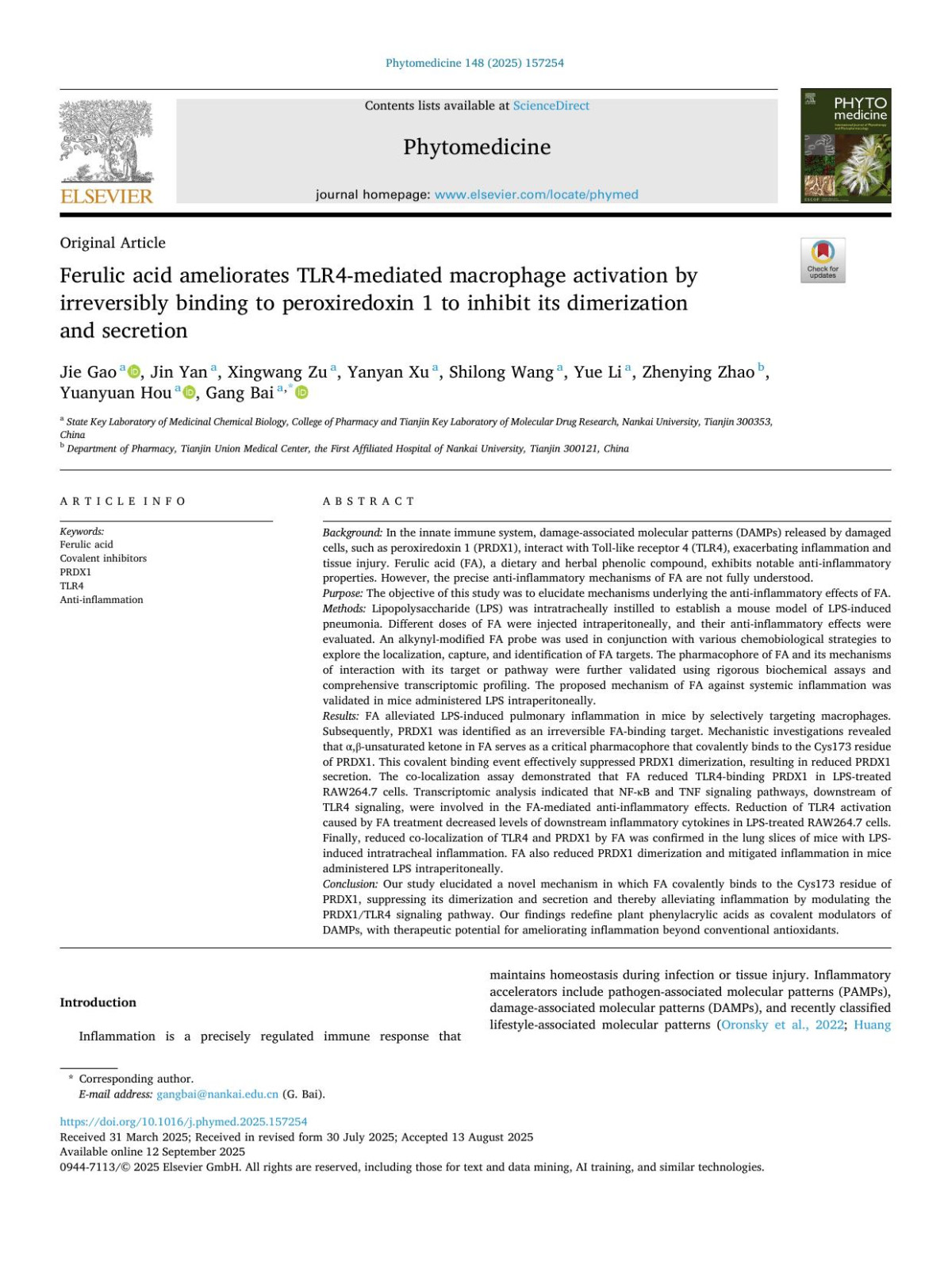
0 reviewsABSTRACTKeywords:Background: In the innate immune system, damage-associated molecular patterns (DAMPs) released by damaged Ferulic acidcells, such as peroxiredoxin 1 (PRDX1), interact with Toll-like receptor 4 (TLR4), exacerbating inflammation and Covalent inhibitorstissue injury. Ferulic acid (FA), a dietary and herbal phenolic compound, exhibits notable anti-inflammatory PRDX1properties. However, the precise anti-inflammatory mechanisms of FA are not fully understood.TLR4Purpose: The objective of this study was to elucidate mechanisms underlying the anti-inflammatory effects of FA.Anti-inflammationMethods: Lipopolysaccharide (LPS) was intratracheally instilled to establish a mouse model of LPS-induced pneumonia. Different doses of FA were injected intraperitoneally, and their anti-inflammatory effects were evaluated. An alkynyl-modified FA probe was used in conjunction with various chemobiological strategies to explore the localization, capture, and identification of FA targets. The pharmacophore of FA and its mechanisms of interaction with its target or pathway were further validated using rigorous biochemical assays and comprehensive transcriptomic profiling. The proposed mechanism of FA against systemic inflammation was validated in mice administered LPS intraperitoneally.Results: FA alleviated LPS-induced pulmonary inflammation in mice by selectively targeting macrophages. Subsequently, PRDX1 was identified as an irreversible FA-binding target. Mechanistic investigations revealed that α,β-unsaturated ketone in FA serves as a critical pharmacophore that covalently binds to the Cys173 residue of PRDX1. This covalent binding event effectively suppressed PRDX1 dimerization, resulting in reduced PRDX1 secretion. The co-localization assay demonstrated that FA reduced TLR4-binding PRDX1 in LPS-treated RAW264.7 cells. Transcriptomic analysis indicated that NF-κB and TNF signaling pathways, downstream of

4.5
26 reviews
4.6
20 reviews
4.8
23 reviews


4.5
7 reviews


4.6
9 reviews