Most ebook files are in PDF format, so you can easily read them using various software such as Foxit Reader or directly on the Google Chrome browser.
Some ebook files are released by publishers in other formats such as .awz, .mobi, .epub, .fb2, etc. You may need to install specific software to read these formats on mobile/PC, such as Calibre.
Please read the tutorial at this link. https://ebooknice.com/page/post?id=faq
We offer FREE conversion to the popular formats you request; however, this may take some time. Therefore, right after payment, please email us, and we will try to provide the service as quickly as possible.
For some exceptional file formats or broken links (if any), please refrain from opening any disputes. Instead, email us first, and we will try to assist within a maximum of 6 hours.
EbookNice Team
Status:
Available4.6
11 reviews
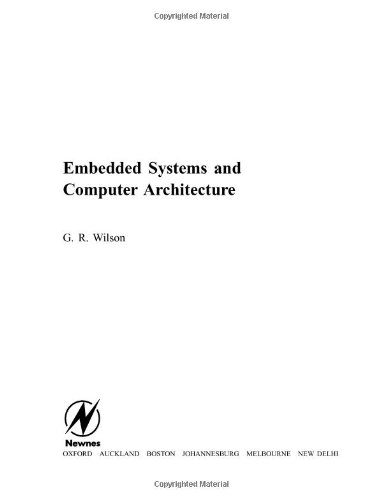
ISBN 10: 0750650648
ISBN 13: 9780750650649
Author: Graham Wilson
Part 1: The Building Blocks
Chapter 1: Binary numbers
1.1 Numbers within a computing machine
1.2 Adding binary integers
1.3 Representing signed integers
1.4 Addition and subtraction of signed integers
1.5 Two’s complement theory*
1.6 Use of hexadecimal representation
1.7 Problems
Chapter 2: Logic expressions
2.1 Logic – the bank vault
2.2 Evaluating the logic expression for the bank vault
2.3 Another solution
2.4 Simplifying logical expressions*
2.5 Rules for simplifying logical expressions using a map*
2.6 Karnaugh-Veitch program, KVMap*
2.7 Quine–McCluskey method*
2.8 Problems
Chapter 3: Electronic logic circuits
3.1 Electronic controller
3.2 Development of the bank vault controller design
3.3 Gates – electronic circuits that perform logical operations
3.4 Decoder circuit
3.5 Multiplexer circuit
3.6 Flip-flops
3.7 Storage registers
3.8 State machines*
3.9 Programmable logic devices*
3.10 Problems
Chapter 4: Computer arithmetic
4.1 Circuit to add numbers
4.2 Adder/Subtractor
4.3 Arithmetic and logic unit
4.4 Shifting data
4.4 Fast adders*
4.5 Floating-point numbers*
4.6 Problems
Part 2: Computing Machines
Chapter 5: Computer design
5.1 A manual computing system
5.2 Storing data and program instructions
5.3 Connecting the machine components
5.4 Architecture of Simple Machine
5.5 More general view of the design of Simple Machine*
5.6 Improvements to Simple Machine
5.7 Architecture of the G80 microprocessor
5.8 Problems
Chapter 6: Instruction set and code assembly
6.1 Programmer’s model
6.2 Instruction format and addressing modes
6.3 Converting the source code to machine code – manual assembly
6.4 Using the assembler
6.5 Assembly language
6.6 Types of instruction
6.7 Problems
Chapter 7: Program structures
7.1 Program control structures
7.2 Data structures
7.3 Subroutines
7.4 Problems
Chapter 8: Simple computer circuits
8.1 G80 external connections
8.2 Read-only memory device – ROM
8.3 COMPI computer – G80 with ROM only
8.4 RAM device
8.5 COMP2 computer – G80 with ROM and RAM
8.6 COMP3 computer
8.7 Microprocessor control signals
8.8 Problems
Chapter 9: Input and output ports
9.1 Simple output port
9.2 Port address space
9.3 A simple input port
9.4 Programmable ports*
9.5 Serial data transmission – UART*
9.6 Problems
Chapter 10: Input and output methods
10.1 Simple input and output
10.2 Handshaking
10.3 Simple output to a slow device
10.4 Do-forever loop
10.5 Processor interrupt
10.6 Possible interrupt mechanisms
10.7 Interrupt priority mechanisms
10.8 Non-maskable interrupt
10.9 G80 interrupt mechanisms
10.10 Direct memory access
10.11 Problems
Chapter 11: More devices
11.1 Counter device and its use in a conveyor belt
11.2 Timer device
11.3 Calendar device
11.4 Pottery kiln
11.5 Multitasking*
11.6 Problems
Chapter 12: Assembler and linker tools
12.1 How an assembler works
12.2 Linker
12.3 Intel format file
12.4 High-level languages
12.5 Problems
Chapter 13: The control unit
13.1 Requirements of the control unit
13.2 Register transfers
13.3 Instruction fetch
13.4 Examples of instruction execution
13.5 Hardwired controller
13.6 More about the hardwired controller
13.7 Microprogrammed control
13.8 Problems
Part 3: Larger Computer
Chapter 14: Larger computers
14.1 General-purpose computers
14.2 Memory bottleneck
14.3 Storage within a computer
14.4 Data bus width and memory address space
14.5 Addressing modes
14.6 Organization of 32-bit memory
14.7 Instruction queue
14.8 Locality of reference
14.9 Operating systems
Chapter 15: Cache memory
15.1 Basic operation of cache
15.2 Cache organization – direct mapping
15.3 Cache organization – set-associative mapping
15.4 Cache organization – fully associative mapping
15.5 Problems
Chapter 16: Memory management
16.1 Virtual and physical addresses – imaginary and real memory
16.2 Pages and page frames
16.3 Page Tables
16.4 Handling a page fault
16.5 Page size
16.6 Two-level paging*
16.7 Translation look-aside buffer
16.8 Memory protection
16.9 Problems
communication protocols in embedded systems
making embedded systems
introduction to embedded systems
cs3691 embedded systems and iot
argus embedded systems
Tags: Graham Wilson, Embedded Systems, Computer Architecture
4.6
14 reviews
5.0
21 reviews
4.5
6 reviews
4.6
10 reviews