
Most ebook files are in PDF format, so you can easily read them using various software such as Foxit Reader or directly on the Google Chrome browser.
Some ebook files are released by publishers in other formats such as .awz, .mobi, .epub, .fb2, etc. You may need to install specific software to read these formats on mobile/PC, such as Calibre.
Please read the tutorial at this link. https://ebooknice.com/page/post?id=faq
We offer FREE conversion to the popular formats you request; however, this may take some time. Therefore, right after payment, please email us, and we will try to provide the service as quickly as possible.
For some exceptional file formats or broken links (if any), please refrain from opening any disputes. Instead, email us first, and we will try to assist within a maximum of 6 hours.
EbookNice Team

Status:
Available0.0
0 reviews
ISBN-10 : 0203930576
ISBN-13 : 9780203930571
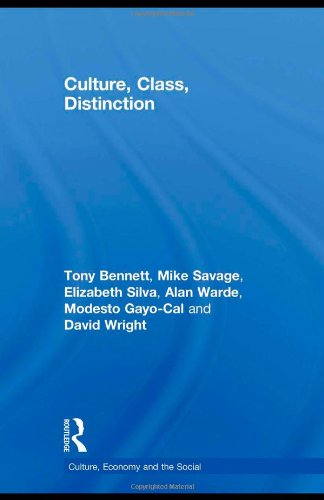
Author: Tony Bennett, Mike Savage, Elizabeth Silva, Alan Warde, Modesto Gayo Cal, David Wright
Choice Recommended Title, February 2010 Culture, Class, Distinction is major contribution to international debates regarding the role of cultural capital in relation to modern forms of inequality. Drawing on a national study of the organisation of cultural practices in contemporary Britain, the authors review Bourdieu’s classic study of the relationships between culture and class in the light of subsequent debates. In doing so they re-appraise the relationships between class, gender and ethnicity, music, film, television, literary, and arts consumption, the organisation of sporting and culinary practices, and practices of bodily and self maintenance. As the most comprehensive account to date of the varied interpretations of cultural capital that have been developed in the wake of Bourdieu’s work, Culture, Class, Distinction offers the first systematic assessment of the relationships between cultural practice and the social divisions of class, gender and ethnicity in contemporary Britain. It is essential reading for anyone interested in the relationships between culture and society.
PART I Situating the analysis
1 Culture after Distinction
1.1 Introduction
1.2 Bourdieu’s three axioms
1.3 Contestations over Bourdieu in French sociology
1.4 Bourdieu in the sociology of stratification and education
1.5 Bourdieu in cultural sociology
1.6 Bourdieu in cultural and media studies
1.7 Conclusion
2 Researching cultural capital: questions of theory and method
2.1 Introduction
2.2 Habitus and the dispersal of practices
2.3 Disaggregating cultural capital
2.4 Field theory and the relational organisation of the social
2.5 Methodological overtures
2.6 Conclusion
PART II Mapping tastes, practices and individuals
3 Mapping British cultural taste and participation
3.1 Introduction
3.2 Using multiple correspondence analysis
3.3 The space of lifestyles: a cultural map of Britain in 2003
3.4 Social groups and the space of lifestyles
3.5 The class structure of Britain
3.6 Conclusion
4 Individuals in cultural maps
4.1 Introduction
4.2 Individuals in the space of lifestyles
4.3 Snobbery and diversity in accounts of taste
4.4 Conclusion
PART III Cultural fields and the organisation of cultural capital
5 Tensions of the musical field
5.1 Introduction
5.2 Music as a contested cultural field
5.3 Contours of musical taste
5.4 The intensities of musical taste
5.5 Music and performance
5.6 Conclusion
6 Popular and rare: exploring the field of reading
6.1 Introduction
6.2 The functions of reading
6.3 Book cultures
6.4 Newspapers and magazines: the uses of everyday reading
6.5 Conclusion
7 A sociological canvas of visual art
7.1 Introduction
7.2 Contrasting paintings
7.3 Consuming visual art
7.4 Appreciating visual art
7.5 Conclusion
8 Contrasting dynamics of distinction: the media field
8.1 Introduction
8.2 The different class registers of television and cinema
8.3 Television and new practices of distinction
8.4 Film and the differential value of ‘aesthetics’ and ‘the real’
8.5 Conclusion
9 Cultural capital and the body
9.1 Introduction
9.2 The concept of embodied cultural capital
9.3 Sport and physical exercise
9.4 Bodily adornment and care
9.5 Eating and cuisine
9.6 Conclusion
Resumé of Part III: Tensions and dynamics
PART IV The social dimensions of distinction
10 Cultural formations of the middle classes
10.1 Introduction
10.2 The debate on the middle classes
10.3 The British middle classes
10.4 Unravelling omnivorousness
10.5 Middle-class identification
10.6 Conclusion
11 Culture and the working class
11.1 Introduction
11.2 Taking account of culture
11.3 The British working class today
11.4 Detachment
11.5 Local games of distinction: divisions within the working class
11.6 Class hostility?
11.7 Conclusion
12 Gender and cultural capital
12.1 Introduction
12.2 Gender and household relations
12.3 Cultural fields and the gendering of individuals
12.4 Contested gender identities
12.5 Conclusion
13 Nation, ethnicity and globalisation
13.1 Introduction
13.2 Home and away
13.3 The culture-scapes of England, America and Europe
13.4 Conclusion
14 Conclusion
culture class distinction pdf
culture class distinction bennett
culture class distinction routledge
cultural distinction
cultural distinction meaning
Tags: Culture, class, distinction, Tony Bennett, Mike Savage, Elizabeth Silva, Alan Warde, Modesto Gayo Cal, David Wright

4.6
12 reviews

4.7
9 reviews
5.0
38 reviews
5.0
34 reviews
4.7
20 reviews
5.0
37 reviews