
Most ebook files are in PDF format, so you can easily read them using various software such as Foxit Reader or directly on the Google Chrome browser.
Some ebook files are released by publishers in other formats such as .awz, .mobi, .epub, .fb2, etc. You may need to install specific software to read these formats on mobile/PC, such as Calibre.
Please read the tutorial at this link. https://ebooknice.com/page/post?id=faq
We offer FREE conversion to the popular formats you request; however, this may take some time. Therefore, right after payment, please email us, and we will try to provide the service as quickly as possible.
For some exceptional file formats or broken links (if any), please refrain from opening any disputes. Instead, email us first, and we will try to assist within a maximum of 6 hours.
EbookNice Team
Status:
Available4.5
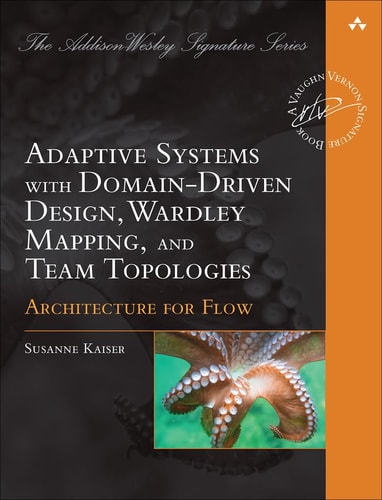
21 reviewsIn today’s rapidly evolving business landscape, the ability to adapt to change is not just advantageous, it’s essential for survival. Architecture for Flow: Adaptive Systems with Domain-Driven Design, Wardley Mapping, and Team Topologies, presents a holistic approach that integrates business strategy, software design and architecture, and team organization to create adaptive, socio-technical systems optimized for continuous change and feedback. By combining Wardley Mapping, Domain-Driven Design, and Team Topologies, this book offers a comprehensive toolset for organizations to anticipate change, unlock blockers to flow, and maintain competitive advantage in an increasingly uncertain world.
Author Susanne Kaiser addresses the fundamental challenge facing modern organizations: how to design and build adaptive systems that thrive amid constant change. Drawing from historical examples of companies that failed to adapt, she emphasizes that optimization requires treating organizations as socio-technical systems where social and technical aspects are aligned and designed together. Her “Architecture for Flow Canvas” provides practical tools and methodologies for designing systems that can evolve continuously while delivering sustainable value.
Understand competitive landscapes and anticipate change through strategic visualization
Analyze problem domains and design modular solution spaces aligned with business and user needs
Implement domain models that keep core business logic decoupled from external changes
Optimize team structures and interactions to reduce bottlenecks and enhance flow
Practical guidance for transforming monolithic systems into adaptive architectures
Foster organizational culture that sustains flow and embraces future change
This book offers a timely and essential perspective that goes beyond local optimization to address systemic
…
4.6
31 reviews
5.0
14 reviews
4.6
28 reviews
4.4
12 reviews
4.7
8 reviews
5.0
22 reviews
4.8
37 reviews
4.5
27 reviews
4.7
9 reviews