
Most ebook files are in PDF format, so you can easily read them using various software such as Foxit Reader or directly on the Google Chrome browser.
Some ebook files are released by publishers in other formats such as .awz, .mobi, .epub, .fb2, etc. You may need to install specific software to read these formats on mobile/PC, such as Calibre.
Please read the tutorial at this link. https://ebooknice.com/page/post?id=faq
We offer FREE conversion to the popular formats you request; however, this may take some time. Therefore, right after payment, please email us, and we will try to provide the service as quickly as possible.
For some exceptional file formats or broken links (if any), please refrain from opening any disputes. Instead, email us first, and we will try to assist within a maximum of 6 hours.
EbookNice Team
Status:
Available4.7
6 reviews
ISBN 10: 0195367421
ISBN 13: 9780195367423
Author: Marin S Robinson, Fredricka L Stoller, Molly Costanza-Robinson, James K Jones
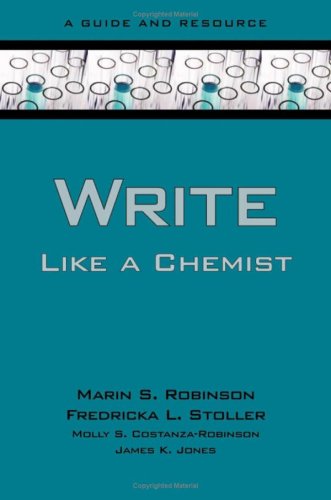
Write Like a Chemist is a unique guide to chemistry-specific writing. Written with National Science Foundation support and extensively piloted in chemistry courses nationwide, it offers a structured approach to writing that targets four important chemistry genres: the journal article, conference abstract, scientific poster, and research proposal. Chemistry students, post-docs, faculty, and other professionals interested in perfecting their disciplinary writing will find it an indispensable reference. Users of the book will learn to write through a host of exercises, ranging in difficulty from correcting single words and sentences to writing professional-quality papers, abstracts, posters, and proposals. The book's read-analyze-write approach teaches students to analyze what they read and then write, paying attention to audience, organization, writing conventions, grammar, and science content, thereby turning the complex process of writing into graduated, achievable tasks. Concise writing and organizational skills are stressed throughout, and "move structures" teach students conventional ways to present their stories of scientific discovery. This resource includes over 350 excerpts from ACS journal articles, ACS conference abstracts, and successful NSF CAREER proposals, excerpts that will serve as useful models of chemistry writing for years to come. Other special features: Usable in chemistry lab, lecture, and writing-dedicated courses Useful as a writing resource for practicing chemists Augmented by Language Tips that address troublesome areas of language and grammer in a self-study format Accompanied
Section One: Writing Modules
Module 1—The Journal Article
1. Learning to Write Like a Chemist
2. Overview of the Journal Article
3. Writing the Methods Section
4. Writing the Results Section
5. Writing the Discussion
6. Writing the Introduction
7. Writing the Abstract and Title
Module 2—The Scientific Poster
8. Writing the Conference Abstract
9. Writing the Poster Text and Title
10. Designing the Poster
Module 3—The Scientific Poster
11. Overview of the Research Proposal
12. Writing the Goals and Importance Section
13. Writing the Proposed Methodology Section
14. Writing the Outcomes and Impacts Section
15. Writing the Project Summary and Title
Section Two: Graphics and Citations
16. Formatting Figures, Tables, and Schemes
17. Formatting Citations and References
18. Finalizing Your Written Work
write like a chemist pdf
write like a chemist a guide and resource
write like a chemist book
write like a chemist a guide and resource pdf
write like a chemist 2nd edition
Tags: Marin S Robinson, Fredricka L Stoller, Molly Costanza Robinson, James K Jones, Write Like a Chemist, Guide, Resource
4.8
31 reviews
4.6
12 reviews
4.7
9 reviews
4.8
41 reviews
5.0
20 reviews
4.3
37 reviews