
Most ebook files are in PDF format, so you can easily read them using various software such as Foxit Reader or directly on the Google Chrome browser.
Some ebook files are released by publishers in other formats such as .awz, .mobi, .epub, .fb2, etc. You may need to install specific software to read these formats on mobile/PC, such as Calibre.
Please read the tutorial at this link. https://ebooknice.com/page/post?id=faq
We offer FREE conversion to the popular formats you request; however, this may take some time. Therefore, right after payment, please email us, and we will try to provide the service as quickly as possible.
For some exceptional file formats or broken links (if any), please refrain from opening any disputes. Instead, email us first, and we will try to assist within a maximum of 6 hours.
EbookNice Team
Status:
Available0.0
0 reviews
ISBN 10: 0520324765
ISBN 13: 9780520324763
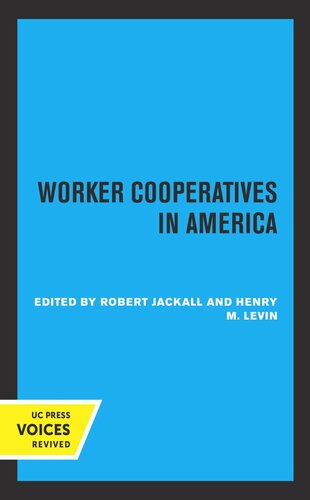
Author: Robert Jackall, Henry Levin
Worker Cooperatives in America maps the past, present, and possible futures of democratic enterprise in the United States, arguing—against the grain of corporate inevitability—that firms owned and governed by workers can address stubborn problems of unemployment, productivity, and workplace alienation. Edited by Robert Jackall and Henry M. Levin, the volume moves from vivid historical arcs—co-ops formed by striking nineteenth-century artisans, New Deal–era self-help ventures—to contemporary case studies of plywood mills, reforestation crews, and urban collectives. Across these sites, contributors probe the hard mechanics of democratic firms: capitalizing without ceding control, balancing egalitarian norms with market exigencies, rotating jobs to build skill and solidarity, and designing governance that is both participatory and effective. Empirical chapters engage Mondragón as a global benchmark, report comparative productivity advantages, and show how cooperatives preserve jobs when conventional owners shutter plants. The result is a rigorous, data-grounded challenge to managerial common sense.
Equally attentive to limits, the book confronts the structural headwinds co-ops face in a legal and financial ecosystem optimized for hierarchical corporations. Essays on Employee Stock Ownership Plans, membership rights, and cooperative law demystify vehicles that can either enable or erode self-management. Analyses of culture, training, and decision rules illuminate why some democracies falter while others endure. Throughout, the editors press a central question: how can enterprises reconcile internal commitments to voice and equity with external demands of competitive markets? With clear-eyed assessments and practical design lessons—revolving credit funds, representative/assembly hybrids, counter-cyclical work-sharing—this collection offers scholars, organizers, and policy makers a usable blueprint. Worker cooperatives, the contributors show, are not a panacea; they are a durable, American repertoire for linking productivity to dignity, enterprise to citizenship, and work to democracy.
This title is part of UC Press's Voices Revived program, which commemorates University of California Press’s mission to seek out and cultivate the brightest minds and give them voice, reach, and impact. Drawing on a backlist dating to 1893, Voices Revived makes high-quality, peer-reviewed scholarship accessible once again using print-on-demand technology. This title was originally published in 1984.
1 Work in America and the Cooperative Movement
2 Employment and Productivity of Producer Cooperatives
3 American Producer Cooperatives and Employee-Owned Firms: A Historical Perspective
4 Self-Help Production Cooperatives: Government-Administered Cooperatives During the Depression
5 The Shape of the Small Worker Cooperative Movement
6 Paradoxes of Collective Work: A Study of the Cheeseboard, Berkeley, California
7 Hoedads Co-op: Democracy and Cooperation at Work
8 Producer Cooperatives and Democratic Theory: The Case of the Plywood Firms
9 Obstacles to the Survival of Democratic Workplaces
10 ESOPs and the Financing of Worker Cooperatives
11 Workers’ Cooperatives: The Question of Legal Structure
12 The Prospects for Worker Cooperatives in the United States
largest worker cooperatives in the us
cooperatives in america
why are worker cooperatives so rare
what are worker cooperatives
worker cooperatives in the united states
Tags: Robert Jackall, Henry Levin, Worker Cooperatives


4.8
24 reviews

4.6
24 reviews

4.7
14 reviews
5.0
31 reviews

4.6
18 reviews