
Most ebook files are in PDF format, so you can easily read them using various software such as Foxit Reader or directly on the Google Chrome browser.
Some ebook files are released by publishers in other formats such as .awz, .mobi, .epub, .fb2, etc. You may need to install specific software to read these formats on mobile/PC, such as Calibre.
Please read the tutorial at this link. https://ebooknice.com/page/post?id=faq
We offer FREE conversion to the popular formats you request; however, this may take some time. Therefore, right after payment, please email us, and we will try to provide the service as quickly as possible.
For some exceptional file formats or broken links (if any), please refrain from opening any disputes. Instead, email us first, and we will try to assist within a maximum of 6 hours.
EbookNice Team
Status:
Available4.6
28 reviews
ISBN 10: 1138024473
ISBN 13: 9781138024472
Author: Ashok Vohra
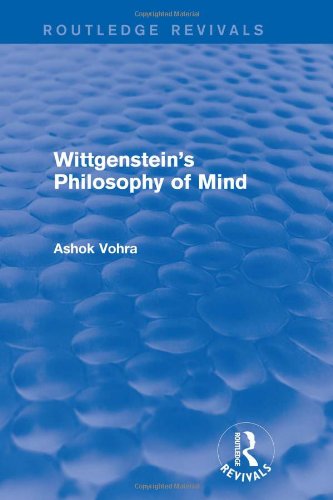
Philosophers since Descartes have felt themselves compelled to make a choice between mind and body. Wittgenstein’s Philosophy of Mind, first published in 1986, argues that there is no genuine epistemological problem of mind, and that the widespread philosophical scepticism with regard to our knowledge of other minds is without foundation. Ashok Vohra applies Wittgenstein’s method to show that the problem has arisen through a tendency to over-philosophise our simple experiences.
Vohra presents a positive account of Wittgenstein’s philosophy of mind, arguing that to consider his philosophy entirely destructive is misleading. He shows that knowledge of mind is gained through a large complex of intersubjectively identifiable factors such as the linguistic and non-linguistic past, present and future behaviour of the person concerned. He thus justifies the belief, on which psychology and psychoanalysis are based, that mind is not a mystery to which only the owner has privileged access.
1. The Concept of Sensation
The Argument from Illusion or Hallucination
The Argument from Verification or from Differential Certainty
The Argument from Causation, or Physiology of Perception
The Argument from Short Causal Chain
The Argument from Time Lag
Notes
2. Privacy and Private Language
Notes
3. Self-Knowledge and Personal Identity
Notes
4. Knowledge of Other Persons
Notes
ludwig wittgenstein philosophy of mind
wittgenstein and contemporary philosophy of mind
wittgenstein philosophy of mind
what is philosophy of mind
philosophy of mind summary
Tags: Ashok Vohra, Wittgenstein's Philosophy


4.6
12 reviews

5.0
9 reviews
4.7
9 reviews
4.7
14 reviews
5.0
33 reviews
4.5
38 reviews