
Most ebook files are in PDF format, so you can easily read them using various software such as Foxit Reader or directly on the Google Chrome browser.
Some ebook files are released by publishers in other formats such as .awz, .mobi, .epub, .fb2, etc. You may need to install specific software to read these formats on mobile/PC, such as Calibre.
Please read the tutorial at this link. https://ebooknice.com/page/post?id=faq
We offer FREE conversion to the popular formats you request; however, this may take some time. Therefore, right after payment, please email us, and we will try to provide the service as quickly as possible.
For some exceptional file formats or broken links (if any), please refrain from opening any disputes. Instead, email us first, and we will try to assist within a maximum of 6 hours.
EbookNice Team
Status:
Available4.8
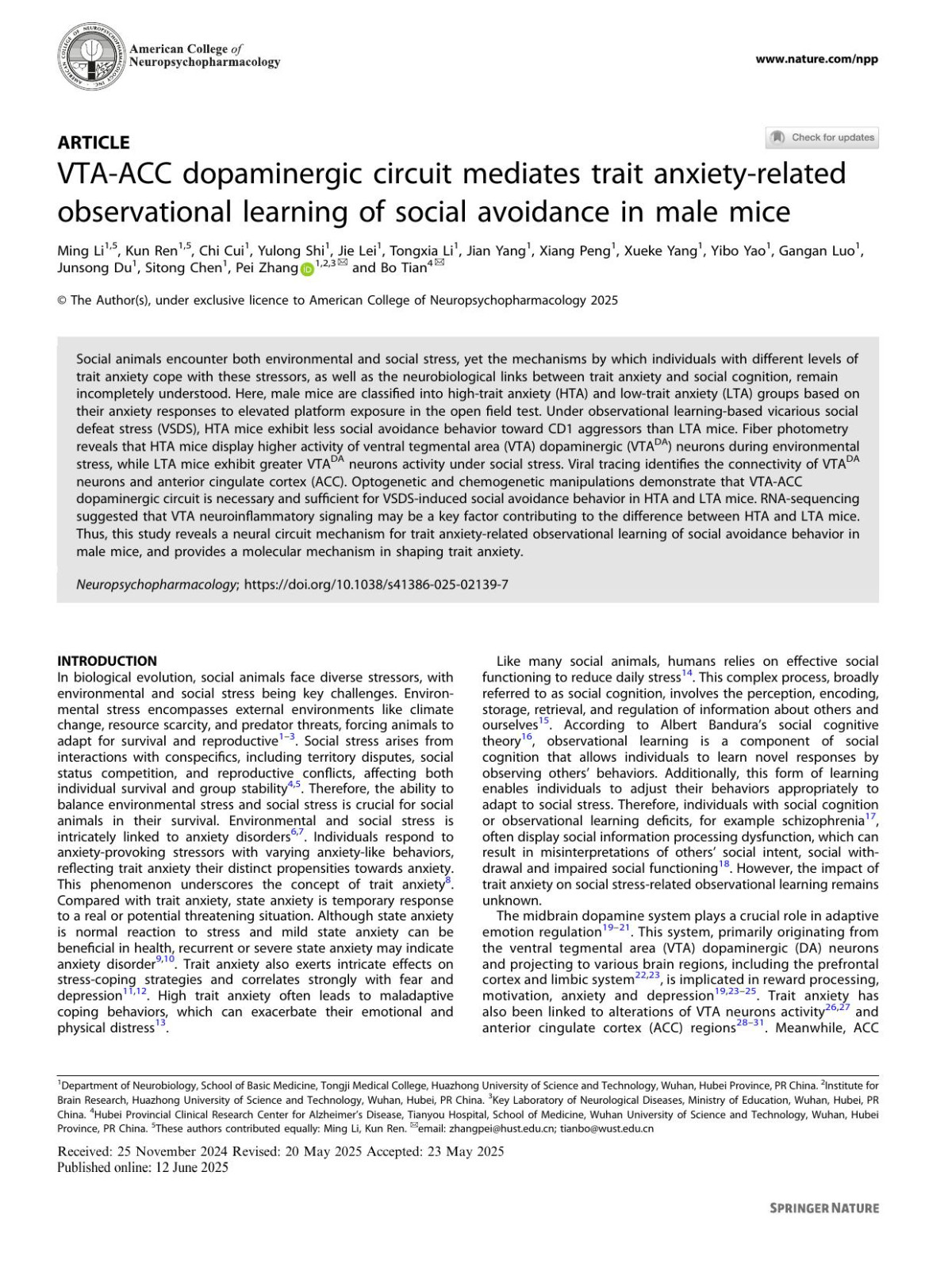
38 reviewsSocial animals encounter both environmental and social stress, yet the mechanisms by which individuals with different levels oftrait anxiety cope with these stressors, as well as the neurobiological links between trait anxiety and social cognition, remainincompletely understood. Here, male mice are classified into high-trait anxiety (HTA) and low-trait anxiety (LTA) groups based ontheir anxiety responses to elevated platform exposure in the open field test. Under observational learning-based vicarious socialdefeat stress (VSDS), HTA mice exhibit less social avoidance behavior toward CD1 aggressors than LTA mice. Fiber photometryreveals that HTA mice display higher activity of ventral tegmental area (VTA) dopaminergic (VTADA) neurons during environmentalstress, while LTA mice exhibit greater VTADA neurons activity under social stress. Viral tracing identifies the connectivity of VTADA1234567890();,:neurons and anterior cingulate cortex (ACC). Optogenetic and chemogenetic manipulations demonstrate that VTA-ACCdopaminergic circuit is necessary and sufficient for VSDS-induced social avoidance behavior in HTA and LTA mice. RNA-sequencingsuggested that VTA neuroinflammatory signaling may be a key factor contributing to the difference between HTA and LTA mice.Thus, this study reveals a neural circuit mechanism for trait anxiety-related observational learning of social avoidance behavior inmale mice, and provides a molecular mechanism in shaping trait anxiety.Neuropsychopharmacology;
4.4
7 reviews
4.5
26 reviews
4.8
15 reviews