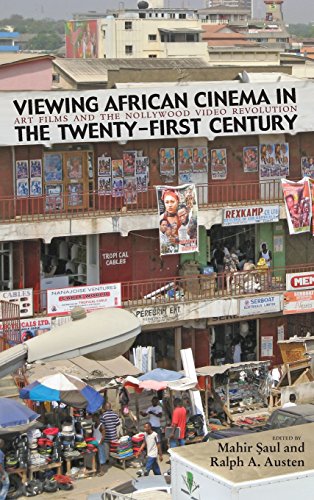
Viewing African cinema in the twenty-first century : art films and the Nollywood video revolution by Saul, Mahir, 1951-; Austen, Ralph A instant download
vii, 248 pages : 23 cm, \"\"Should African film cater to a mass market, or should it seek higher aesthetic or political goals? In addition to this crucial question, Viewing African Cinema in the Twenty-first Century addresses the changes in African cinema and the new directions it is now taking. The approaches consider current work on audience reception, production, and cinematography. This is an essential contribution to the current state of African cinema studies.\"K̮enneth W. Harrow, author of Postcolonial African Cinema: From Political Engagement to Postmodernism, African cinema in the 1960's originated mainly from Francophone countries. It resembled the art cinema of contemporary Europe and relied on support from the French film industry and the French state. Beginning in 1969 the biennial Festival Panafricain du CinTma et de la TTlTvision de Ouagadougou (FESPACO), held in Burkina Faso, became the major showcase for these films. But since the early 1990's, a new phenomenon has come to dominate the African cinema world: mass-marketed films shot on less-expensive video cameras. These \"Nollywood\" films, so named because many originate in southern Nigeria, are a thriving industry dominating the world of African cinema, Viewing African Cinema in the Twenty-first Century brings together a set of fascinating essays by international scholars on these contrasting cinema forms, Mahir Saul is a professor of anthropology at the University of Illinois, Urbana-Champaign. He is coauthor of African Challenge to Empire: Culture and History in the Volta-Bani Anticolonial War, Ralph A. Austen is a professor emeritus of African history at the University of Chicago. He is the author of African Economic History and Trans-Saharan Africa in World History.\"--Jacket, Includes bibliographical references and index, Introduction / Ralph A. Austen and Mahir Șaul -- The \"problem\" of Nollywood. What is to be done? film studies and Nigerian and Ghanaian videos / Jonathan Haynes --…
*Free conversion of into popular formats such as PDF, DOCX, DOC, AZW, EPUB, and MOBI after payment.