logo
Product categories

EbookNice.com

Most ebook files are in PDF format, so you can easily read them using various software such as Foxit Reader or directly on the Google Chrome browser.
Some ebook files are released by publishers in other formats such as .awz, .mobi, .epub, .fb2, etc. You may need to install specific software to read these formats on mobile/PC, such as Calibre.

Please read the tutorial at this link.  https://ebooknice.com/page/post?id=faq


We offer FREE conversion to the popular formats you request; however, this may take some time. Therefore, right after payment, please email us, and we will try to provide the service as quickly as possible.


For some exceptional file formats or broken links (if any), please refrain from opening any disputes. Instead, email us first, and we will try to assist within a maximum of 6 hours.

EbookNice Team
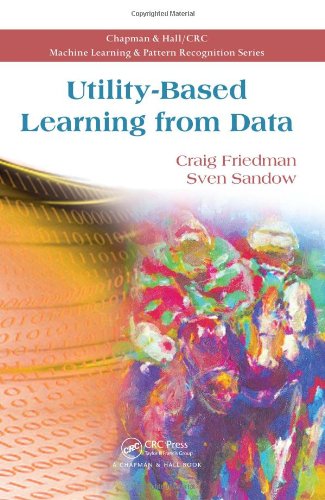
(Ebook) Utility-Based Learning from Data by Craig Friedman, Sven Sandow ISBN 9781584886228, 1584886226

  • SKU: EBN-1735104
Zoomable Image
$ 32 $ 40 (-20%)

Status:

Available

0.0

0 reviews
Instant download (eBook) Utility-Based Learning from Data after payment.
Authors:Craig Friedman, Sven Sandow
Pages:412 pages.
Year:2011
Editon:1
Publisher:Chapman & Hall CRC
Language:english
File Size:2.69 MB
Format:pdf
ISBNS:9781584886228, 1584886226
Categories: Ebooks

Product desciption

(Ebook) Utility-Based Learning from Data by Craig Friedman, Sven Sandow ISBN 9781584886228, 1584886226

Utility-Based Learning from Data provides a pedagogical, self-contained discussion of probability estimation methods via a coherent approach from the viewpoint of a decision maker who acts in an uncertain environment. This approach is motivated by the idea that probabilistic models are usually not learned for their own sake; rather, they are used to make decisions. Specifically, the authors adopt the point of view of a decision maker who(i) operates in an uncertain environment where the consequences of possible outcomes are explicitly monetized,(ii) bases his decisions on a probabilistic model, and(iii) builds and assesses his models accordingly.These assumptions are naturally expressed in the language of utility theory, which is well known from finance and decision theory. By taking this point of view, the book sheds light on and generalizes some popular statistical learning approaches, connecting ideas from information theory, statistics, and finance. It strikes a balance between rigor and intuition, conveying the main ideas to as wide an audience as possible.
*Free conversion of into popular formats such as PDF, DOCX, DOC, AZW, EPUB, and MOBI after payment.

Related Products