
Most ebook files are in PDF format, so you can easily read them using various software such as Foxit Reader or directly on the Google Chrome browser.
Some ebook files are released by publishers in other formats such as .awz, .mobi, .epub, .fb2, etc. You may need to install specific software to read these formats on mobile/PC, such as Calibre.
Please read the tutorial at this link. https://ebooknice.com/page/post?id=faq
We offer FREE conversion to the popular formats you request; however, this may take some time. Therefore, right after payment, please email us, and we will try to provide the service as quickly as possible.
For some exceptional file formats or broken links (if any), please refrain from opening any disputes. Instead, email us first, and we will try to assist within a maximum of 6 hours.
EbookNice Team
Status:
Available4.8
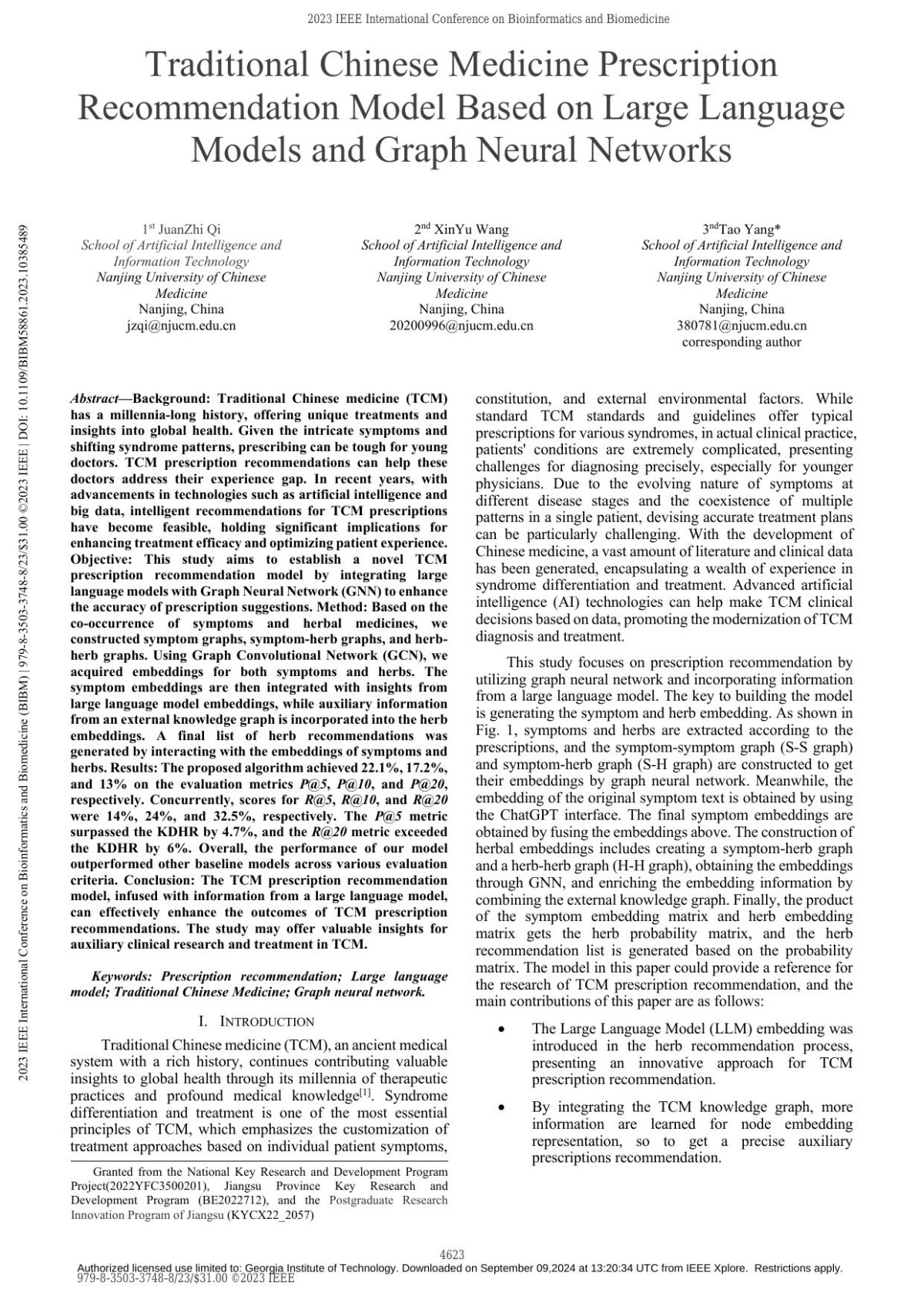
40 reviewsAbstract—Background:Traditional Chinese medicine (TCM)has a millennia-long history, offering unique treatments and insights into global health. Given the intricate symptoms and shifting syndrome patterns, prescribing can be tough for young doctors. TCM prescription recommendations can help these doctors address their experience gap. In recent years, with advancements in technologies such as artificial intelligence and big data, intelligent recommendations for TCM prescriptions have become feasible, holding significant implications for enhancing treatment efficacy and optimizing patient experience.Objective:This study aims to establish a novel TCM prescription recommendation model by integrating large language models with Graph Neural Network (GNN) to enhance the accuracy of prescription suggestions. Method: Based on the co-occurrence of symptoms and herbal medicines, we constructed symptom graphs, symptom-herb graphs, and herb-herb graphs. Using Graph Convolutional Network (GCN), we acquired embeddings for both symptoms and herbs. The symptom embeddings are then integrated with insights from large language model embeddings, while auxiliary information from an external knowledge graph is incorporated into the herb embeddings. A final list of herb recommendations was generated by interacting with the embeddings of symptoms and herbs. Results: The proposed algorithm achieved 22.1%, 17.2%,and 13% on the evaluation metrics P@s, P@10, and P@20, respectively. Concurrently, scores for R@S, R@10, and R@20were 14%,24%,and 32.5%,respectively. The P@5 metric surpassed the KDHR by 4.7%, and the R@20 metric exceeded the KDHR by 6%.Overall, the performance of our model outperformed other baseline models across various evaluation criteria. Conclusion: The TCM prescription recommendation model, infused with information from a large language model
4.6
29 reviews
4.6
31 reviews
4.4
11 reviews
4.9
32 reviews
4.4
16 reviews
4.4
37 reviews
4.4
19 reviews
4.5
35 reviews