
Most ebook files are in PDF format, so you can easily read them using various software such as Foxit Reader or directly on the Google Chrome browser.
Some ebook files are released by publishers in other formats such as .awz, .mobi, .epub, .fb2, etc. You may need to install specific software to read these formats on mobile/PC, such as Calibre.
Please read the tutorial at this link. https://ebooknice.com/page/post?id=faq
We offer FREE conversion to the popular formats you request; however, this may take some time. Therefore, right after payment, please email us, and we will try to provide the service as quickly as possible.
For some exceptional file formats or broken links (if any), please refrain from opening any disputes. Instead, email us first, and we will try to assist within a maximum of 6 hours.
EbookNice Team
Status:
Available4.9
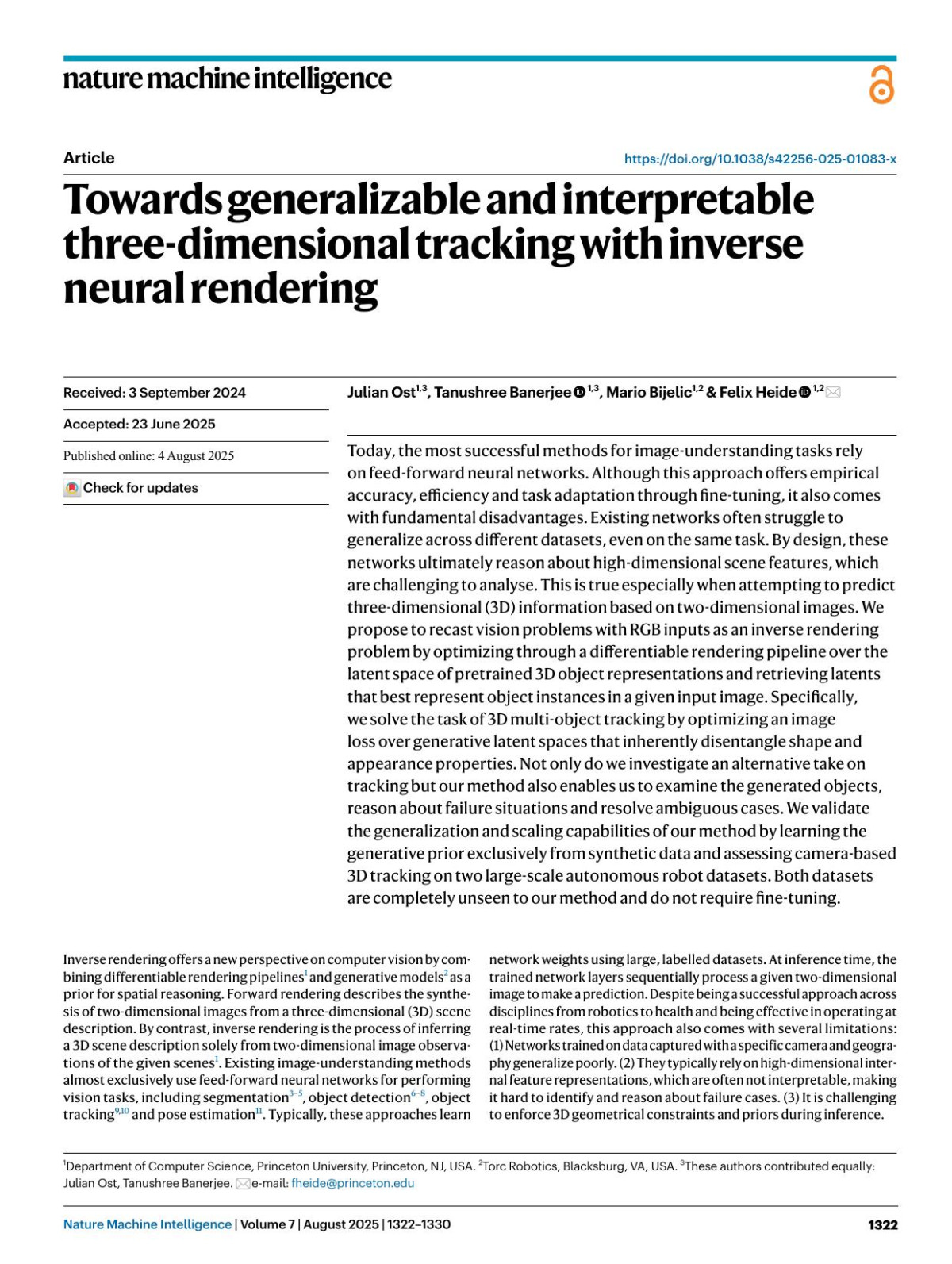
22 reviewsToday, the most successful methods for image-understanding tasks rely
on feed-forward neural networks. Although this approach offers empirical
accuracy, efficiency and task adaptation through fine-tuning, it also comes
with fundamental disadvantages. Existing networks often struggle to
generalize across different datasets, even on the same task. By design, these
networks ultimately reason about high-dimensional scene features, which
are challenging to analyse. This is true especially when attempting to predict
three-dimensional (3D) information based on two-dimensional images. We
propose to recast vision problems with RGB inputs as an inverse rendering
problem by optimizing through a differentiable rendering pipeline over the
latent space of pretrained 3D object representations and retrieving latents
that best represent object instances in a given input image. Specifically,
we solve the task of 3D multi-object tracking by optimizing an image
loss over generative latent spaces that inherently disentangle shape and
appearance properties. Not only do we investigate an alternative take on
tracking but our method also enables us to examine the generated objects,
reason about failure situations and resolve ambiguous cases. We validate
the generalization and scaling capabilities of our method by learning the
generative prior exclusively from synthetic data and assessing camera-based
3D tracking on two large-scale autonomous robot datasets. Both datasets
are completely unseen to our method and do not require fine-tuning.

4.4
6 reviews
4.3
26 reviews
4.7
8 reviews
4.8
6 reviews
4.7
20 reviews
4.4
35 reviews
4.4
18 reviews

4.6
24 reviews
4.6
14 reviews