
Most ebook files are in PDF format, so you can easily read them using various software such as Foxit Reader or directly on the Google Chrome browser.
Some ebook files are released by publishers in other formats such as .awz, .mobi, .epub, .fb2, etc. You may need to install specific software to read these formats on mobile/PC, such as Calibre.
Please read the tutorial at this link. https://ebooknice.com/page/post?id=faq
We offer FREE conversion to the popular formats you request; however, this may take some time. Therefore, right after payment, please email us, and we will try to provide the service as quickly as possible.
For some exceptional file formats or broken links (if any), please refrain from opening any disputes. Instead, email us first, and we will try to assist within a maximum of 6 hours.
EbookNice Team
Status:
Available4.5
33 reviews
ISBN 10: 3631623399
ISBN 13: 9783631623398
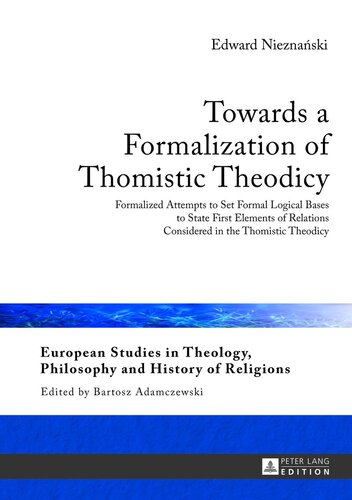
Author: Edward Nieznanski
The aim of the book is to gauge the possibilities of formalization of the Thomistic Theodicy. The benefits of such formalization attempts may be mutual, both in applied logic and the formalized field. Concerning formal logic on the linguistic improvements in all areas of science, formalization attempts provide useful material that can be applied to develop semiotics of the Thomistic language.
1. Preliminaries
1.1. Introductory remarks
1.2. Introducing auxiliary terms
1.2.1. ‘Formalized language’
1.2.2. ‘Relational system’
1.2.3. ‘Language semi-model’
1.2.4. ‘Model for a set of formulae’
1.2.5. ‘Semi-models and proper models’
1.2.6. ‘Calculus (formal theory)’
1.2.7. ‘Interpreted calculus (formalized theory)’
1.2.8. ‘Formalization’
2. Basic arrangements
2.1. Subject of the treatise
2.2. Aims of the treatise
2.2.1. Objectives overview
2.2.2. Obstacles in the realization of the objectives
2.3. Structure of the treatise
Part One: Proposal for a formal-logical theory of first elements of relations
1. Auxiliary arrangements
1.1. The notion of a relation
1.2. First and minimal elements of a relation
1.3. Images and restrictions of relations
1.4. Compositions and ancestral closures of relations
1.5. Transitive, asymmetric and irreflexive relations
1.6. Ordering relations
1.7. Cyclic relations
1.8. Multiplicative quasi-semilattices
2. Basic theorems
2.1. Theorems on first and minimal elements of arbitrary relations
2.2 Theorems on first and minimal elements of relations of certain types
2.2.1 Connections between first and minimal elements in asymmetric, irreflexive or total relations
2.2.2 Uniqueness of a first element in asymmetric or irreflexive relations
2.2.3 First elements of functions
2.2.4 First elements of transitive relations
2.2.5 First and minimal elements of ordering relations
2.2.6 First and minimal elements of cyclic relations
2.2.7 Dense orderings and the existence of firstand minimal elements
Part Two: Formalization of findings of the Thomistic theodicy about stating the existence of first e
1. Presentation, comparison and evaluation of existing formalizations
1.1. Attempts to formalize findings of the Thomistc theodicy about the existence of the First Mover
1.1.1. Jan Salamucha’s calculus
1.1.2. Proposals of I.M. Bocheński for improvements of Salamucha’s calculus
1.1.3. Three formalisms of J. Bendiek
1.1.4. The first formalization of F. Rivetti Barbò
1.1.5. I. Thomas and P. Selvaggi’s proposals to improve the first formalization by F. Rivetti Barb
1.1.6. Formalization attempt by Z. Zdybicka
1.1.7. Second formalization by F. Rivetti Barbò
1.1.8. Findings of B.L. Clarke and the calculus by K. Policki
1.1.9. Formalization contributions by L. Larouche, W. Marciszewski, C.H. Keiser and G. Klaus
1.2. Contributions to the formalization of findingsabout the existence of the First Efficient Cause
1.2.1.
1.2.2.
1.2.3.
1.2.4.
1.2.5.
1.2.6.
1.3. Contributions to formalize findings of the Thomistic theodicy on the existence of the Ultimate
1.3.1. Formalization of philosophical findings about different kinds of existence and being
1.3.2. Contributions to the formalization of the incidence argument
1.4. Formalization achievements in the non-Thomistic theodicy as a contribution to the formalization
1.4.1. In particular, a special attention should be paid to attempts to formalize the so called onti
2. Author’s own formalization attempts inspired by issues of the Thomistic theodicy
2.1. The issue of the First Being in the formalized theory of necessary conditions for existence
2.2. A significant extension of the theory of necessary conditions for existence to the calculus det
2.3. Assumptions of the Thomistic vision of the world
2.3.1. Assumptions of theism – overview by Hartshorne
2.3.2. Selection of assumptions of the Thomistic vision of the world
2.3.3. Consistency of the Thomistic vision of the world
Summary
a formal theory of differentiation in organizations
a theory of natural philosophy boscovich pdf
boris eichenbaum the theory of the formal method pdf
the theory of the formal method pdf
the theory of formal method
theory of formalism
doctrine of formal discipline
Tags: Edward Nieznanski, Formalization, Thomistic
4.5
35 reviews
4.4
24 reviews
5.0
23 reviews
4.5
15 reviews
4.4
18 reviews
5.0
17 reviews
4.3
21 reviews
4.7
23 reviews