
Most ebook files are in PDF format, so you can easily read them using various software such as Foxit Reader or directly on the Google Chrome browser.
Some ebook files are released by publishers in other formats such as .awz, .mobi, .epub, .fb2, etc. You may need to install specific software to read these formats on mobile/PC, such as Calibre.
Please read the tutorial at this link. https://ebooknice.com/page/post?id=faq
We offer FREE conversion to the popular formats you request; however, this may take some time. Therefore, right after payment, please email us, and we will try to provide the service as quickly as possible.
For some exceptional file formats or broken links (if any), please refrain from opening any disputes. Instead, email us first, and we will try to assist within a maximum of 6 hours.
EbookNice Team
Status:
Available4.5
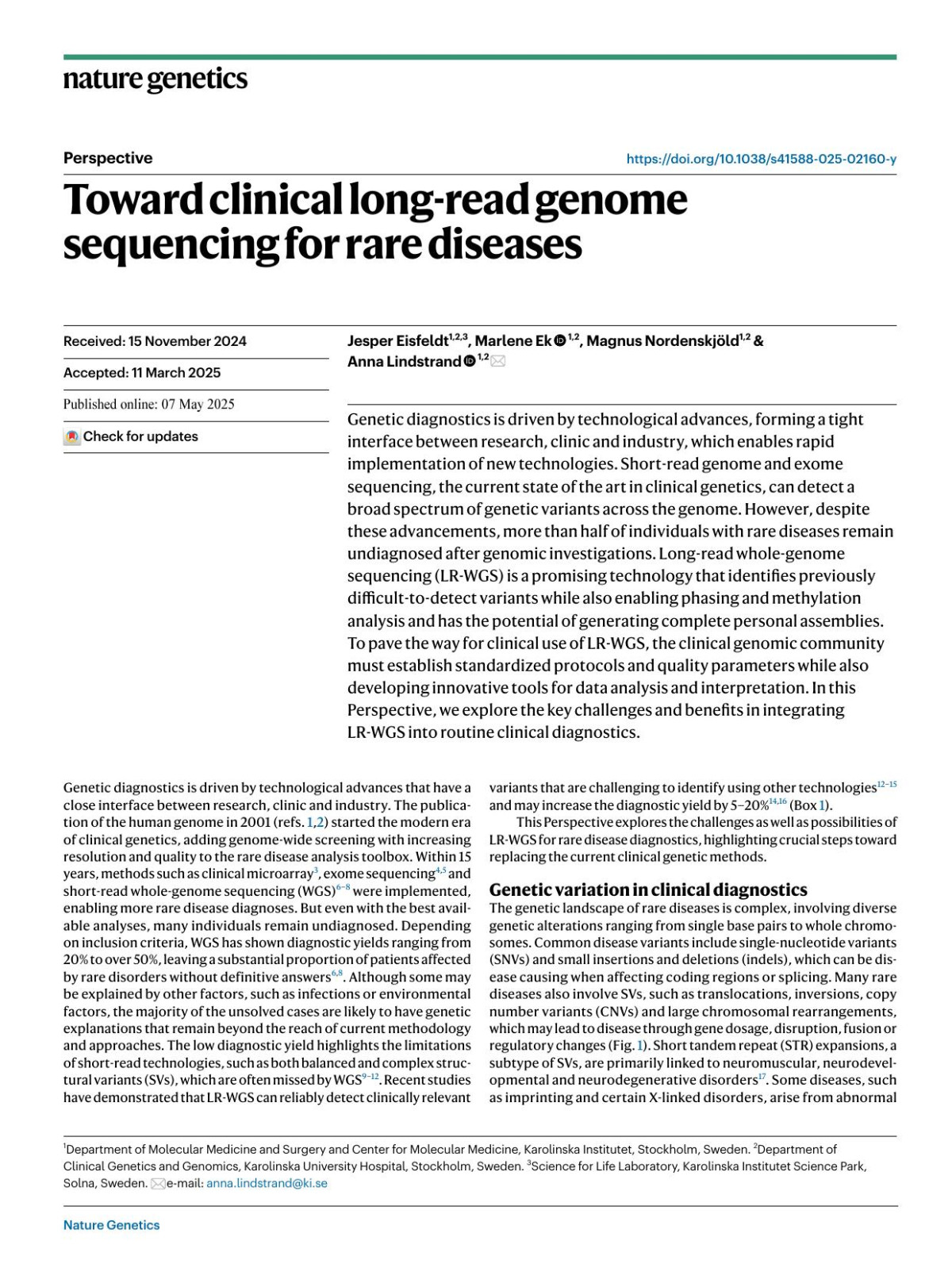
26 reviewsGenetic diagnostics is driven by technological advances, forming a tight interface between research, clinic and industry, which enables rapid implementation of new technologies. Short-read genome and exome sequencing, the current state of the art in clinical genetics, can detect a broad spectrum of genetic variants across the genome. However, despite these advancements, more than half of individuals with rare diseases remain undiagnosed after genomic investigations. Long-read whole-genome sequencing (LR-WGS) is a promising technology that identifes previously difcult-to-detect variants while also enabling phasing and methylation analysis and has the potential of generating complete personal assemblies. To pave the way for clinical use of LR-WGS, the clinical genomic community must establish standardized protocols and quality parameters while also developing innovative tools for data analysis and interpretation. In this Perspective, we explore the key challenges and benefts in integrating LR-WGS into routine clinical diagnostics.
4.4
16 reviews
4.8
21 reviews
4.5
32 reviews
4.3
41 reviews
4.6
40 reviews
4.8
13 reviews
4.4
22 reviews
4.5
26 reviews
4.7
37 reviews