Most ebook files are in PDF format, so you can easily read them using various software such as Foxit Reader or directly on the Google Chrome browser.
Some ebook files are released by publishers in other formats such as .awz, .mobi, .epub, .fb2, etc. You may need to install specific software to read these formats on mobile/PC, such as Calibre.
Please read the tutorial at this link. https://ebooknice.com/page/post?id=faq
We offer FREE conversion to the popular formats you request; however, this may take some time. Therefore, right after payment, please email us, and we will try to provide the service as quickly as possible.
For some exceptional file formats or broken links (if any), please refrain from opening any disputes. Instead, email us first, and we will try to assist within a maximum of 6 hours.
EbookNice Team
Status:
Available5.0
19 reviews
ISBN-10 : 1793616949
ISBN-13 : 9781793616944
Author: Erich Herrmann Rast
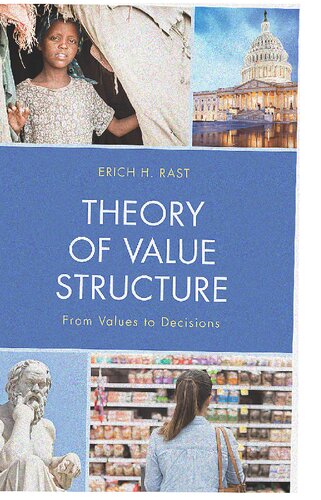
The theory of value structure concerns the meaning of “better than” and “good,” as well as the way in which values serve as a basis for rational decision making. Drawing methodologically from economics and theories of decision making, the aim of serious axiology in metaethics is to do justice to problems that have puzzled philosophers of value for centuries. Can value comparisons be cyclic? Are all values comparable with each other and can decision makers just add up different aspects of an evaluation to determine the best course of action? A Theory of Value Structure: From Values to Decisions starts with a thorough introduction to the modeling of “better than” comparisons from a normative perspective. In the philosophical part of the book, Erich H. Rast argues that aspects of “better than” comparisons can differ qualitatively so much that one aspect may outrank another. Consequently, the classical weighted sum aggregation model fails. Values cannot always be summed up and comparisons may be fundamentally noncompensatory, an indeterminacy that explains problems like the apparent nontransitivity of “better than” and hard cases in decision making. Using a lexicographic method of value comparisons, Rast develops a multidimensional theory of “better than” and shows how and to which extent it can be combined with standard methods of decision making under uncertainty by using rank-dependent utility theory.
I Preliminaries
1 Basic Monist Value Structure
1.1 Introduction
1.2 Comparative Forms
1.3 Representation by Preorders
1.4 Incommensurability and Partial Orderings
2 Relaxing Requirements
2.1 Nontransitive Value Equality and Equipreference
2.2 Partial Semiorders
2.3 Weak Eligibility
2.4 Strong Eligibility
2.5 What Consistency Requirements Are Needed?
3 Utility Functions
3.1 A Historical Remark
3.2 Representation of the Standard Model
3.3 Representations for All Models
3.4 Ordinal Versus Cardinal Utilities
4 The Complexity of Value
4.1 Positive, Comparative, Superlative
4.2 Good in Terms of Better Than
4.3 Satisficing
4.4 How Context-Sensitive Are Values?
5 Multidimensional Value
5.1 Introduction
5.2 Additive Value Aggregation
5.3 Other Forms of Utility Aggregation
5.4 Value Aggregation and Social Choice
5.5 The Most General Aggregation Method?
II Philosophy of Value Structure
6 Problems of Value Analysis
6.1 The Good as a Primitive
6.2 The Paradox of Analysis
6.3 A Fregean Solution
6.4 The Connection to Meaning and Value Metaphysics
7 Parity
7.1 Motivation and Key Properties
7.2 Using Interval Orders
7.3 Modeling Parity by Sets of Relations
7.4 Trichotomic Parity
7.5 Comparison
8 Spectrum Cases
8.1 Typical Scenarios
8.2 Ways to Preserve Transitivity
8.3 Why a Lexicographic Approach?
9 A Theory of Betterness
9.1 Overview
9.2 Formalization for Ordinal Value
9.3 The Aggregation Problem
9.4 Explaining the Puzzles
9.5 Towards a General Axiology
10 Risk
10.1 Risk versus Uncertainty
10.2 Basic Notions
10.3 Expected Value
10.4 Choquet Expected Utility
10.5 On the Rationality of Risk Attitudes
10.6 Limitations
theory of value definition
theory of value philosophy
theory of value economics
theoretical values psychology
what is the value of a theory
Tags: Theory, Value Structure, Values, Decisions, Erich Herrmann Rast
4.8
37 reviews
4.4
34 reviews
4.5
12 reviews
4.7
16 reviews

4.6
17 reviews
5.0
14 reviews
4.8
23 reviews