
Most ebook files are in PDF format, so you can easily read them using various software such as Foxit Reader or directly on the Google Chrome browser.
Some ebook files are released by publishers in other formats such as .awz, .mobi, .epub, .fb2, etc. You may need to install specific software to read these formats on mobile/PC, such as Calibre.
Please read the tutorial at this link. https://ebooknice.com/page/post?id=faq
We offer FREE conversion to the popular formats you request; however, this may take some time. Therefore, right after payment, please email us, and we will try to provide the service as quickly as possible.
For some exceptional file formats or broken links (if any), please refrain from opening any disputes. Instead, email us first, and we will try to assist within a maximum of 6 hours.
EbookNice Team
Status:
Available0.0
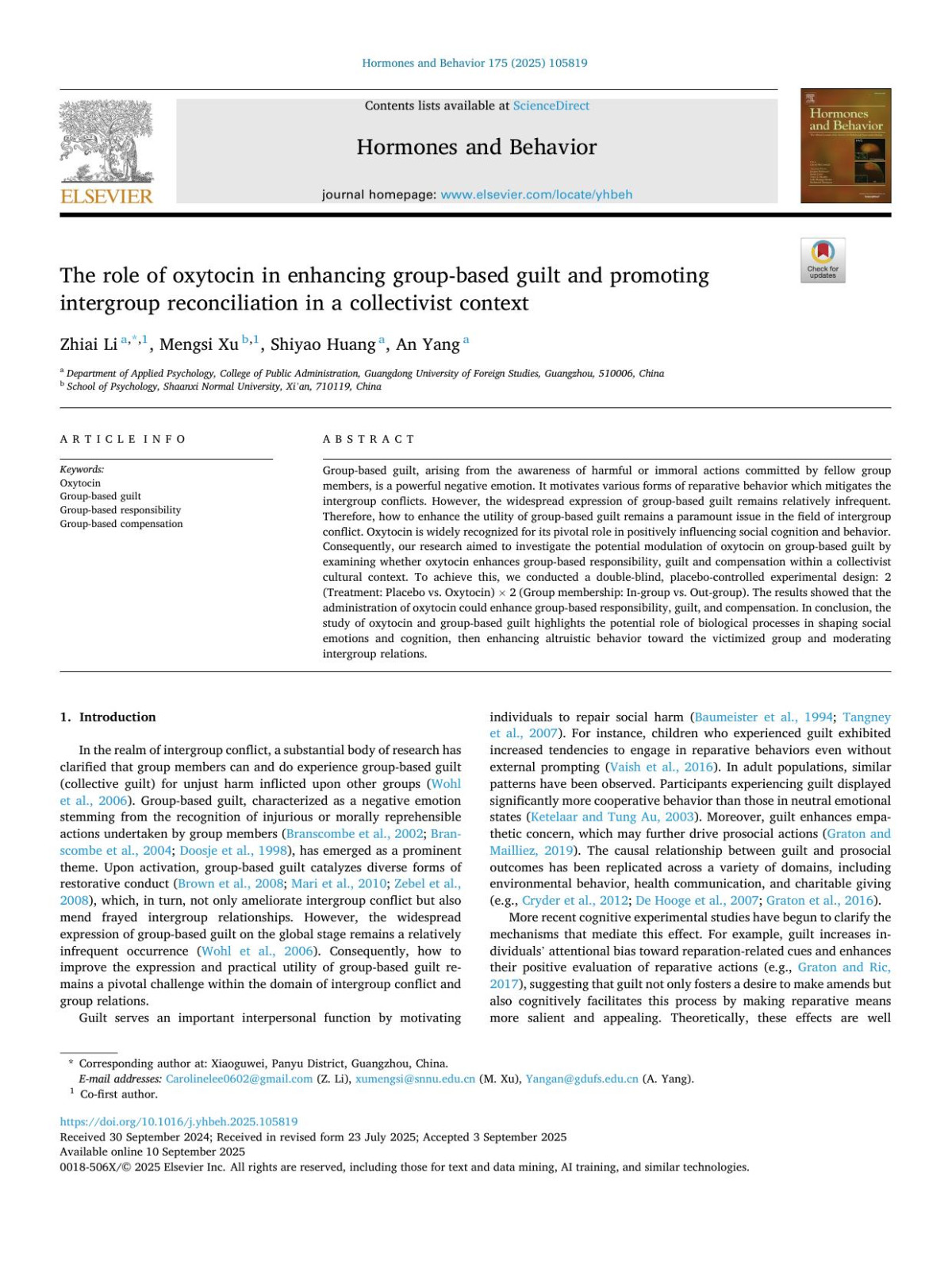
0 reviewsGroup-based guilt, arising from the awareness of harmful or immoral actions committed by fellow group members, is a powerful negative emotion. It motivates various forms of reparative behavior which mitigates the intergroup conflicts. However, the widespread expression of group-based guilt remains relatively infrequent. Therefore, how to enhance the utility of group-based guilt remains a paramount issue in the field of intergroup conflict. Oxytocin is widely recognized for its pivotal role in positively influencing social cognition and behavior. Consequently, our research aimed to investigate the potential modulation of oxytocin on group-based guilt by examining whether oxytocin enhances group-based responsibility, guilt and compensation within a collectivist cultural context. To achieve this, we conducted a double-blind, placebo-controlled experimental design: 2 (Treatment: Placebo vs. Oxytocin) × 2 (Group membership: In-group vs. Out-group). The results showed that the administration of oxytocin could enhance group-based responsibility, guilt, and compensation. In conclusion, the study of oxytocin and group-based guilt highlights the potential role of biological processes in shaping social emotions and cognition, then enhancing altruistic behavior toward the victimized group and moderating intergroup relations.

5.0
5 reviews
4.7
13 reviews
4.5
41 reviews


4.9
15 reviews
5.0
9 reviews
4.4
13 reviews

4.6
22 reviews