
Most ebook files are in PDF format, so you can easily read them using various software such as Foxit Reader or directly on the Google Chrome browser.
Some ebook files are released by publishers in other formats such as .awz, .mobi, .epub, .fb2, etc. You may need to install specific software to read these formats on mobile/PC, such as Calibre.
Please read the tutorial at this link. https://ebooknice.com/page/post?id=faq
We offer FREE conversion to the popular formats you request; however, this may take some time. Therefore, right after payment, please email us, and we will try to provide the service as quickly as possible.
For some exceptional file formats or broken links (if any), please refrain from opening any disputes. Instead, email us first, and we will try to assist within a maximum of 6 hours.
EbookNice Team
Status:
Available0.0
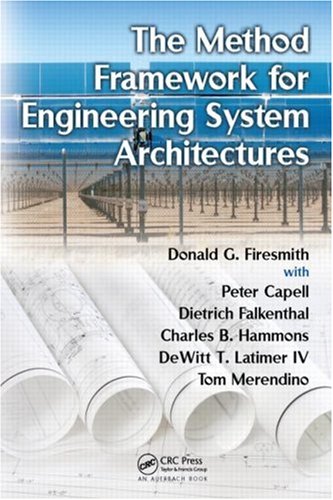
0 reviewsThe architects of today’s large and complex systems all too often struggle with the lack of a consistent set of principles and practices that adequately address the entire breadth of systems architecture. The Method Framework for Engineering System Architectures (MFESA) enables system architects and process engineers to create methods for effectively and efficiently engineering high-quality architecture for systems, subsystems, and software components.
Meets the Needs of Specific Projects
The book begins by documenting the common challenges that must be addressed by system architecture engineering. It explores the major principles answering these challenges and forming the basis of MFESA. Next, the authors introduce MFESA, including its primary goals, inputs, tasks, outputs, and assumptions. Then they describe the fundamental concepts and terminology on which the systems architecture engineering is founded. This is followed by a description of each of the ten system architecture engineering tasks including associated goals and objectives, preconditions, inputs, steps, postconditions, work products, guidelines, and pitfalls.
Finally, the book documents the relationship between quality and architecture, explains the quality model underlying MFESA, and provides a summary of MFESA method framework, as well as a list of points to remember and future directions planned for MFESA.
В Explains Specific Rationales
 Organized as a handy desk reference, this book harnesses more than 100 years of the authors’ combined professional experience to provide extensive guidelines, best practices, and tips on avoiding possible pitfalls. It presents a direct rationale of why steps are taken, how things can go wrong, and guidance for how and when to tailor the model for a system’s specific context.


4.6
12 reviews

4.7
9 reviews



4.4
30 reviews
5.0
17 reviews