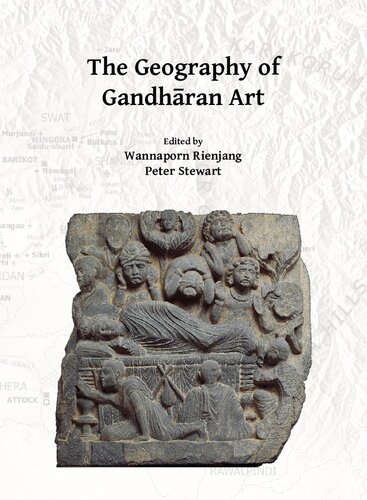
(Ebook) The Geography of Gandhāran Art: Proceedings of the Second International Workshop of the Gandhāra Connections Project, University of Oxford, 22nd-23rd March, 2018 by Wannaporn Rienjang (editor), Peter Stewart (editor) ISBN 9781789691863, 1789691869
Gandhāran art is usually regarded as a single phenomenon – a unified regional artistic tradition or ‘school’. Indeed it has distinctive visual characteristics, materials, and functions, and is characterized by its extensive borrowings from the Graeco-Roman world. Yet this tradition is also highly varied. Even the superficial homogeneity of Gandhāran sculpture, which constitutes the bulk of documented artistic material from this region in the early centuries AD, belies a considerable range of styles, technical approaches, iconographic choices, and levels of artistic skill. The geographical variations in Gandhāran art have received less attention than they deserve. Many surviving Gandhāran artefacts are unprovenanced and the difficulty of tracing substantial assemblages of sculpture to particular sites has obscured the fine-grained picture of its artistic geography. Well documented modern excavations at particular sites and areas, such as the projects of the Italian Archaeological Mission in the Swat Valley, have demonstrated the value of looking at sculptures in context and considering distinctive aspects of their production, use, and reuse within a specific locality. However, insights of this kind have been harder to gain for other areas, including the Gandhāran heartland of the Peshawar basin. Even where large collections of artworks can be related to individual sites, the exercise of comparing material within and between these places is still at an early stage. The relationship between the Gandhāran artists or ‘workshops’, particular stone sources, and specific sites is still unclear. Addressing these and other questions, this second volume of the Gandhāra Connections project at Oxford University’s Classical Art Research Centre presents the proceedings of a workshop held in March 2018. Its aim is to pick apart the regional geography of Gandhāran art, presenting new discoveries at particular sites, textual evidence, and the challenges and opportunities of exploring Gandhāra’s artistic geography.Table of ContentsEditors’ notePreface – by Wannaporn Rienjang and Peter StewartPart 1 Artistic GeographiesGandhāran art(s): Methodologies and preliminary results of a stylistic analysis – by Jessie PonsGeographical differences and similarities in Gandhāran sculptures – by Satoshi NaikiPart 2 Provenances and LocalitiesSources of acquisition for the Gandhāran Buddhist sculptures in the former S.R.O. collection of the Department of Archaeology and Museums, Government of Pakistan, in the light of ar¬chival documents – by Zarawar KhanFresh discoveries at the Buddhist Monastic Complex Bādalpur, Taxila valley – by Muhammad Ashraf KhanFresh research on the Buddhist monastic complex of Takht-i-Bāhī – by M.H. Khan KhattakThe scope of the Buddhist 'workshops' and artistic 'centres’ in the Swat Valley, ancient Uḍḍiyāna, in Pakistan – by Abdul Ghafoor LoneRegional workshops and small stūpas in the Swat Valley: an analysis of the evidence from Gumbat, Saidu Sharif, and Pānṛ – by Pia Brancaccio and Luca Maria OlivieriDifferences and similarities in Gandhāran art production: the case of the modelling school of Haḍḍa (Afghanistan) – by Alexandra VanleenePart 3 Geography and TextA survey of place-names in Gāndhārī inscriptions and a new oil lamp from Malakand – by Stefan BaumsMaking places for Buddhism in Gandhāra: stories of previous births in image and text – by Jason Neelis
*Free conversion of into popular formats such as PDF, DOCX, DOC, AZW, EPUB, and MOBI after payment.