logo
Product categories

EbookNice.com

Most ebook files are in PDF format, so you can easily read them using various software such as Foxit Reader or directly on the Google Chrome browser.
Some ebook files are released by publishers in other formats such as .awz, .mobi, .epub, .fb2, etc. You may need to install specific software to read these formats on mobile/PC, such as Calibre.

Please read the tutorial at this link.  https://ebooknice.com/page/post?id=faq


We offer FREE conversion to the popular formats you request; however, this may take some time. Therefore, right after payment, please email us, and we will try to provide the service as quickly as possible.


For some exceptional file formats or broken links (if any), please refrain from opening any disputes. Instead, email us first, and we will try to assist within a maximum of 6 hours.

EbookNice Team
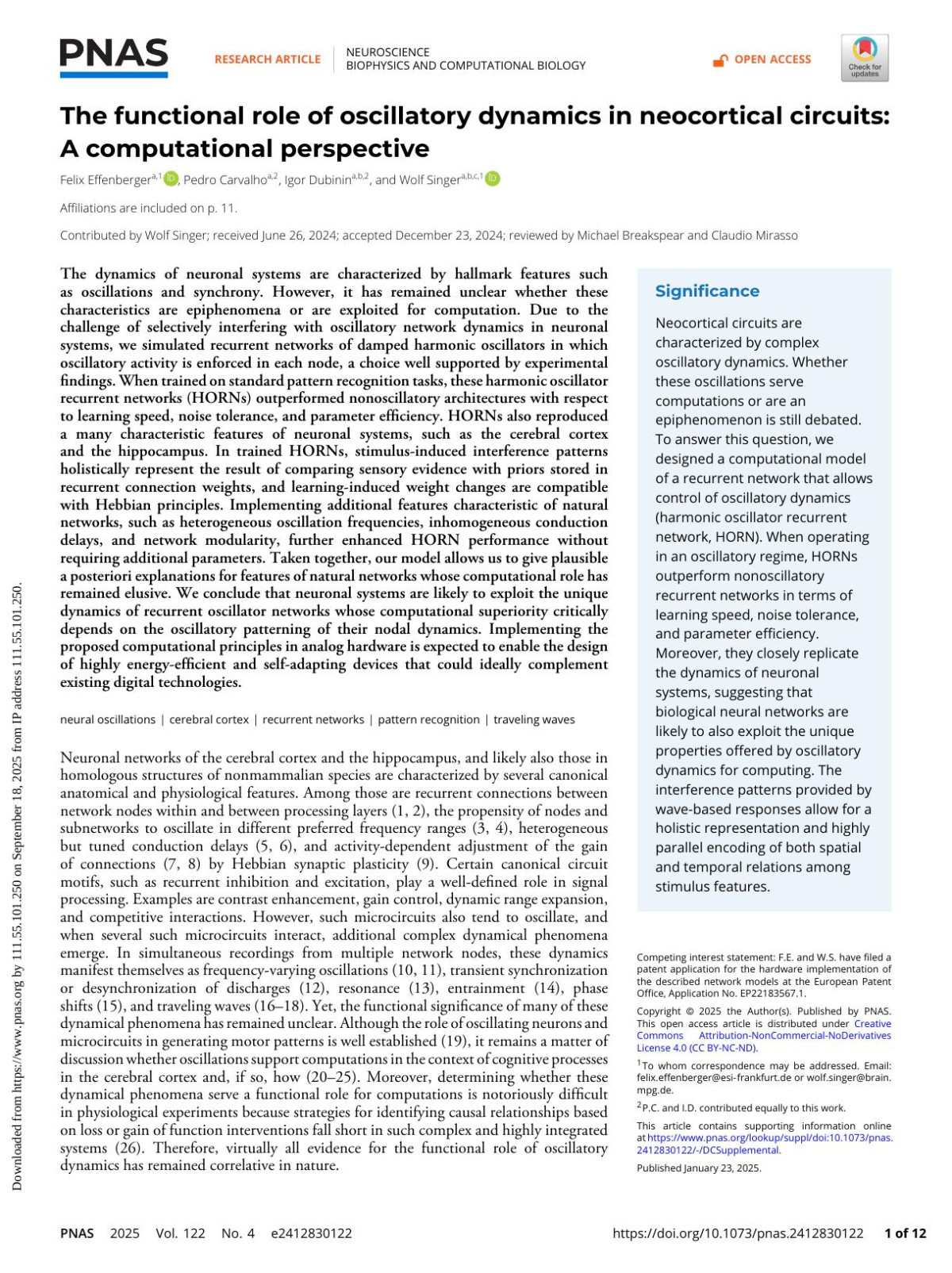
The functional role of oscillatory dynamics in neocortical circuits: A computational perspective by Felix Effenbergera, Pedro Carvalhoa, Igor Dubinina, Wolf Singera ISBN 10.1073/PNAS.2412830122 instant download

  • SKU: EBN-239016412
Zoomable Image
$ 32 $ 40 (-20%)

Status:

Available

4.7

8 reviews
Instant download (eBook) The functional role of oscillatory dynamics in neocortical circuits: A computational perspective after payment.
Authors:Felix Effenbergera, Pedro Carvalhoa, Igor Dubinina, Wolf Singera
Pages:12 pages
Year:2025
Publisher:x
Language:english
File Size:6.92 MB
Format:pdf
ISBNS:10.1073/PNAS.2412830122
Categories: Ebooks

Product desciption

The functional role of oscillatory dynamics in neocortical circuits: A computational perspective by Felix Effenbergera, Pedro Carvalhoa, Igor Dubinina, Wolf Singera ISBN 10.1073/PNAS.2412830122 instant download

The dynamics of neuronal systems are characterized by hallmark features suchas oscillations and synchrony. However, it has remained unclear whether thesecharacteristics are epiphenomena or are exploited for computation. Due to thechallenge of selectively interfering with oscillatory network dynamics in neuronalsystems, we simulated recurrent networks of damped harmonic oscillators in whichoscillatory activity is enforced in each node, a choice well supported by experimentalfindings. When trained on standard pattern recognition tasks, these harmonic oscillatorrecurrent networks (HORNs) outperformed nonoscillatory architectures with respectto learning speed, noise tolerance, and parameter efficiency. HORNs also reproduceda many characteristic features of neuronal systems, such as the cerebral cortexand the hippocampus. In trained HORNs, stimulus-induced interference patternsholistically represent the result of comparing sensory evidence with priors stored inrecurrent connection weights, and learning-induced weight changes are compatiblewith Hebbian principles. Implementing additional features characteristic of naturalnetworks, such as heterogeneous oscillation frequencies, inhomogeneous conductiondelays, and network modularity, further enhanced HORN performance withoutrequiring additional parameters. Taken together, our model allows us to give plausiblea posteriori explanations for features of natural networks whose computational role hasremained elusive. We conclude that neuronal systems are likely to exploit the uniquedynamics of recurrent oscillator networks whose computational superiority criticallydepends on the oscillatory patterning of their nodal dynamics. Implementing theproposed computational principles in analog hardware is expected to enable the designof highly energy-efficient and self-adapting devices that could ideally complementexisting digital technologies.
*Free conversion of into popular formats such as PDF, DOCX, DOC, AZW, EPUB, and MOBI after payment.

Related Products