Most ebook files are in PDF format, so you can easily read them using various software such as Foxit Reader or directly on the Google Chrome browser.
Some ebook files are released by publishers in other formats such as .awz, .mobi, .epub, .fb2, etc. You may need to install specific software to read these formats on mobile/PC, such as Calibre.
Please read the tutorial at this link. https://ebooknice.com/page/post?id=faq
We offer FREE conversion to the popular formats you request; however, this may take some time. Therefore, right after payment, please email us, and we will try to provide the service as quickly as possible.
For some exceptional file formats or broken links (if any), please refrain from opening any disputes. Instead, email us first, and we will try to assist within a maximum of 6 hours.
EbookNice Team
Status:
Available4.6
32 reviewsISBN 10: 3110341999
ISBN 13: 9783110341997
Author: Benjamin Fine
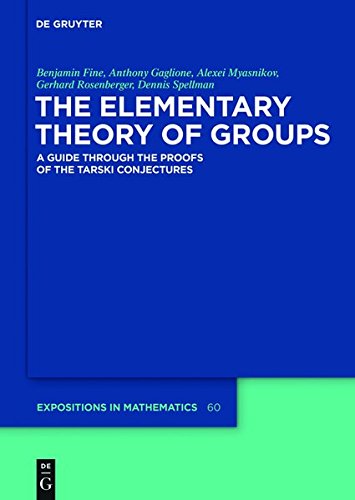
After being an open question for sixty years the Tarski conjecture was answered in the affirmative by Olga Kharlampovich and Alexei Myasnikov and independently by Zlil Sela. Both proofs involve long and complicated applications of algebraic geometry over free groups as well as an extension of methods to solve equations in free groups originally developed by Razborov. This book is an examination of the material on the general elementary theory of groups that is necessary to begin to understand the proofs. This material includes a complete exposition of the theory of fully residually free groups or limit groups as well a complete description of the algebraic geometry of free groups. Also included are introductory material on combinatorial and geometric group theory and first-order logic. There is then a short outline of the proof of the Tarski conjectures in the manner of Kharlampovich and Myasnikov.
1 Group theory and logic: introduction
1.1 Group theory and logic
1.2 The elementary theory of groups
1.3 Overview of this monograph
2 Combinatorial group theory
2.1 Combinatorial group theory
2.2 Free groups and free products
2.3 Group complexes and the fundamental group
2.4 Group amalgams
2.5 Subgroup theorems for amalgams
2.6 Nielsen transformations
2.7 Bass-Serre theory
3 Geometric group theory
3.1 Geometric group theory
3.2 The Cayley graph
3.3 Dehn algorithms and small cancellation theory
3.4 Hyperbolic groups
3.5 Free actions on trees: arboreal group theory
3.6 Automatic groups
3.7 Stallings foldings and subgroups of free groups
4 First order languages and model theory
4.1 First order language for group theory
4.2 Elementary equivalence
4.3 Models and model theory
4.4 Varieties and quasivarieties
4.5 Filters and ultraproducts
5 The Tarski problems
5.1 The Tarski problems
5.2 Initial work on the Tarski problems
5.3 The positive solution to the Tarski problems
5.4 Tarski-like problems
6 Fully residually free groups I
6.1 Residually free and fully residually free groups
6.2 CSA groups and commutative transitivity
6.3 Universally free groups
6.4 Constructions of residually free groups
6.4.1 Exponential and free exponential groups
6.4.2 Fully residually free groups embedded in
6.4.3 A characterization in terms of ultrapowers
6.5 Structure of fully residually free groups
7 Fully residually free groups II
7.1 Fully residually free groups: limit groups
7.1.1 Geometric limit groups
7.2 JSJ-decompositions and automorphisms
7.2.1 Automorphisms of fully residually free groups
7.2.2 Tame automorphism groups
7.2.3 The isomorphism problem for limit groups
7.2.4 Constructible limit groups
7.2.5 Factor sets and MR-diagrams
7.3 Faithful representations of limit groups
7.4 Infinite words and algorithmic theory
7.4.1 ℤn-free groups
8 Algebraic geometry over groups
8.1 Algebraic geometry
8.2 The category of G-groups
8.3 Domains and equationally Noetherian groups
8.3.1 Zero divisors and G-domains
8.3.2 Equationally Noetherian groups
8.3.3 Separation and discrimination
8.4 The affine geometry of G-groups
8.4.1 Algebraic sets and the Zariski topology
8.4.2 Ideals of algebraic sets
8.4.3 Morphisms of algebraic sets
8.4.5 Equivalence of the categories of affine algebraic sets and coordinate groups
8.4.6 The Zariski topology of equationally Noetherian groups
8.5 The theory of ideals
8.5.1 Maximal and prime ideals
8.5.2 Radicals and radical ideals
8.5.3 Some decomposition theorems for ideals
8.6 Coordinate groups
8.6.1 Coordinate groups of irreducible varieties
8.6.2 Decomposition theorems
8.7 The Nullstellensatz
9 The solution of the Tarski problems
9.1 The Tarski problems
9.2 Components of the solution
9.3 The Tarski–Vaught test and the overall strategy
9.4 Algebraic geometry and fully residually free groups
9.5 Quadratic equations and quasitriangular systems
9.6 Quantifier elimination and the elimination process
9.7 Proof of the elementary embedding
9.8 Proof of decidability
10 On elementary free groups and extensions
10.1 Elementary free groups
10.2 Surface groups and Magnus’ theorem
10.3 Questions and something for nothing
10.4 Results on elementary free groups
10.4.1 Hyperbolicity and stable hyperbolicity
10.4.2 The retract theorem and Turner groups
10.4.3 Conjugacy separability of elementary free groups
10.4.4 Tame automorphisms of elementary free groups
10.4.5 The isomorphism problem for elementary free groups
10.4.6 Faithful representations in PSL(2, C)
10.4.7 Elementary free groups and the Howson property
10.5 The Lyndon properties
10.5.1 The basic Lyndon properties
10.5.2 Lyndon properties in amalgams
10.5.3 The Lyndon properties and HNN constructions
10.5.4 The Lyndon properties in certain one-relator groups
10.5.5 The Lyndon properties and tree-free groups
10.6 The class of BX-groups
10.6.1 Big powers groups and univeral freeness
11 Discriminating and squarelike groups
11.1 Discriminating groups
11.2 Examples of discriminating groups
11.2.1 Abelian discriminating groups
11.2.2 Trivially discriminating groups and universal type groups
11.2.3 Nontrivially discriminating groups
11.3 Negative examples: nondiscriminating groups
11.3.1 Further negative examples in varieties
11.4 Squarelike groups and axiomatic properties
11.5 The axiomatic closure property
11.6 Further axiomatic information about discriminating and squarelike groups
11.7 Varietal discrimination
11.8 Co-discriminating groups and domains
elementary theory of groups pdf
benjamin fine group theory
abstract algebra group theory book
group theory textbook undergraduate
introduction to algebraic structures
Tags: The Elementary, Theory of Groups, Benjamin Fine, Theory

4.5
41 reviews
5.0
41 reviews


4.5
33 reviews
4.6
30 reviews
5.0
27 reviews