(Ebook) The Charter of the United Nations a commentary 1st Edition by Bruno Simma, Daniel Erasmus Khan, Georg Nolte, Andreas Paulus ISBN 9780191788246 0191788244
(Ebook) The Charter of the United Nations a commentary 1st Edition by Bruno Simma, Daniel Erasmus Khan, Georg Nolte, Andreas Paulus - Ebook PDF Instant Download/Delivery: 9780191788246 ,0191788244
Full download Edit(Ebook) The Charter of the United Nations a commentary 1st Edition ion after payment
Product details:
ISBN 10: 0191788244
ISBN 13: 9780191788246
Author: Bruno Simma, Daniel Erasmus Khan, Georg Nolte, Andreas Paulus
work in the field of international law. This comprehensive two-volume commentary offers an in-depth, article-by-article analysis of the United Nations Charter, providing insights into its legislative history, interpretation, and practical application. The editors, along with a team of expert contributors, have meticulously examined the Charter's provisions, integrating state practice, judicial decisions, and scholarly perspectives. The first edition, published in 1994, set a new standard for scholarly works on the UN Charter, and subsequent editions have continued to build upon this foundation, incorporating developments in international law and the evolving role of the United Nations in global governance.
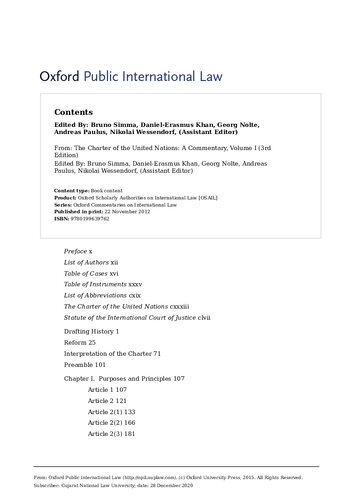
(Ebook) The Charter of the United Nations a commentary 1st Edition Table of contents:
I. Proposals by Individuals and Private Groups
(p. 8) II. Planning by the Experts
III. The United Nations in the Proclamations of the Leading Statesmen on the War Aims
IV. The Dumbarton Oaks Conference67
V. The Yalta Compromise
VI. The Founding Conference at San Francisco
VII. Ratification and Entry into Force
C. Transition from League of Nations to United Nations
Footnotes:
Reform
Thilo Rensmann
From: The Charter of the United Nations: A Commentary, Volume I (3rd Edition)
Edited By: Bruno Simma, Daniel-Erasmus Khan, Georg Nolte, Andreas Paulus, Nikolai Wessendorf, (Assistant Editor)
(p. 25) Reform
Select Bibliography
Main Text
A. Notion of Reform
B. Reform and the Charter
I. The Charter as a Programme For Reform
II. The Charter as a Constraint on Reform
1. UN Reform Without Reforming the Charter
2. UN Reform By Means of Reforming the Charter
(a) Reform Through Formal Amendment
(p. 31) (b) Reform Through Practice
(c) Reform Through (Re-)Interpretation
(d) Reform Through Informal Charter Amendment
3. Reform of the UN and Reform of the UN System
(p. 34) C. Phases of Reform
I. Collective Security and Cold War
1. The Ideal of Collective Security and the Reality of Cold War
2. Unredeemed Promise of a Review Conference
3. Informal Adaptation of the Collective Security System to the Exigencies of the Cold War
(a) Limitation of the Veto Power
(b) Introduction of the ‘Franchise Model’
(c) Shift of Power from the SC to the GA
(d) The ‘Invention’ of Peacekeeping Forces
(e) The Enhanced Political Role of the SG
(f) The ‘Intergovernmentalization’ of the Secretariat
II. Decolonization and the Shift to Development
1. From War-Time Alliance to Universal Membership: Reform of the Admissions Procedure
2. Self-determination and Human Rights: The Constitutional Underpinnings of Decolonization
3. Equitable Representation of the Newly Independent Member States in the SC and ECOSOC
4. Shift of the Reform Agenda to Development
(p. 44) (a) Original Design: Functional Decentralization and Economic Liberalism
(b) Diversification and Duplication within the UN Development System
(c) The Challenge of Coordination: Study on the Capacity of the UN Development System
(d) Reforming Global Economic Governance: the Attempt to Establish a New International Economic Order
(e) Adapting the Structure of the UN System to the New International Economic Order
III. Reforming For Survival: Focus on Administrative and Budgetary Reform
IV. End of the Cold War and the Revitalization of the Collective Security System
1. Continuity and Change in the Post-Cold War Era
2. The New Activism of the SC
3. An Agenda for Peace
4. SC Reform
5. An Agenda for Development
6. A New SG and a New Millennium: UN Reform Regains Momentum
V. New Threats to Collective Security and the 2005 World Summit
1. A Fork in the Road
2. 2005 World Summit Outcome
(a) Peace and Security
(b) Development
(c) Human Rights
VI. World Summit Follow-Up and Future Prospects for Reform
1. Peace and Security
(a) SC Reform
(b) Peacekeeping
(c) Responsibility to Protect
2. Development and System-Wide Coherence
3. Human Rights
4. Environment
5. Management
(p. 69) D. Outlook
Footnotes:
Interpretation of the Charter
Stefan Kadelbach
From: The Charter of the United Nations: A Commentary, Volume I (3rd Edition)
Edited By: Bruno Simma, Daniel-Erasmus Khan, Georg Nolte, Andreas Paulus, Nikolai Wessendorf, (Assistant Editor)
(p. 71) Interpretation of the Charter
Select Bibliography
Main Text
A. Introduction
B. Rules of Interpretation
I. The Vienna Convention and Customary International Law
II. The Interpretation of Founding Instruments of International Organizations
III. Constitutional Interpretation of the Charter
IV. Rules of Interpretation as Applied to the Charter
1. Constitutional and Contractual Elements
2. Wording
3. Context
4. Object and Purpose
5. Subsequent Practice
6. Other Relevant Rules of International Law
7. Travaux Préparatoires
C. The Charter in the Practice of Its Interpreters
I. General Remarks
II. UN Institutions
1. The International Court of Justice
2. The General Assembly
3. The Security Council
(a) Charter Interpretation
(b) Interpretation of Security Council Resolutions
4. The Secretary-General
III. Member States
D. Interpretation and Revision
E. Concluding Remarks
Footnotes:
Preamble
Rüdiger Wolfrum
From: The Charter of the United Nations: A Commentary, Volume I (3rd Edition)
Edited By: Bruno Simma, Daniel-Erasmus Khan, Georg Nolte, Andreas Paulus, Nikolai Wessendorf, (Assistant Editor)
(p. 101) Preamble
Select Bibliography
Main Text
A. Introduction*
B. Legislative History
C. Practice
Footnotes:
Ch.I Purposes and Principles, Article 1
Rüdiger Wolfrum
From: The Charter of the United Nations: A Commentary, Volume I (3rd Edition)
Edited By: Bruno Simma, Daniel-Erasmus Khan, Georg Nolte, Andreas Paulus, Nikolai Wessendorf, (Assistant Editor)
Article 1
Select Bibliography
A. Introduction*
B. Interpretation
(p. 116) C. Practice
Footnotes:
Ch.I Purposes and Principles, Article 2
Andreas Paulus
From: The Charter of the United Nations: A Commentary, Volume I (3rd Edition)
Edited By: Bruno Simma, Daniel-Erasmus Khan, Georg Nolte, Andreas Paulus, Nikolai Wessendorf, (Assistant Editor)
(p. 121) Article 2
Select Bibliography
A. Introduction*
B. Drafting History
C. Foundational Principles of International Law
D. ‘in pursuit of the Purposes stated in Article 1’
E. The Organization and its Members
I. Organization
II. Members
III. Non-members and the Charter Principles (Article 2 (6))
(p. 131) F. Constitution or Treaty?
Footnotes:
Ch.I Purposes and Principles, Article 2 (1)
Bardo Fassbender
From: The Charter of the United Nations: A Commentary, Volume I (3rd Edition)
Edited By: Bruno Simma, Daniel-Erasmus Khan, Georg Nolte, Andreas Paulus, Nikolai Wessendorf, (Assistant Editor)
(p. 133) Article 2 (1)
Select Bibliography
Sovereignty
Equality
Sovereign Equality
A. Introduction
(p. 136) B. Historical and Philosophical Background
I. Sovereignty in the ‘International Law of Co-existence’
II. Equality of States
(p. 144) C. Drafting History
D. Elaboration of the Principle in the Practice of the United Nations
I. Draft Declaration on Rights and Duties of States
II. The Friendly Relations Declaration
III. Permanent Sovereignty over Natural Resources
IV. Decisions of the International Court of Justice
E. The Substance of Sovereign Equality in Present International Law
I. Sovereign Equality as a New Concept
II. The Scope of Application ratione personae
III. Sovereign Equality as Constitutional Autonomy
IV. Equal Status under the Constitution of the International Community
1. Rights Protecting Constitutional Autonomy
2. Rights of Participation in the International Community
3. Sovereign Equality in the United Nations
4. Equality of States in their Mutual Relations
V. Sovereign Equality in an Age of Globalization
F. The Untamed Side of Sovereignty
Footnotes:
Ch.I Purposes and Principles, Article 2 (2)
Robert Kolb
From: The Charter of the United Nations: A Commentary, Volume I (3rd Edition)
Edited By: Bruno Simma, Daniel-Erasmus Khan, Georg Nolte, Andreas Paulus, Nikolai Wessendorf, (Assistant Editor)
(p. 166) Article 2 (2)
Select Bibliography
A. On the Genesis of Article 2 (2)*
B. The Scope and the Interpretation of the Good Faith Requirement
I. The Obligation Covered by the Good Faith Clause
II. The Addressees of the Obligation
III. The Systematic Setting of Article 2 (2): Its Relation to Articles 1 and 2 (1)
IV. The Purpose-Oriented Interpretation of Article 2 (2): Commitment to Community Objectives
C. The Specific Content of the Obligation of Good Faith in the Framework of the Charter
I. Good Faith as a General Legal Principle in International Law
II. Good Faith as a Directive for Interpretation
III. Good Faith as an Element of Constitutional Decision-Making to Secure Cooperation
D. The Application of Good Faith in the UN Practice
I. Case Practice
1. Voting Rights and Veto Power
2. Effects of Recommendations of UN Organs (especially the General Assembly)
3. Prohibition of Abuse of Procedure49
II. Treaty Practice
(p. 180) E. Conclusion
Footnotes:
Ch.I Purposes and Principles, Article 2 (3)
Christian Tomuschat
From: The Charter of the United Nations: A Commentary, Volume I (3rd Edition)
Edited By: Bruno Simma, Daniel-Erasmus Khan, Georg Nolte, Andreas Paulus, Nikolai Wessendorf, (Assistant Editor)
(p. 181) Article 2 (3)
UN Materials
Select Bibliography
A. Historical Background
B. Systematic Context
(p. 186) C. Elaboration of the Principle of the Peaceful Settlement of Disputes in the Practice of the United Nations
I. The Friendly Relations Declaration
II. The Manila Declaration
III. UNGA Resolution 40/9
IV. Declaration on the Prevention and Removal of Disputes and Situations which May Threaten International Peace and Security, and on the Role of the United Nations in this Field
V. United Nations Decade of International Law
VI. Millennium Declaration
VII. World Summit Outcome
VIII. The Rule of Law
(p. 188) D. The Scope of Application ratione personae
I. Member States of the United Nations
II. Third States
III. United Nations
IV. Other International Organizations
E. The Substance of Obligation
I. Legally Binding Effect
II. Content
III. Obligation of Conduct
IV. Ius Cogens?
(p. 192) F. International Disputes
I. Disputes and Situations
(p. 193) II. The International Character of Disputes
III. Other Characteristics
G. Peaceful Means
I. Exclusiveness
II. Prohibition of Recourse to Armed Force
III. Other Measures that Violate Rights
IV. Countermeasures
(p. 198) H. Settlement
I. Justice
I. Drafting History
II. Meaning
III. The Manila Declaration
People also search for (Ebook) The Charter of the United Nations a commentary 1st Edition:
signing of the charter of the united nations
charter of the united nations (sanctions – lebanon) regulations 2008
r chapter vii of the charter of the united nations
united nations charter on the rights of the child
charter of the united nations sanctions the taliban regulation 2013
Tags: Bruno Simma, Daniel Erasmus Khan, Georg Nolte, Andreas Paulus, United Nations
*Free conversion of into popular formats such as PDF, DOCX, DOC, AZW, EPUB, and MOBI after payment.