
Most ebook files are in PDF format, so you can easily read them using various software such as Foxit Reader or directly on the Google Chrome browser.
Some ebook files are released by publishers in other formats such as .awz, .mobi, .epub, .fb2, etc. You may need to install specific software to read these formats on mobile/PC, such as Calibre.
Please read the tutorial at this link. https://ebooknice.com/page/post?id=faq
We offer FREE conversion to the popular formats you request; however, this may take some time. Therefore, right after payment, please email us, and we will try to provide the service as quickly as possible.
For some exceptional file formats or broken links (if any), please refrain from opening any disputes. Instead, email us first, and we will try to assist within a maximum of 6 hours.
EbookNice Team
Status:
Available5.0
15 reviews
ISBN 10: 0520312368
ISBN 13: 9780520312364
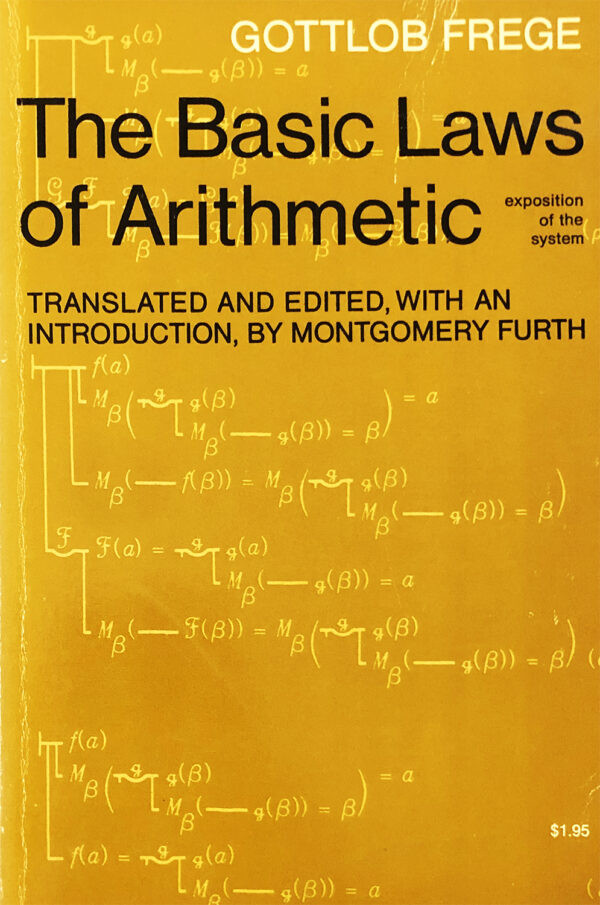
Author: Gottlob Frege, Montgomery Furth
Basic Laws of Arithmetic: Exposition of the System by Gottlob Frege is a seminal work that aims to establish arithmetic and mathematical analysis as logical systems derived from pure logic. Published in 1893, it represents a cornerstone in the history of mathematical and philosophical thought. Frege’s primary objective was to substantiate logicism, the view that truths of arithmetic are not irreducibly mathematical, synthetic a priori, or empirical, but are instead expressions of logical truths. The book lays out three core tasks: defining logical propositions and rules of inference, and deriving arithmetic's fundamental truths from these logical principles. While Frege’s meticulous approach to these tasks helped establish mathematical logic as a discipline, his work ultimately failed to achieve its purpose, as the set theory underpinning his system proved inconsistent, a flaw brought to his attention by Bertrand Russell.
Despite its failure as Frege envisioned it, the work remains profoundly influential. Frege’s exploration of logical truth and inference pioneered formal logic, including propositional calculus, quantification theory, and set theory. His philosophy of language, embedded within the system’s semantics, offers a deep and nuanced understanding of meaning that continues to resonate within analytical philosophy. Moreover, Frege’s precise and rigorous standards of reasoning surpass many subsequent works, including the more widely adopted Principia Mathematica. Although his logicism is untenable in its original form, Frege’s ideas remain a vital resource for understanding the intersection of logic, mathematics, and language, making his Grundgesetze a crucial study for philosophers, logicians, and historians. This translation of key sections emphasizes its ongoing relevance to modern philosophical inquiries into meaning and language.
This title is part of UC Press's Voices Revived program, which commemorates University of California Press’s mission to seek out and cultivate the brightest minds and give them voice, reach, and impact. Drawing on a backlist dating to 1893, Voices Revived makes high-quality, peer-reviewed scholarship accessible once again using print-on-demand technology. This title was originally published in 1964.
§ 0. Our task. Demands on the conduct of proof. Dedekind's system. Schroder's class
Exposition of the Begriffsschrift
1. Primitive Signs
i. Introduction: Function, Concept, Relation
§1. The function is unsaturated
§2. Truth-values. Denotation and sense. Thought. Object
§3. Course-of-values of a function. Concept. Extension of a concept
§4. Functions of two arguments
ii. Signs for Functions
§5. Judgment and thought. Judgment-stroke and horizontal
§6. Negation-stroke. Amalgamation of horizontals
§7. The identity-sign
§8. Generality. Gothic letters. Their scope. Amalgamation of horizontals
§9. Notation for the course-of-values. Small Greek vowels. Their scope
§10. The course-of-values of a function more exactly specified
§11. Substitute for the definite article: the function ξ
§12. Condition-stroke. And. Neither-nor. Or. Subcomponents. Main component
iii. Inferences and Consequences
§14. First method of inference
15. Second method of inference. Contraposition
§16. Third method of inference
§17. Roman letters. Transition from Roman to Gothic letters
§18. Laws in symbols of Begriffsschrift (I. IV. VI.)
iv. Extension of the Notation for Generality
§19. Generality with respect to functions. Function-letters. Object-letters
§20. Laws in symbols of Begriffsschrift (lla. III. V.)
§21. Functions and concepts of first and second level
§22. Examples of second-level functions. Unequal-leveled functions and relations
§23. Types of arguments and argument-places. Second-level functions of arguments of type 2 and type 3
§24. General explanation of the use of function-letters
§25. Generality with respect to second-level functions. Basic Law lib
2. Definitions
i. General Remarks
§26. Classification of signs. Names. Marks. Proposition of Begriffsschrift. Transition-sign
§27. The double-stroke of definition
§28. Correct formation of names
§29. When does a name denote something?
§30. Two ways to form a name
§31. Our simple names denote something
§32. Every proposition of Begriffsschrift expresses a thought
§33. Principles of definition
ii. Particular Definitions
§34. Definition of the function ξ-ζ
§35. Representation of second-level functions by first-level 54 functions
§36. The double course-of-values. The extension of a relation
§37. Definition of the function 1 ξ
§38. Definition of the function ) ξ
§39. Definition of the function ξ
§40. Definition of the function ξ
§41. Definition of θ
§42. Definition of 1. Concept of Number
§43. Definition of f
§44. Some propositions of Begriffsschrift as examples
§45. Definition of the function - £ Following and preceding in a series
§46. Definition of the function u ξ
3. Derived Laws
§47. Summary of the Basic Laws
§48. Summary of the Rules
§49. Derivation of some propositions from (I)
§50. Derivation of the main principles of the function ξ = ζ
§51. Derivation of some propositions from (IV)
§52. Derivation of some propositions from (V) and (VI)
the basic laws of arithmetic frege
the basic laws of arithmetic exposition of the system
the basic laws of arithmetic frege pdf
what are the three laws of arithmetic
what are the basic rules of arithmetic
Tags: Gottlob Frege, Montgomery Furth, The Basic
4.7
40 reviews
4.4
10 reviews
4.6
24 reviews
5.0
27 reviews
4.7
14 reviews
5.0
31 reviews
4.6
18 reviews
4.8
24 reviews