logo
Product categories

EbookNice.com

Most ebook files are in PDF format, so you can easily read them using various software such as Foxit Reader or directly on the Google Chrome browser.
Some ebook files are released by publishers in other formats such as .awz, .mobi, .epub, .fb2, etc. You may need to install specific software to read these formats on mobile/PC, such as Calibre.

Please read the tutorial at this link.  https://ebooknice.com/page/post?id=faq


We offer FREE conversion to the popular formats you request; however, this may take some time. Therefore, right after payment, please email us, and we will try to provide the service as quickly as possible.


For some exceptional file formats or broken links (if any), please refrain from opening any disputes. Instead, email us first, and we will try to assist within a maximum of 6 hours.

EbookNice Team
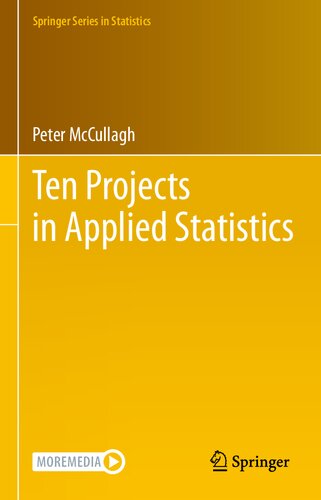
(Ebook) Ten Projects in Applied Statistics by Peter McCullagh ISBN 9783031142741, 9783031142758, 3031142748, 3031142756

  • SKU: EBN-49162676
Zoomable Image
$ 32 $ 40 (-20%)

Status:

Available

4.5

6 reviews
Instant download (eBook) Ten Projects in Applied Statistics after payment.
Authors:Peter McCullagh
Pages:431 pages.
Year:2023
Editon:1
Publisher:Springer Nature
Language:english
File Size:10.25 MB
Format:pdf
ISBNS:9783031142741, 9783031142758, 3031142748, 3031142756
Categories: Ebooks

Product desciption

(Ebook) Ten Projects in Applied Statistics by Peter McCullagh ISBN 9783031142741, 9783031142758, 3031142748, 3031142756

The first half of the book is aimed at quantitative research workers in biology, medicine, ecology and genetics. The book as a whole is aimed at graduate students in statistics, biostatistics, and other quantitative disciplines. Ten detailed examples show how the author approaches real-world statistical problems in a principled way that allows for adequate compromise and flexibility. The need to accommodate correlations associated with space, time and other relationships is a recurring theme, so variance-components models feature prominently. Statistical pitfalls are illustrated via examples taken from the recent scientific literature. Chapter 11 sets the scene, not just for the second half of the book, but for the book as a whole. It begins by defining fundamental concepts such as baseline, observational unit, experimental unit, covariates and relationships, randomization, treatment assignment, and the role that these play in model formulation. Compatibility of the model with the randomization scheme is crucial. The effect of treatment is invariably modelled as a group action on probability distributions. Technical matters connected with space-time covariance functions, residual likelihood, likelihood ratios, and transformations are discussed in later chapters.
*Free conversion of into popular formats such as PDF, DOCX, DOC, AZW, EPUB, and MOBI after payment.

Related Products