Most ebook files are in PDF format, so you can easily read them using various software such as Foxit Reader or directly on the Google Chrome browser.
Some ebook files are released by publishers in other formats such as .awz, .mobi, .epub, .fb2, etc. You may need to install specific software to read these formats on mobile/PC, such as Calibre.
Please read the tutorial at this link. https://ebooknice.com/page/post?id=faq
We offer FREE conversion to the popular formats you request; however, this may take some time. Therefore, right after payment, please email us, and we will try to provide the service as quickly as possible.
For some exceptional file formats or broken links (if any), please refrain from opening any disputes. Instead, email us first, and we will try to assist within a maximum of 6 hours.
EbookNice Team
Status:
Available5.0
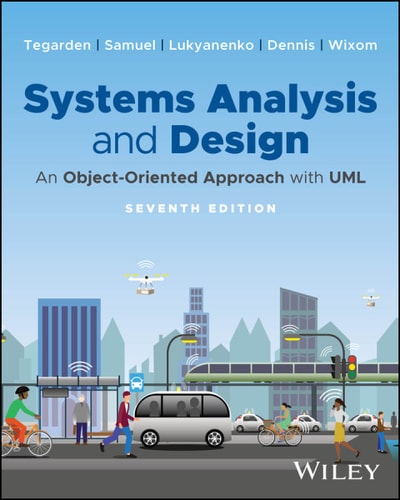
36 reviewsSystems Analysis and Design: An Object-Oriented Approach with UML, Seventh Edition captures the dynamic aspects of the field by keeping students focused on doing SAD while presenting the core set of skills that every systems analyst needs to know today and in the future.
The team of expert authors introduces each major technique, explains what it is, explains how to do it, presents an example, and provides opportunities for students to practice before they do it for real in a project. After reading each chapter, students will be able to perform that step in the system development process.
NEW TO THIS EDITION
A greater emphasis on developing information systems using an incremental and iterative approach and verifying, validating, and testing throughout the book
Chapter on agile development
Chapter that overviews the supporting workflows of the Unified Process
Greatly expanded the Library Management System (LMS) example integrated throughout the chapters
Converted the Campus Housing example to a set of “Your Turn” exercises. Also, suggested answers to each exercise are included in the Instructor’s Manual
Appendix section on sequence, decision, and looping/repeating programming structures
New and expanded sections on storytelling, NoSQL, data distribution and peer-to-peer architecture
Expanded coverage of the interdependencies among the functional (Chapter 3), structural (Chapter 4), and behavioral (Chapter 5) models
New and revised figures throughout the book
Updated MS Word templates that can be used for system requests, system proposals, use case descriptions, CRC cards, contracts, method specifications, use case test plan, class test plan, and class invariant test specifications
WILEY ADVANTAGE
Focuses on real-world application by guiding students through practice problems and using the technique in a project
Presents a contemporary, object-oriented approach using UML (Unified Modeling Language)
Integrates
…
4.6
35 reviews
4.5
5 reviews
4.3
35 reviews
5.0
6 reviews
4.5
8 reviews
4.6
32 reviews
4.4
6 reviews
5.0
27 reviews
4.5
13 reviews