
Most ebook files are in PDF format, so you can easily read them using various software such as Foxit Reader or directly on the Google Chrome browser.
Some ebook files are released by publishers in other formats such as .awz, .mobi, .epub, .fb2, etc. You may need to install specific software to read these formats on mobile/PC, such as Calibre.
Please read the tutorial at this link. https://ebooknice.com/page/post?id=faq
We offer FREE conversion to the popular formats you request; however, this may take some time. Therefore, right after payment, please email us, and we will try to provide the service as quickly as possible.
For some exceptional file formats or broken links (if any), please refrain from opening any disputes. Instead, email us first, and we will try to assist within a maximum of 6 hours.
EbookNice Team
Status:
Available5.0
27 reviews
ISBN 10: 1588110656
ISBN 13: 978-1588110657
Author: Talmy Givon
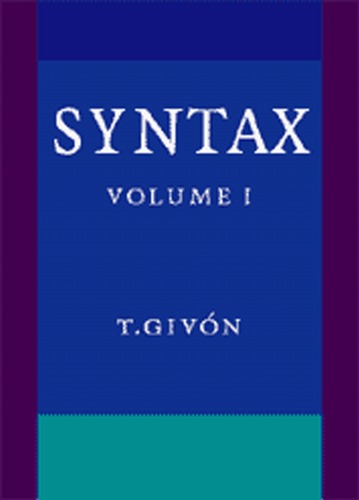
This new edition of Syntax: A functional-typological introduction is at many points radically revised. In the previous edition (1984) the author deliberately chose to de-emphasize the more formal aspects of syntactic structure, in favor of a more comprehensive treatment of the semantic and pragmatic correlates of syntactic structure. With hindsight the author now finds the de-emphasis of the formal properties a somewhat regrettable choice, since it creates the false impression that one could somehow be a functionalist without being at the same time a structuralist. To redress the balance, explicit treatment is given to the core formal properties of syntactic constructions, such as constituency and hierarchy (phrase structure), grammatical relations and relational control, clause union, finiteness and governed constructions.
At the same time, the cognitive and communicative underpinning of grammatical universals are further elucidated and underscored, and the interplay between grammar, cognition and neurology is outlined. Also the relevant typological database is expanded, now exploring in greater precision the bounds of syntactic diversity. Lastly, Syntax treats synchronic-typological diversity more explicitly as the dynamic by-product of diachronic development or grammaticalization. In so doing a parallel is drawn between linguistic diversity and diachrony on the one hand and biological diversity and evolution on the other. It is then suggested that ― as in biology ― synchronic universals of grammar are exercised and instantiated primarily as constraints on development, and are thus merely the apparent by-products of universal constraints on grammaticalization.
Chapter1 : Introduction
Chapter 2: Content
Chapter 3: Conclusion
Chapter 4: Appendices
Chapter 5: Glossary
Chapter 6: References
Chapter 7: Index
talmy givon syntax an introduction
givon syntax
syntax an introduction
a gentle introduction to symbolic computation
syntax givon
Tags: Talmy Givon, An Introduction

4.6
12 reviews

4.7
9 reviews

5.0
36 reviews
4.6
39 reviews
4.4
15 reviews