
Most ebook files are in PDF format, so you can easily read them using various software such as Foxit Reader or directly on the Google Chrome browser.
Some ebook files are released by publishers in other formats such as .awz, .mobi, .epub, .fb2, etc. You may need to install specific software to read these formats on mobile/PC, such as Calibre.
Please read the tutorial at this link. https://ebooknice.com/page/post?id=faq
We offer FREE conversion to the popular formats you request; however, this may take some time. Therefore, right after payment, please email us, and we will try to provide the service as quickly as possible.
For some exceptional file formats or broken links (if any), please refrain from opening any disputes. Instead, email us first, and we will try to assist within a maximum of 6 hours.
EbookNice Team
Status:
Available0.0
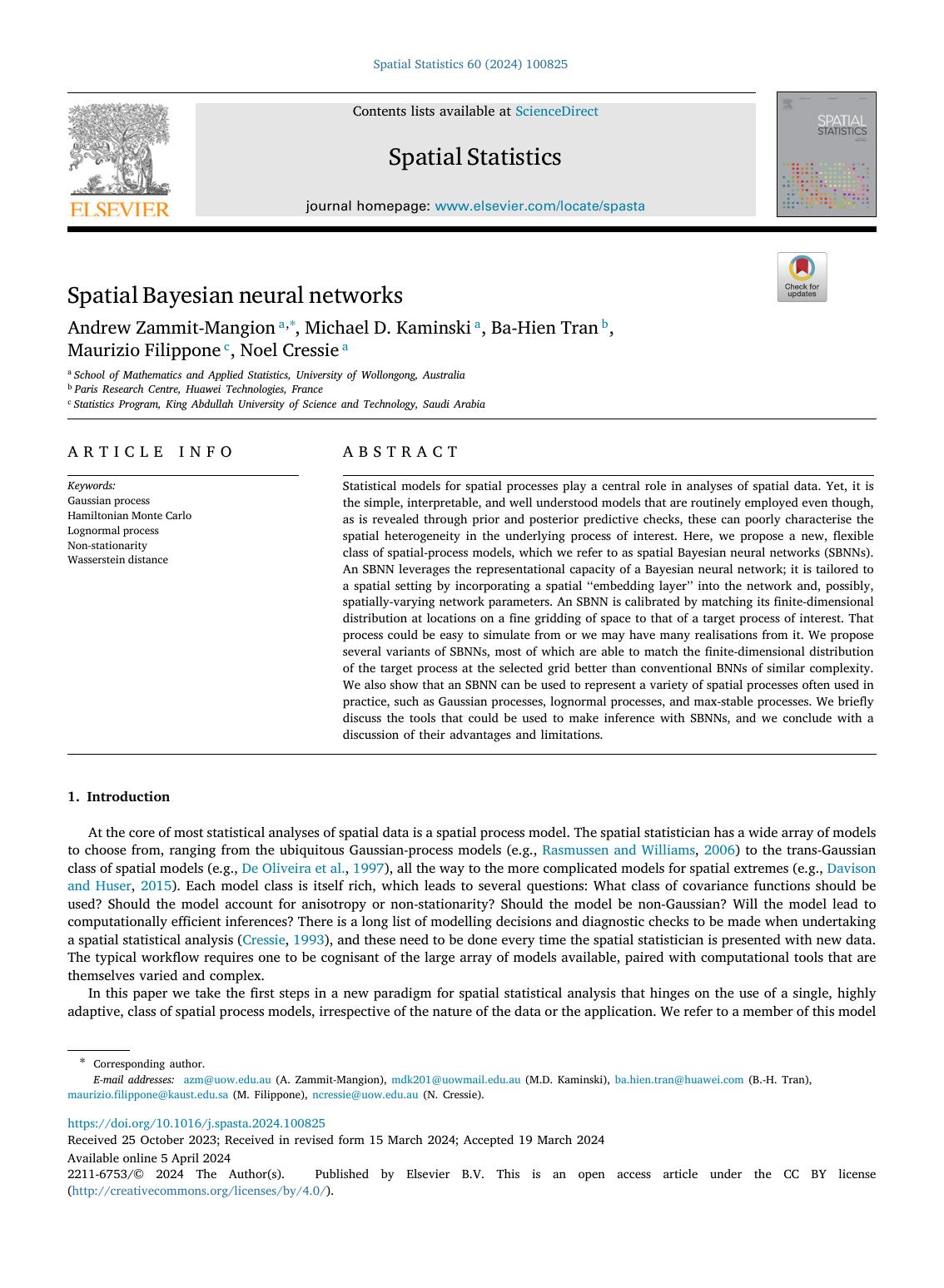
0 reviewsA B S T R A C TKeywords:Statistical models for spatial processes play a central role in analyses of spatial data. Yet, it isGaussian processthe simple, interpretable, and well understood models that are routinely employed even though,Hamiltonian Monte Carloas is revealed through prior and posterior predictive checks, these can poorly characterise theLognormal processspatial heterogeneity in the underlying process of interest. Here, we propose a new, flexibleNon-stationarityclass of spatial-process models, which we refer to as spatial Bayesian neural networks (SBNNs).Wasserstein distanceAn SBNN leverages the representational capacity of a Bayesian neural network; it is tailored toa spatial setting by incorporating a spatial ‘‘embedding layer’’ into the network and, possibly,spatially-varying network parameters. An SBNN is calibrated by matching its finite-dimensionaldistribution at locations on a fine gridding of space to that of a target process of interest. Thatprocess could be easy to simulate from or we may have many realisations from it. We proposeseveral variants of SBNNs, most of which are able to match the finite-dimensional distributionof the target process at the selected grid better than conventional BNNs of similar complexity.We also show that an SBNN can be used to represent a variety of spatial processes often used inpractice, such as Gaussian processes, lognormal processes, and max-stable processes. We brieflydiscuss the tools that could be used to make inference with SBNNs, and we conclude with adiscussion of their advantages and limitations.
4.5
19 reviews
4.6
29 reviews
4.4
12 reviews
4.4
21 reviews
4.6
40 reviews
4.7
19 reviews
4.9
24 reviews
4.4
16 reviews