
Most ebook files are in PDF format, so you can easily read them using various software such as Foxit Reader or directly on the Google Chrome browser.
Some ebook files are released by publishers in other formats such as .awz, .mobi, .epub, .fb2, etc. You may need to install specific software to read these formats on mobile/PC, such as Calibre.
Please read the tutorial at this link. https://ebooknice.com/page/post?id=faq
We offer FREE conversion to the popular formats you request; however, this may take some time. Therefore, right after payment, please email us, and we will try to provide the service as quickly as possible.
For some exceptional file formats or broken links (if any), please refrain from opening any disputes. Instead, email us first, and we will try to assist within a maximum of 6 hours.
EbookNice Team
Status:
Available4.6
32 reviews
ISBN 10: 0585489084
ISBN 13: 9780585489087
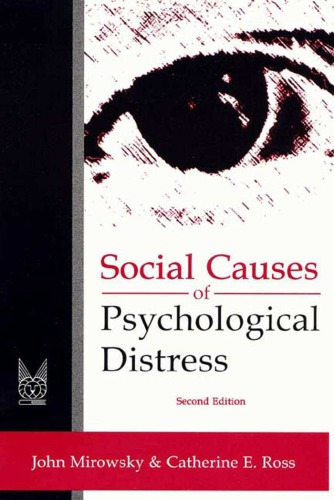
Author: John Mirowsky, Catherine E Ross
A core interest of social science is the study of stratification--inequalities in income, power, and prestige. Few persons would care about such inequalities if the poor, powerless, and despised were as happy and fulfilled as the wealthy, powerful, and admired. Social research often springs from humanistic empathy and concern as much as from scholarly and scientific curiosity. An economist might observe that black Americans are disproportionately poor, and investigate racial differences in education, employment, and occupation that account for disproportionate poverty. A table comparing additional income blacks and whites can expect for each additional year of education is thus as interesting in its own right as any dinosaur bone or photo of Saturn. However, something more than curiosity underscores our interest in the table. Racial differences in status and income are a problem in the human sense. Inequality in misery makes social and economic inequality personally meaningful. There are two ways social scientists avoid advocacy in addressing issues of social stratification. The first way is to resist projecting personal beliefs, values, and responses as much as possible, while recognizing that the attempt is never fully successful. The second way is by giving the values of the subjects an expression in the research design. Typically, this takes the form of opinion or attitude surveys. Researchers ask respondents to rate the seriousness of crimes, the appropriateness of a punishment for a crime, the prestige of occupations, the fair pay for a job, or the largest amount of money a family can earn and not be poor, and so on. The aggregate judgments, and variations in judgments, represent the values of the subjects and not those of the researcher. They are objective facts with causes and consequences of interest in their own right. This work is an effort to move methodology closer to human concerns without sacrificing the scientific grounds of research as such. The
Part I: Introduction Social Causes of Psychological Distress
Part II: Researching the Causes of Distress
2. Measuring Psychological Distress
– What Is Psychological Distress?
– Depression and Anxiety; Mood and Malaise
– The Opposite of Well-Being
– Not Dissatisfaction or Alienation
– Not Mental Illness
– A Human Universal
– Diagnosis: Superimposed Distinctions
– Reification of Categories in Psychiatry
– The Alternative: Type and Severity of Symptoms
– Reliability vs. Certainty
– Diagnosis and Help
– Diagnosing Schizophrenia
– Patterns of Symptoms
– Mapping Correlations
– Multiplication of Diagnoses
– Conclusion: The Story of a Woman Diagnosed
– Appendix of Symptom Indexes (Schizophrenia, Paranoia, Depression, Mania, Anxiety, Behavioral, Obsessive, Alcoholism)
Real-World Causes of Real-World Misery
– Establishing Cause in Human Sciences
– Criteria for Causation
– Population Studies of Distress
– Experimental Studies of Distress
– Limitations of Experiments
– Explaining Real Patterns
Part III: Social Patterns of Distress
4. Basic Patterns
– Community Mental Health Surveys
– Socioeconomic Status and Education
– Employment and Work
– Economic Resources and Sense of Control
– Marriage and Social Integration
– Supportive Relationships
– Children and Family Hardships
– Gender Differences and Stressfulness of Roles
– Response Bias and Expression of Distress
– Age and Views of the Life Course
– Conditions, Beliefs, and Age Effects
– Discussion
New Patterns
– Life Course Disruptions: Parental Divorce, Early Parenthood
– Age at First Birth
– Parenthood and Gender Differences
– The Trend toward Later Parenthood
– Age and the Gender Gap in Depression
– Neighborhood Disadvantage and Disorder
– Urban Concentrations and Distress
Part IV: Explaining the Patterns
6. Life Change: An Abandoned Explanation
– Conceptual History of Life Change and Stress
– Contradictory Evidence
– Daily Hassles, Chronic Stress, and Trauma
– Alternative Concepts and Future Research
Alienation
– Control: Locus, Self-Efficacy, Learned Helplessness
– Measuring Perceived Control
– Belief and Experience
– Sociodemographic Correlates
– Powerlessness and Distress
– Contingent and Moderating Effects
– Commitment, Support, Meaning, Normlessness, Labeling, Role Stress
– Alienation as the Prime Stressor
Authoritarianism and Inequity
– Authoritarianism, Inflexibility, Mistrust
– Social Capital and Collective Efficacy
– Disorder and Powerlessness
– Inequity in Marriage, Income, and Treatment
Part V: Conclusion
9. Why Some People Are More Distressed Than Others
– Control and Distress
– Importance of Social Factors
– Severe Psychological Problems and Social Causes
– Genetics and Biochemistry as Alternatives
– Down-Regulating Iatrogenic Helplessness
– What Can Be Done? (Education, Jobs, Supportive Relationships)
3 social effects of stress
social psychology and stress
exploring social psychology 9th edition ebook
social distress examples
social stress causes
on social stress
what causes psychological distress
Tags: John Mirowsky, Catherine E Ross, psychological, distress
4.3
29 reviews
5.0
5 reviews

4.5
33 reviews
5.0
27 reviews

4.7
34 reviews

4.3
24 reviews