logo
Product categories

EbookNice.com

Most ebook files are in PDF format, so you can easily read them using various software such as Foxit Reader or directly on the Google Chrome browser.
Some ebook files are released by publishers in other formats such as .awz, .mobi, .epub, .fb2, etc. You may need to install specific software to read these formats on mobile/PC, such as Calibre.

Please read the tutorial at this link.  https://ebooknice.com/page/post?id=faq


We offer FREE conversion to the popular formats you request; however, this may take some time. Therefore, right after payment, please email us, and we will try to provide the service as quickly as possible.


For some exceptional file formats or broken links (if any), please refrain from opening any disputes. Instead, email us first, and we will try to assist within a maximum of 6 hours.

EbookNice Team
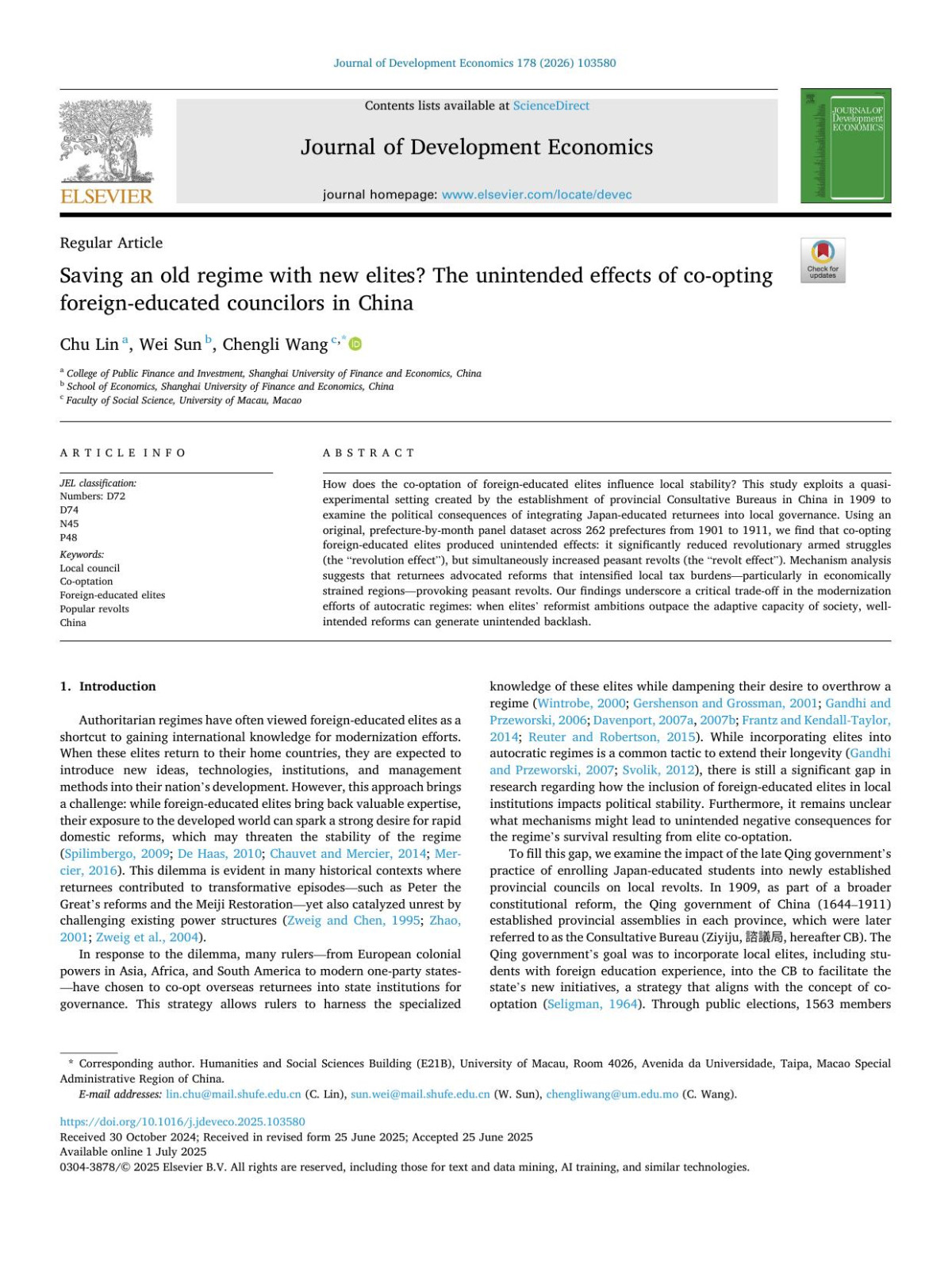
Saving an old regime with new elites? The unintended effects of co-opting foreign-educated councilors in China, by Chu Lin, Wei Sun, Chengli Wang, ISBN 101016/JJDEVECO2025103580 instant download

  • SKU: EBN-239207812
Zoomable Image
$ 32 $ 40 (-20%)

Status:

Available

4.7

38 reviews
Instant download (eBook) Saving an old regime with new elites? The unintended effects of co-opting foreign-educated councilors in China, after payment.
Authors:Chu Lin, Wei Sun, Chengli Wang,
Pages:updating ...
Year:2026
Publisher:Elsevier B.V.
Language:english
File Size:3.43 MB
Format:pdf
ISBNS:101016/JJDEVECO2025103580
Categories: Ebooks

Product desciption

Saving an old regime with new elites? The unintended effects of co-opting foreign-educated councilors in China, by Chu Lin, Wei Sun, Chengli Wang, ISBN 101016/JJDEVECO2025103580 instant download

Abstract: How does the co-optation of foreign-educated elites influence local stability? This study exploits a quasi-experimental setting created by the establishment of provincial Consultative Bureaus in China in 1909 to examine the political consequences of integrating Japan-educated returnees into local governance. Using an original, prefecture-by-month panel dataset across 262 prefectures from 1901 to 1911, we find that co-opting foreign-educated elites produced unintended effects: it significantly reduced revolutionary armed struggles (the “revolution effect”), but simultaneously increased peasant revolts (the “revolt effect”). Mechanism analysis suggests that returnees advocated reforms that intensified local tax burdens—particularly in economically strained regions—provoking peasant revolts. Our findings underscore a critical trade-off in the modernization efforts of autocratic regimes: when elites’ reformist ambitions outpace the adaptive capacity of society, well-intended reforms can generate unintended backlash.

Keywords: Local council; Co-optation; Foreign-educated elites; Popular revolts; China

*Free conversion of into popular formats such as PDF, DOCX, DOC, AZW, EPUB, and MOBI after payment.

Related Products