
Most ebook files are in PDF format, so you can easily read them using various software such as Foxit Reader or directly on the Google Chrome browser.
Some ebook files are released by publishers in other formats such as .awz, .mobi, .epub, .fb2, etc. You may need to install specific software to read these formats on mobile/PC, such as Calibre.
Please read the tutorial at this link. https://ebooknice.com/page/post?id=faq
We offer FREE conversion to the popular formats you request; however, this may take some time. Therefore, right after payment, please email us, and we will try to provide the service as quickly as possible.
For some exceptional file formats or broken links (if any), please refrain from opening any disputes. Instead, email us first, and we will try to assist within a maximum of 6 hours.
EbookNice Team
Status:
Available4.4
34 reviews
ISBN-10 : 1841136867
ISBN-13 : 9781847316998
Author: Allan Beever
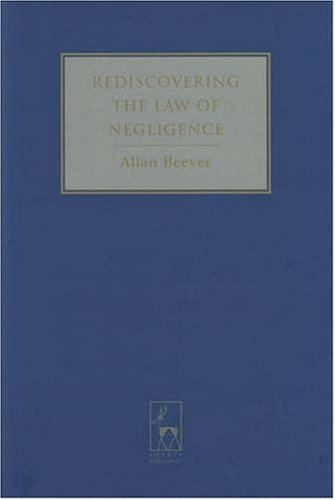
Rediscovering the Law of Negligence offers a systematic and theoretical exploration of the law of negligence. Its aim is to re-establish the notion that thinking about the law ought to and can proceed on the basis of principle. As such, it is opposed to the prevalent modern view that the various aspects of the law are and must be based on individual policy decisions and that the task of the judge or commentator is to shape the law in terms of the relevant policies as she sees them. The book, then, is an attempt to re-establish the law of negligence as a body of law rather than as a branch of politics. The book argues that the law of negligence is best understood in terms of a relatively small set of principles enunciated in a small number of leading cases. It further argues that these principles are themselves best seen in terms of an aspect of morality called corrective justice which, when applied to the most important aspects of the law of negligence reveals that the law - even as it now exists - possesses a far greater degree of conceptual unity than is commonly thought. Using this method the author is able to examine familiar aspects of the law of negligence such as the standard of care; the duty of care; remoteness; misfeasance; economic loss; negligent misrepresentation; the liability of public bodies; wrongful conception; nervous shock; the defences of contributory negligence, voluntary assumption of risk, and illegality; causation; and issues concerning proof, to show that when the principles are applied and the idea of corrective justice is properly understood then the law appears both systematic and conceptually satisfactory. The upshot is a rediscovery of the law of negligence.
1. Introduction
I. The Disintegration of the Modern Law
A. A Very Brief History
B. Implications of the Development of the Modern Law: The Role of Policy
C. Implications of the Development of the Modern Law: The Role of Principle
D. Less ‘Realistic’ Views
E. Defining Policy Narrowly
II. An Alternative
A. History Revisited
B. Strategy and Methodology
(i) General Strategy
(a) Interpretive Legal Theory
(b) Reflective Equilibrium
(c) Transparency, Policy, Judicial Decision Making and Reflective Equilibrium
(ii) Applying the Methodology to the Law of Negligence
(a) The Principled Approach
(b) The Modern Law
(c) An Internal, not External, Analysis
(iii) Format of the Book
III. Concluding Remarks
2. Corrective Justice, Negligence and Tort Law
I. Spheres of Morality
II. The Form of Corrective Justice
III. Corrective Justice, the Principled Approach and the Role of Judgement
IV. Corrective Justice and the Definition of Principle and Policy
V. The Apolitical Nature of Corrective Justice
VI. Two Potential Objections
A. The Incompleteness Objection and the Right of Corrective Justice
(i) The Incompleteness of Corrective Justice
(ii) The Incompleteness of the Principled Approach
(iii) The Rights Base of the Law of Negligence and Corrective Justice
(iv) The Rights Base of the Law of Negligence and Distributive Justice
(v) Conclusion
B. The Inconsistency Objection: Corrective Justice and the General Law of Tort
3. The Standard of Care
I. The Distinction between Action and Mere Behaviour
II. The Objective Standard
A. Justifying the Objective Standard
B. Who is the Ordinary Reasonable Person?
C. The Objective Standard and Corrective Justice
D. Adjusting the Objective Standard
III. Reasonable Care
A. The Leading Cases
B. The Standard of Care and Corrective Justice
C. Summary
D. Problematic Cases
E. Conclusion
IV. Strict Liability and Corrective Justice
V. Recent Legislation
4. Duty and Remoteness
I. The Duty of Care
A. The Nature of the Duty of Care
(i) Winterbottom v Wright
(ii) Donoghue v Stevenson
(iii) Palsgraf
B. The Duty of Care and Corrective Justice
II. Remoteness of Damage
A. The Nature of Remoteness
(i) Polemis
(ii) The Wagon Mound (No 1)
B. Remoteness and Corrective Justice
C. Remoteness, the Injury and the Accident
(i) The General Approach
(ii) The Chain of Events
(iii) The Extent of the Claimant’s Injury
(iv) Remoteness and Judgment
(v) Hughes v Lord Advocate Again
III. The Role of Reasonable Foreseeability in Duty and Remoteness
IV. Illustrations of Duty and Remoteness
A. Liability to Rescuers
B. Not-yet-existent Claimants
C. Novus Actus Interveniens
(i) Case Law
(ii) An Alternative
D. The Exception: the Thin Skull Rule
V. Conclusion
5. Modern Approaches to the Duty of Care
I. The Anns Approach
A. The Development of the Anns Approach
B. Criticism of the Anns Approach
II. The Incremental Approach
A. The Formulation of the Incremental Approach
B. The Incremental Approach and the Neighbour Test
(i) Proximity and Reasonable Foreseeability
(ii) The Incremental Approach and Policy
C. Incrementalism and Justification
D. Conclusion
III. Vulnerability: A New Approach?
IV. The Modern Approaches and the Place of Tort Law within the Law of Obligations
V. Comparing the Approaches
VI. Conclusion
6. Misfeasance, Nonfeasance and the Rights Base of the Law of Negligence
I. The Traditional Understanding of the Distinction between Misfeasance and Nonfeasance
A. Acts and Omissions
B. Justification for the Act/Omission Distinction
II. The Rights Base of the Law of Negligence
A. Primary Rights and Injuries
B. Primary Rights and the Structure of the Law of Obligations
C. Standard Objections
III. The Distinction between Misfeasance and Nonfeasance
IV. Conclusion
7. Economic Loss
I. Consequential and Relational Economic Loss
A. The Modern Approaches
B. The Principled Approach
(i) Indeterminate Liability
(ii) Ultramares
(iii) Donoghue v Stevenson, Nonfeasance and the Rights of Tort Law
C. The Principled Approach to Relational Loss
D. The Principled Approach to Consequential Loss
II. Pure Economic Loss
A. The Building Cases
(i) The Principled Approach
(ii) The Policy-driven Approaches
(iii) The Risk to the Owner’s Person and Property and Risk to Others
B. The Disappointed Beneficiary Cases
III. Economic Loss, Primary Rights and the General Law
IV. Economic Loss in Negligence and the Economic Torts
V. Conclusion
8. Negligent Misrepresentation and Assumption of Responsibility
I. The Negligence Model
A. Candler v Crane Christmas & Co
B. The Anns Test and Negligent Misrepresentation
C. The Incremental Approach and Negligent Misrepresentation
D. Rejection of the Negligence Model
II. The Assumption of Responsibility Model
A. The Judgment in Hedley Byrne
B. The Role of Assumption of Responsibility in Negligent Misrepresentation
(i) Disclaimers
(ii) Causal Conversations
(iii) Special Skill
(iv) The Purpose of the Representation and the Person for whose Benefit the Statement was Made
C. Perceived Difficulties with the Assumption of Responsibility Model
(i) The Pigeonhole Argument
(ii) The Role of Proximity
(iii) The Role of Reasonable Foreseeability
(iv) The Role of Reliance
(v) The Role of Negligence
(vi) Criticisms of the Notion of Assumption of Responsibility
D. Conclusion 310
III. ‘Negligent Misrepresentation’ and the Private Law
IV. The Right of Spring
9. Nonfeasance and the Liability of Public Bodies
I. Nonfeasance in General
A. The Scope of the Rule
B. Assumptions of Responsibility and Nonfeasance
II. The Liability of Public Bodies
A. General Theory
(i) The Liability of Public Bodies where, Prima Facie, a Common Law Primary Right has been Violated
(ii) The Liability of Public Bodies where, Prima Facie, a Common Law Primary Right has not been Violated
B. Case Law
10. Defences
I. Contributory Negligence
II. Volenti Non Fit Injuria
A. The Two Parts of the Defence
B. Willing the Harm
C. Consenting to the Risk of the Harm
D. The Volenti Defence and Rescuers
III. Illegality
A. Gala v Preston
B. Cory J in Hall v Hebert
C. Corrective Justice and Illegality: Weinrib and McLachlin Jin Hall v Hebert
11. Wrongful Birth, Wrongful Conception and Nervous Shock
I. Wrongful Birth
II. Wrongful Conception
A. Case Law
B. The Law of Negligence
C. Recovery under an Assumption of Responsibility
III. Nervous Shock
A. Primary Victims
B. Secondary Victims
C. Nervous Shock and the Rights of the Claimant
12. Causation
I. Why Causation?
II. The Nature of Factual Causation
A. Case Law: The But For Test and its Alternatives
B. The NESS Test and the Targeted But For Test
(i) Introducing the Tests
(ii) Problems with the Targeted But For Test
(iii) Problems with the NESS Test
C. The Nature of Factual Causation in Outline
D. Exploring Factual Causation
III. Liability in Cases of Over-determination
A. The Problem
B. Negligence and Nominal Damages
C. Wright on Damages 434
D. The Claimant’s Rights and Factual Causation
E. Applying the Theory to More Complex Fact Patterns
13. Proof and Uncertainty
I. The Burden of Proof13. Proof and Uncertainty
II. Uncertainty over whether the Defendant was Negligent
III. Uncertainty over Factual Causation
A. The Principled Approach to Factual Uncertainty
B. Applying the Principled Approach to Cases of Factual Uncertainty
(i) McGhee
(ii) Wilsher
(iii) Fairchild
(iv) Scientific Uncertainty and Uncertainty in General
IV. Loss of a Chance
A. The Problem: Gregg v Scott
(i) Lord Nicholls’ Main Argument
(ii) Lord Nicholls’ Secondary Argument
(iii) Lord Hoffmann’s Main Argument
(iv) Lord Hoffmann’s Secondary Argument
B. What Does it Mean to Say that There Was a Chance?
(i) The Argument from Quantum Physics
(ii) Free Will
(iii) Loss of Chance and Factual Uncertainty
C. Another Kind of Loss of a Chance
14. Conclusion
I. Corrective Justice and Legal Change
II. Policy and Principle: Rediscovering the Law of Negligence
beever rediscovering the law of negligence
law of contributory negligence
recognize the elements of negligence
rediscovering definition
ignoring the law
Tags: Rediscovering, the Law, Negligence, Allan Beever, Negligence


4.6
12 reviews

4.7
9 reviews
5.0
8 reviews
4.3
33 reviews
4.5
6 reviews
4.4
24 reviews