
Most ebook files are in PDF format, so you can easily read them using various software such as Foxit Reader or directly on the Google Chrome browser.
Some ebook files are released by publishers in other formats such as .awz, .mobi, .epub, .fb2, etc. You may need to install specific software to read these formats on mobile/PC, such as Calibre.
Please read the tutorial at this link. https://ebooknice.com/page/post?id=faq
We offer FREE conversion to the popular formats you request; however, this may take some time. Therefore, right after payment, please email us, and we will try to provide the service as quickly as possible.
For some exceptional file formats or broken links (if any), please refrain from opening any disputes. Instead, email us first, and we will try to assist within a maximum of 6 hours.
EbookNice Team
Status:
Available4.7
11 reviews
ISBN 10: 0415773571
ISBN 13: 978-0415773577
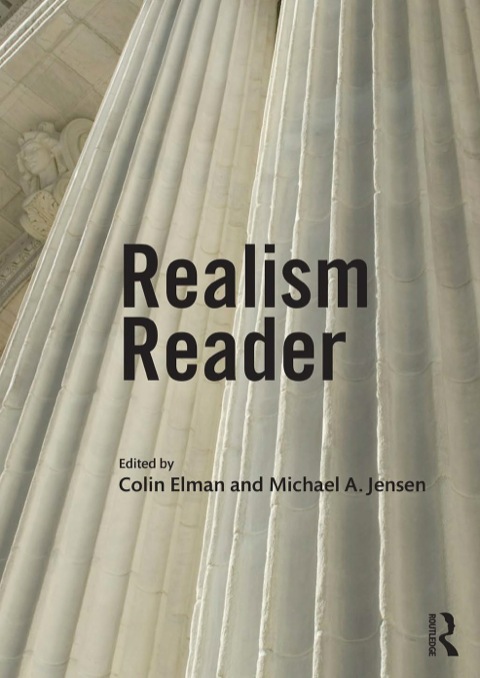
Author: Colin Elman, Michael Jensen
The Realism Reader provides broad coverage of a centrally important tradition in the study of foreign policy and international politics. After some years in the doldrums, political realism is again in contention as a leading tradition in the international relations sub-field.
Divided into three main sections, the book covers seven different and distinctive approaches within the realist tradition: classical realism, balance of power theory, neorealism, defensive structural realism, offensive structural realism, rise and fall realism, and neoclassical realism. The middle section of the volume covers realism’s engagement with critiques levelled by liberalism, institutionalism, and constructivism and the English School. The final section of the book provides materials on realism’s engagement with some contemporary issues in international politics, with collections on United States (U.S.) hegemony, European cooperation, and whether future threats will arise from non-state actors or the rise of competing great powers.
The book offers a logically coherent and manageable framework for organizing the realist canon, and provides exemplary literature in each of the traditions and dialogues which are included in the volume. Offering substantial commentary and analysis and including enhanced pedagogy to facilitate student learning, The Realism Reader will provide a 'one-stop-shop' for undergraduates and masters students taking a course in contemporary international relations theory, with a particular focus on realism.
1. Introduction
Section One: Realist research programs
2. Classical realism: The twentieth century
The beginnings of a science
The realist critique
The moral blindness of scientific man
A realist theory of international politics
Idealist internationalism and the security dilemma
The pole of power and the pole of indifference
3. Balance of power theory
The balance of power: prescription, concept, or propaganda?
Aims
Feedback
Balancing on land and at sea: do states ally against the leading global power?
4. Neorealism
Political structures
Anarchic orders and balances of power
Realist thought and neorealist theory
The origins of war in neorealist theory
5. Defensive structural realism
Cooperation under the security dilemma
Alliance formation and the balance of world power
Introduction
Realists as optimists: cooperation as self-help
Breaking out of the security dilemma: realism, reassurance, and the problem of uncertainty
6. Offensive structural realism
Anarchy and the struggle for power
Mearsheimer’s world: offensive realism and the struggle for security
The “poster child for offensive realism”: America as a global hegemon
7. Rise and fall realism
Power transition
The power transition research program: A Lakatosian analysis
The nature of international political change
Hegemonic war and international change
Declining power and the preventive motivation for war
Neorealism and the myth of bipolar stability: toward a new dynamic realist theory of major war
8. Neoclassical realism
The necessary and natural evolution of structural realism
Introduction: neoclassical realism, the state, and foreign policy
Chain gangs and passed bucks: predicting alliance patterns in multipolarity
Unanswered threats: a neoclassical realist theory of underbalancing
Neoclassical realism and the national interest: presidents, domestic politics, and major military in
Section Two: Critiques and responses
9. Engaging liberal critiques
Taking preferences seriously: a liberal theory of international politics
Is anybody not an (international relations) liberal?
How liberalism produces democratic peace
Kant or cant: the myth of the democratic peace
10. Engaging the institutionalist critiques
Neoliberalism, neorealism, and world politics
Institutional theory as a research program
Anarchy and the limits of cooperation: a realist critique of the newest liberal institutionalism
The false promise of international institutions
11. Engaging the constructivist and English School critiques
Anarchy is what states make of it: the social construction of power politics
Culture clash: assessing the importance of ideas in security studies
The English School vs. American realism: a meeting of minds or divided by a common language?
A realist critique of the English School
Section Three: Realist theories and contemporary international politics
12. Realism, American hegemony, and soft balancing
The stability of a unipolar world
The unipolar illusion revisited: the coming end of the United States’ unipolar moment
Soft balancing against the United States
Waiting for balancing: why the world is not pushing back
13. Realism and European cooperation
The future of the American pacifier
European Union security and defense policy: response to unipolarity?
Still not pushing back: why the European Union is not balancing the United States
14. Realism, non-state actors, and the rise of China
Structural realism in a more complex world
The security dilemma and ethnic conflict
China’s unpeaceful rise
The tragedy of offensive realism: classical realism and the rise of China
15. Is realism heading in the right direction?
The realist paradigm and degenerative versus progressive research programs: an appraisal of neotradi
Evaluating theories
The progressive power of realism
Is anybody still a realist?
Correspondence: brother, can you spare a paradigm?
realism era books
realism reader
realism books examples
realism reading
realism reader pdf
Tags: Colin Elman, Michael Jensen, Realism Reader
4.6
13 reviews
4.4
38 reviews
4.5
32 reviews
5.0
33 reviews
4.4
40 reviews
4.8
12 reviews
4.5
15 reviews
4.5
20 reviews