
Most ebook files are in PDF format, so you can easily read them using various software such as Foxit Reader or directly on the Google Chrome browser.
Some ebook files are released by publishers in other formats such as .awz, .mobi, .epub, .fb2, etc. You may need to install specific software to read these formats on mobile/PC, such as Calibre.
Please read the tutorial at this link. https://ebooknice.com/page/post?id=faq
We offer FREE conversion to the popular formats you request; however, this may take some time. Therefore, right after payment, please email us, and we will try to provide the service as quickly as possible.
For some exceptional file formats or broken links (if any), please refrain from opening any disputes. Instead, email us first, and we will try to assist within a maximum of 6 hours.
EbookNice Team
Status:
Available4.6
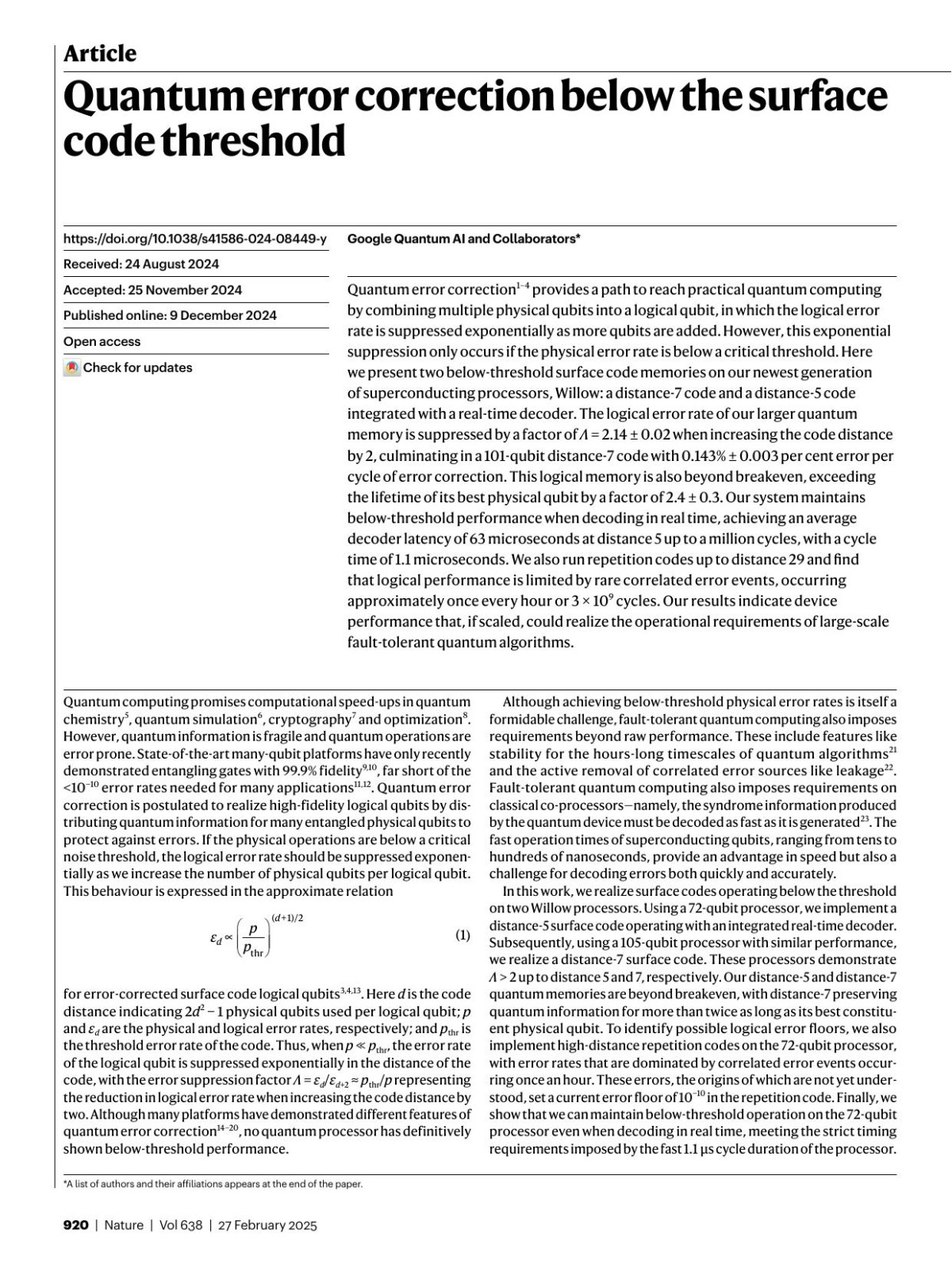
6 reviewsQuantum error correction1–4 provides a path to reach practical quantum computing Published online: 9 December 2024by combining multiple physical qubits into a logical qubit, in which the logical error Open accessrate is suppressed exponentially as more qubits are added. However, this exponential suppression only occurs if the physical error rate is below a critical threshold. Here Check for updateswe present two below-threshold surface code memories on our newest generation of superconducting processors, Willow: a distance-7 code and a distance-5 code integrated with a real-time decoder. The logical error rate of our larger quantum memory is suppressed by a factor of Λ = 2.14 ± 0.02 when increasing the code distance by 2, culminating in a 101-qubit distance-7 code with 0.143% ± 0.003 per cent error per cycle of error correction. This logical memory is also beyond breakeven, exceeding the lifetime of its best physical qubit by a factor of 2.4 ± 0.3. Our system maintains below-threshold performance when decoding in real time, achieving an average decoder latency of 63 microseconds at distance 5 up to a million cycles, with a cycle time of 1.1 microseconds. We also run repetition codes up to distance 29 and fnd that logical performance is limited by rare correlated error events, occurring approximately once every hour or 3 × 10⁹ cycles. Our results indicate device performance that, if scaled, could realize the operational requirements of large-scale fault-tolerant quantum algorithms.
4.7
27 reviews