
Most ebook files are in PDF format, so you can easily read them using various software such as Foxit Reader or directly on the Google Chrome browser.
Some ebook files are released by publishers in other formats such as .awz, .mobi, .epub, .fb2, etc. You may need to install specific software to read these formats on mobile/PC, such as Calibre.
Please read the tutorial at this link. https://ebooknice.com/page/post?id=faq
We offer FREE conversion to the popular formats you request; however, this may take some time. Therefore, right after payment, please email us, and we will try to provide the service as quickly as possible.
For some exceptional file formats or broken links (if any), please refrain from opening any disputes. Instead, email us first, and we will try to assist within a maximum of 6 hours.
EbookNice Team
Status:
Available0.0
0 reviews
ISBN 10: 1787125939
ISBN 13: 9781787125933
Author: Sebastian Raschka, Vahid Mirjalili
Publisher's Note: This edition from 2017 is outdated and is not compatible with TensorFlow 2 or any of the most recent updates to Python libraries. A new third edition, updated for 2020 and featuring TensorFlow 2 and the latest in scikit-learn, reinforcement learning, and GANs, has now been published.
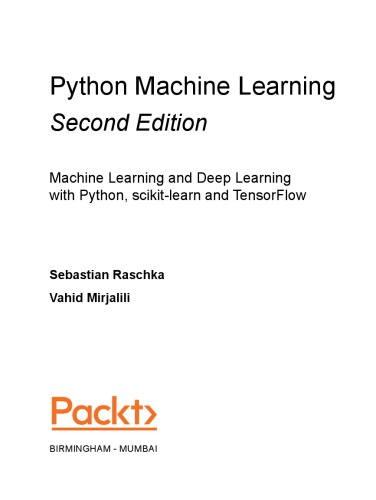
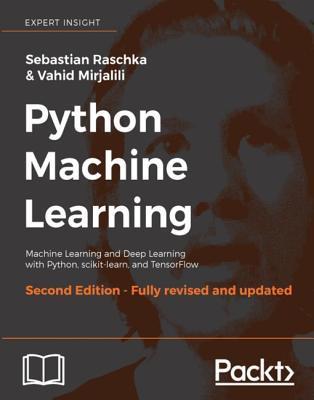
Machine learning is eating the software world, and now deep learning is extending machine learning. Understand and work at the cutting edge of machine learning, neural networks, and deep learning with this second edition of Sebastian Raschka’s bestselling book, Python Machine Learning. Using Python's open source libraries, this book offers the practical knowledge and techniques you need to create and contribute to machine learning, deep learning, and modern data analysis.
Fully extended and modernized, Python Machine Learning Second Edition now includes the popular TensorFlow 1.x deep learning library. The scikit-learn code has also been fully updated to v0.18.1 to include improvements and additions to this versatile machine learning library.
Sebastian Raschka and Vahid Mirjalili’s unique insight and expertise introduce you to machine learning and deep learning algorithms from scratch, and show you how to apply them to practical industry challenges using realistic and interesting examples. By the end of the book, you’ll be ready to meet the new data analysis opportunities.
If you’ve read the first edition of this book, you’ll be delighted to find a balance of classical ideas and modern insights into machine learning. Every chapter has been critically updated, and there are new chapters on key technologies. You’ll be able to learn and work with TensorFlow 1.x more deeply than ever before, and get essential coverage of the Keras neural network library, along with updates to scikit-learn 0.18.1.
1. Giving Computers the Ability to Learn from Data
Building intelligent machines to transform data into knowledge
The three different types of machine learning
Making predictions about the future with supervised learning
Classification for predicting class labels
Regression for predicting continuous outcomes
Solving interactive problems with reinforcement learning
Discovering hidden structures with unsupervised learning
Finding subgroups with clustering
Dimensionality reduction for data compression
Introduction to the basic terminology and notations
A roadmap for building machine learning systems
Preprocessing – getting data into shape
Training and selecting a predictive model
Evaluating models and predicting unseen data instances
Using Python for machine learning
Installing Python and packages from the Python Package Index
Using the Anaconda Python distribution and package manager
Packages for scientific computing, data science, and machine learning
Summary
2. Training Simple Machine Learning Algorithms for Classification
Artificial neurons – a brief glimpse into the early history of machine learning
The formal definition of an artificial neuron
The perceptron learning rule
Implementing a perceptron learning algorithm in Python
An object-oriented perceptron API
Training a perceptron model on the Iris dataset
Adaptive linear neurons and the convergence of learning
Minimizing cost functions with gradient descent
Implementing Adaline in Python
Improving gradient descent through feature scaling
Large-scale machine learning and stochastic gradient descent
Summary
3. A Tour of Machine Learning Classifiers Using scikit-learn
Choosing a classification algorithm
First steps with scikit-learn – training a perceptron
Modeling class probabilities via logistic regression
Logistic regression intuition and conditional probabilities
Learning the weights of the logistic cost function
Converting an Adaline implementation into an algorithm for logistic regression
Training a logistic regression model with scikit-learn
Tackling overfitting via regularization
Maximum margin classification with support vector machines
Maximum margin intuition
Dealing with a nonlinearly separable case using slack variables
Alternative implementations in scikit-learn
Solving nonlinear problems using a kernel SVM
Kernel methods for linearly inseparable data
Using the kernel trick to find separating hyperplanes in high-dimensional space
Decision tree learning
Maximizing information gain – getting the most bang for your buck
Building a decision tree
Combining multiple decision trees via random forests
K-nearest neighbors – a lazy learning algorithm
Summary
4. Building Good Training Sets – Data Preprocessing
Dealing with missing data
Identifying missing values in tabular data
Eliminating samples or features with missing values
Imputing missing values
Understanding the scikit-learn estimator API
Handling categorical data
Nominal and ordinal features
Creating an example dataset
Mapping ordinal features
Encoding class labels
Performing one-hot encoding on nominal features
Partitioning a dataset into separate training and test sets
Bringing features onto the same scale
Selecting meaningful features
L1 and L2 regularization as penalties against model complexity
A geometric interpretation of L2 regularization
Sparse solutions with L1 regularization
Sequential feature selection algorithms
Assessing feature importance with random forests
Summary
5. Compressing Data via Dimensionality Reduction
Unsupervised dimensionality reduction via principal component analysis
The main steps behind principal component analysis
Extracting the principal components step by step
Total and explained variance
Feature transformation
Principal component analysis in scikit-learn
Supervised data compression via linear discriminant analysis
Principal component analysis versus linear discriminant analysis
The inner workings of linear discriminant analysis
Computing the scatter matrices
Selecting linear discriminants for the new feature subspace
Projecting samples onto the new feature space
LDA via scikit-learn
Using kernel principal component analysis for nonlinear mappings
Kernel functions and the kernel trick
Implementing a kernel principal component analysis in Python
Example 1 – separating half-moon shapes
Example 2 – separating concentric circles
Projecting new data points
Kernel principal component analysis in scikit-learn
Summary
6. Learning Best Practices for Model Evaluation and Hyperparameter Tuning
Streamlining workflows with pipelines
Loading the Breast Cancer Wisconsin dataset
Combining transformers and estimators in a pipeline
Using k-fold cross-validation to assess model performance
The holdout method
K-fold cross-validation
Debugging algorithms with learning and validation curves
Diagnosing bias and variance problems with learning curves
Addressing over- and underfitting with validation curves
Fine-tuning machine learning models via grid search
Tuning hyperparameters via grid search
Algorithm selection with nested cross-validation
Looking at different performance evaluation metrics
Reading a confusion matrix
Optimizing the precision and recall of a classification model
Plotting a receiver operating characteristic
Scoring metrics for multiclass classification
Dealing with class imbalance
Summary
7. Combining Different Models for Ensemble Learning
Learning with ensembles
Combining classifiers via majority vote
Implementing a simple majority vote classifier
Using the majority voting principle to make predictions
Evaluating and tuning the ensemble classifier
Bagging – building an ensemble of classifiers from bootstrap samples
Bagging in a nutshell
Applying bagging to classify samples in the Wine dataset
Leveraging weak learners via adaptive boosting
How boosting works
Applying AdaBoost using scikit-learn
Summary
8. Applying Machine Learning to Sentiment Analysis
Preparing the IMDb movie review data for text processing
Obtaining the movie review dataset
Preprocessing the movie dataset into more convenient format
Introducing the bag-of-words model
Transforming words into feature vectors
Assessing word relevancy via term frequency-inverse document frequency
Cleaning text data
Processing documents into tokens
Training a logistic regression model for document classification
Working with bigger data – online algorithms and out-of-core learning
Topic modeling with Latent Dirichlet Allocation
Decomposing text documents with LDA
LDA with scikit-learn
Summary
9. Embedding a Machine Learning Model into a Web Application
Serializing fitted scikit-learn estimators
Setting up an SQLite database for data storage
Developing a web application with Flask
Our first Flask web application
Form validation and rendering
Setting up the directory structure
Implementing a macro using the Jinja2 templating engine
Adding style via CSS
Creating the result page
Turning the movie review classifier into a web application
Files and folders – looking at the directory tree
Implementing the main application as app.py
Setting up the review form
Creating a results page template
Deploying the web application to a public server
Creating a PythonAnywhere account
Uploading the movie classifier application
Updating the movie classifier
Summary
10. Predicting Continuous Target Variables with Regression Analysis
Introducing linear regression
Simple linear regression
Multiple linear regression
Exploring the Housing dataset
Loading the Housing dataset into a data frame
Visualizing the important characteristics of a dataset
Looking at relationships using a correlation matrix
Implementing an ordinary least squares linear regression model
Solving regression for regression parameters with gradient descent
Estimating coefficient of a regression model via scikit-learn
Fitting a robust regression model using RANSAC
Evaluating the performance of linear regression models
Using regularized methods for regression
Turning a linear regression model into a curve – polynomial regression
Adding polynomial terms using scikit-learn
Modeling nonlinear relationships in the Housing dataset
Dealing with nonlinear relationships using random forests
Decision tree regression
Random forest regression
Summary
11. Working with Unlabeled Data – Clustering Analysis
Grouping objects by similarity using k-means
K-means clustering using scikit-learn
A smarter way of placing the initial cluster centroids using k-means++
Hard versus soft clustering
Using the elbow method to find the optimal number of clusters
Quantifying the quality of clustering via silhouette plots
Organizing clusters as a hierarchical tree
Grouping clusters in bottom-up fashion
Performing hierarchical clustering on a distance matrix
Attaching dendrograms to a heat map
Applying agglomerative clustering via scikit-learn
Locating regions of high density via DBSCAN
Summary
12. Implementing a Multilayer Artificial Neural Network from Scratch
Modeling complex functions with artificial neural networks
Single-layer neural network recap
Introducing the multilayer neural network architecture
Activating a neural network via forward propagation
Classifying handwritten digits
Obtaining the MNIST dataset
Implementing a multilayer perceptron
Training an artificial neural network
Computing the logistic cost function
Developing your intuition for backpropagation
Training neural networks via backpropagation
About the convergence in neural networks
A few last words about the neural network implementation
Summary
13. Parallelizing Neural Network Training with TensorFlow
TensorFlow and training performance
What is TensorFlow?
How we will learn TensorFlow
First steps with TensorFlow
Working with array structures
Developing a simple model with the low-level TensorFlow API
Training neural networks efficiently with high-level TensorFlow APIs
Building multilayer neural networks using TensorFlow's Layers API
Developing a multilayer neural network with Keras
Choosing activation functions for multilayer networks
Logistic function recap
Estimating class probabilities in multiclass classification via the softmax function
Broadening the output spectrum using a hyperbolic tangent
Rectified linear unit activation
Summary
14. Going Deeper – The Mechanics of TensorFlow
Key features of TensorFlow
TensorFlow ranks and tensors
How to get the rank and shape of a tensor
Understanding TensorFlow's computation graphs
Placeholders in TensorFlow
Defining placeholders
Feeding placeholders with data
Defining placeholders for data arrays with varying batchsizes
Variables in TensorFlow
Defining variables
Initializing variables
Variable scope
Reusing variables
Building a regression model
Executing objects in a TensorFlow graph using their names
Saving and restoring a model in TensorFlow
Transforming Tensors as multidimensional data arrays
Utilizing control flow mechanics in building graphs
Visualizing the graph with TensorBoard
Extending your TensorBoard experience
Summary
15. Classifying Images with Deep Convolutional Neural Networks
Building blocks of convolutional neural networks
Understanding CNNs and learning feature hierarchies
Performing discrete convolutions
Performing a discrete convolution in one dimension
The effect of zero-padding in a convolution
Determining the size of the convolution output
Performing a discrete convolution in 2D
Subsampling
Putting everything together to build a CNN
Working with multiple input or color channels
Regularizing a neural network with dropout
Implementing a deep convolutional neural network using TensorFlow
The multilayer CNN architecture
Loading and preprocessing the data
Implementing a CNN in the TensorFlow low-level API
Implementing a CNN in the TensorFlow Layers API
Summary
16. Modeling Sequential Data Using Recurrent Neural Networks
Introducing sequential data
Modeling sequential data – order matters
Representing sequences
The different categories of sequence modeling
RNNs for modeling sequences
Understanding the structure and flow of an RNN
Computing activations in an RNN
The challenges of learning long-range interactions
LSTM units
Implementing a multilayer RNN for sequence modeling in TensorFlow
Project one – performing sentiment analysis of IMDb movie reviews using multilayer RNNs
Preparing the data
Embedding
Building an RNN model
The SentimentRNN class constructor
The build method
Step 1 – defining multilayer RNN cells
Step 2 – defining the initial states for the RNN cells
Step 3 – creating the RNN using the RNN cells and their states
The train method
The predict method
Instantiating the SentimentRNN class
Training and optimizing the sentiment analysis RNN model
Project two – implementing an RNN for character-level language modeling in TensorFlow
Preparing the data
Building a character-level RNN model
The constructor
The build method
The train method
The sample method
Creating and training the CharRNN Model
The CharRNN model in the sampling mode
Chapter and book summary
machine learning in python journal of machine learning research
machine learning mastery with python machine learning mastery
scikit learn machine learning in python machine learning in python
is python good for machine learning
is it necessary to learn python for machine learning
Tags: Sebastian Raschka, Vahid Mirjalili, Python Machine, Deep Learning

5.0
14 reviews
5.0
40 reviews
4.6
14 reviews
4.4
39 reviews
4.8
6 reviews