
Most ebook files are in PDF format, so you can easily read them using various software such as Foxit Reader or directly on the Google Chrome browser.
Some ebook files are released by publishers in other formats such as .awz, .mobi, .epub, .fb2, etc. You may need to install specific software to read these formats on mobile/PC, such as Calibre.
Please read the tutorial at this link. https://ebooknice.com/page/post?id=faq
We offer FREE conversion to the popular formats you request; however, this may take some time. Therefore, right after payment, please email us, and we will try to provide the service as quickly as possible.
For some exceptional file formats or broken links (if any), please refrain from opening any disputes. Instead, email us first, and we will try to assist within a maximum of 6 hours.
EbookNice Team
Status:
Available4.8
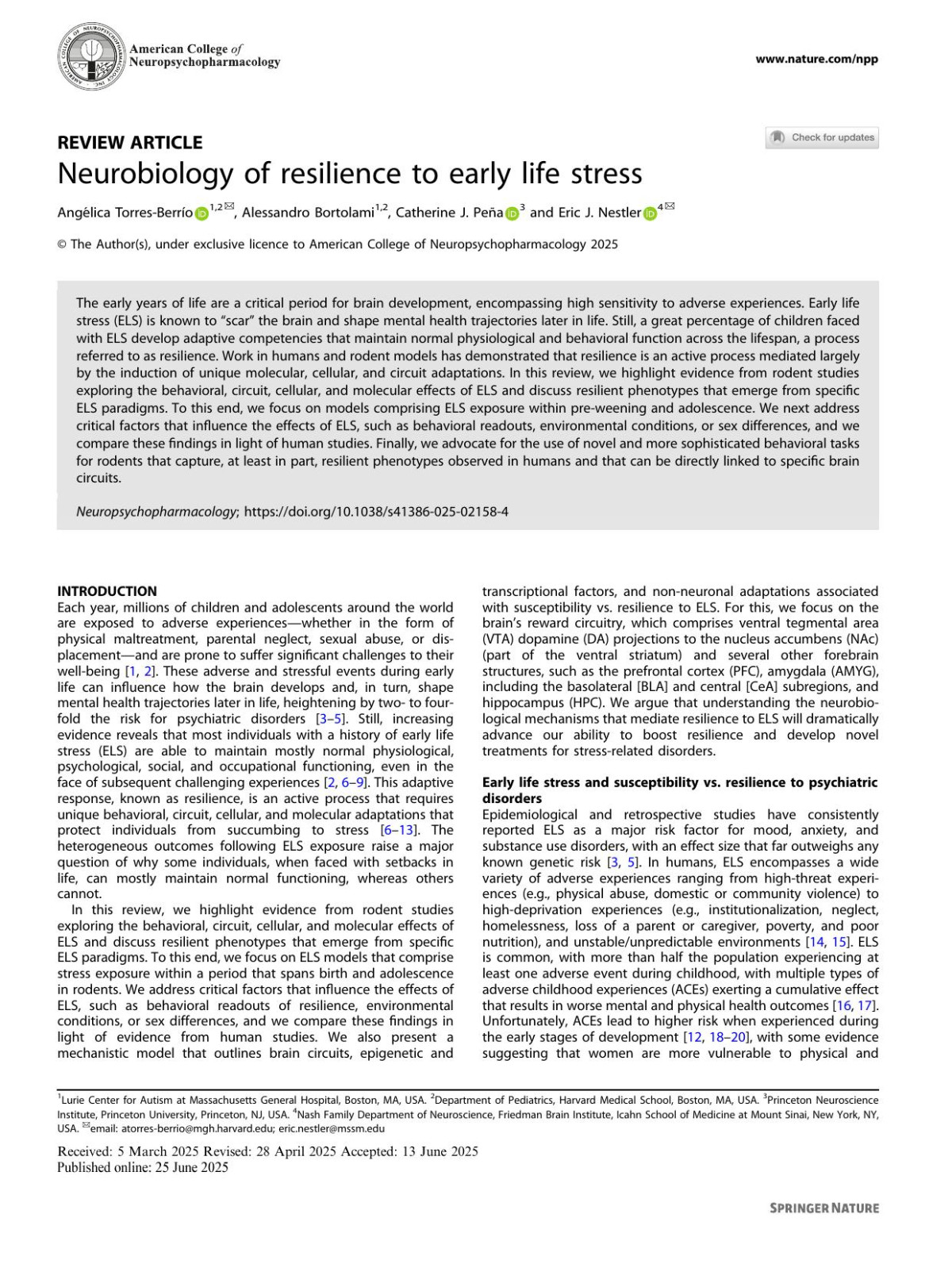
7 reviewsThe early years of life are a critical period for brain development, encompassing high sensitivity to adverse experiences. Early lifestress (ELS) is known to “scar” the brain and shape mental health trajectories later in life. Still, a great percentage of children facedwith ELS develop adaptive competencies that maintain normal physiological and behavioral function across the lifespan, a processreferred to as resilience. Work in humans and rodent models has demonstrated that resilience is an active process mediated largelyby the induction of unique molecular, cellular, and circuit adaptations. In this review, we highlight evidence from rodent studiesexploring the behavioral, circuit, cellular, and molecular effects of ELS and discuss resilient phenotypes that emerge from specificELS paradigms. To this end, we focus on models comprising ELS exposure within pre-weening and adolescence. We next addresscritical factors that influence the effects of ELS, such as behavioral readouts, environmental conditions, or sex differences, and wecompare these findings in light of human studies. Finally, we advocate for the use of novel and more sophisticated behavioral tasksfor rodents that capture, at least in part, resilient phenotypes observed in humans and that can be directly linked to specific brain1234567890();,:circuits.Neuropsychopharmacology;
4.3
27 reviews
4.8
24 reviews
4.5
28 reviews
4.3
32 reviews
4.6
26 reviews
4.8
6 reviews
4.4
21 reviews
4.7
37 reviews