
Most ebook files are in PDF format, so you can easily read them using various software such as Foxit Reader or directly on the Google Chrome browser.
Some ebook files are released by publishers in other formats such as .awz, .mobi, .epub, .fb2, etc. You may need to install specific software to read these formats on mobile/PC, such as Calibre.
Please read the tutorial at this link. https://ebooknice.com/page/post?id=faq
We offer FREE conversion to the popular formats you request; however, this may take some time. Therefore, right after payment, please email us, and we will try to provide the service as quickly as possible.
For some exceptional file formats or broken links (if any), please refrain from opening any disputes. Instead, email us first, and we will try to assist within a maximum of 6 hours.
EbookNice Team
Status:
Available0.0
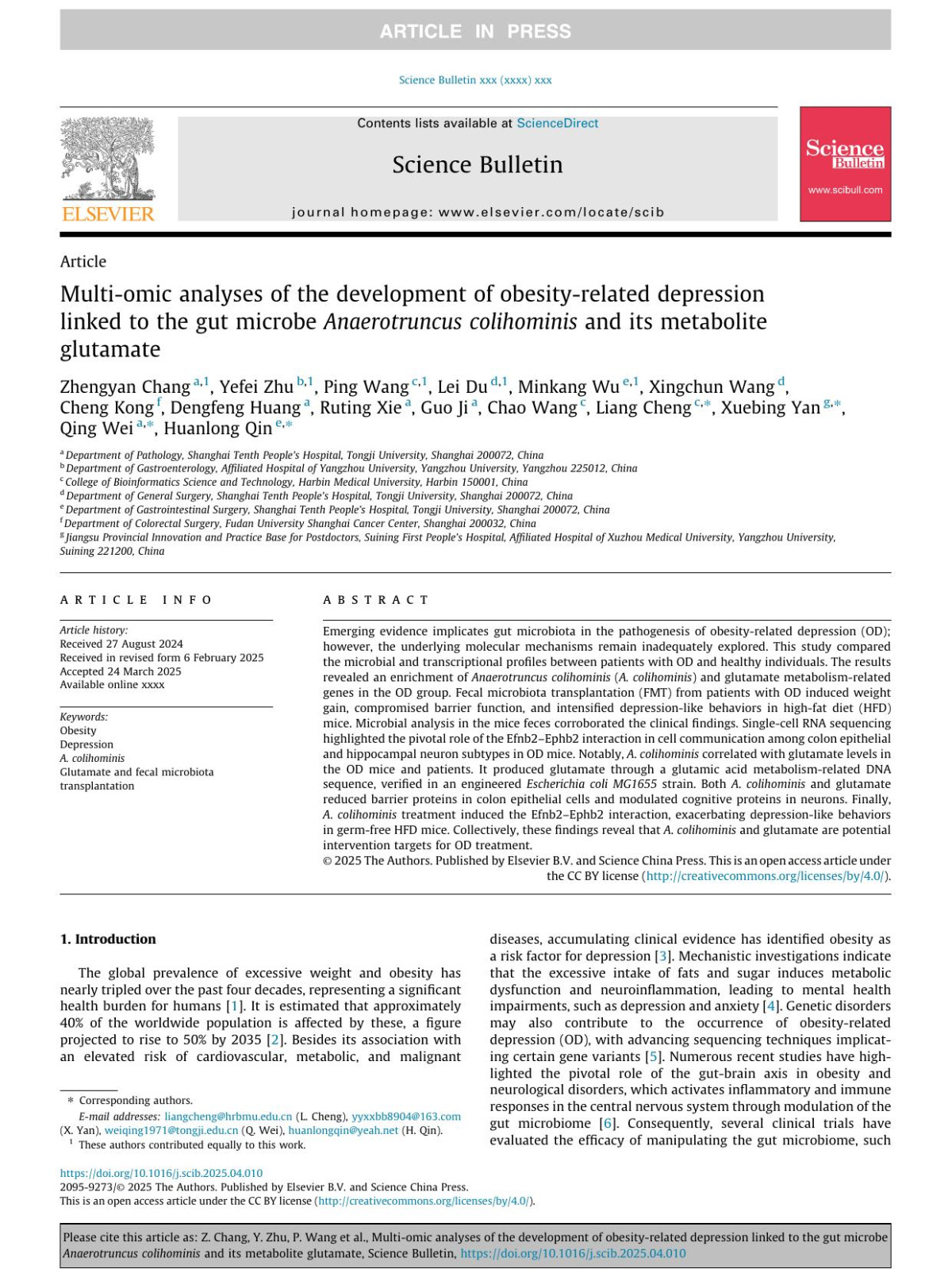
0 reviewsa b s t r a c t Article history: Emerging evidence implicates gut microbiota in the pathogenesis of obesity-related depression (OD); Received 27 August 2024 however, the underlying molecular mechanisms remain inadequately explored. This study compared Received in revised form 6 February 2025 the microbial and transcriptional profiles between patients with OD and healthy individuals. The results Accepted 24 March 2025 revealed an enrichment of Anaerotruncus colihominis (A. colihominis) and glutamate metabolism-related Available online xxxx genes in the OD group. Fecal microbiota transplantation (FMT) from patients with OD induced weight Keywords: gain, compromised barrier function, and intensified depression-like behaviors in high-fat diet (HFD) mice. Microbial analysis in the mice feces corroborated the clinical findings. Single-cell RNA sequencing Obesity highlighted the pivotal role of the Efnb2–Ephb2 interaction in cell communication among colon epithelial Depression and hippocampal neuron subtypes in OD mice. Notably, A. colihominis correlated with glutamate levels in A. colihominis the OD mice and patients. It produced glutamate through a glutamic acid metabolism-related DNA Glutamate and fecal microbiota transplantation sequence, verified in an engineered Escherichia coli MG1655 strain. Both A. colihominis and glutamate reduced barrier proteins in colon epithelial cells and modulated cognitive proteins in neurons. Finally, A. colihominis treatment induced the Efnb2–Ephb2 interaction, exacerbating depression-like behaviors in germ-free HFD mice. Collectively, these findings reveal that A. colihominis and glutamate are potential intervention targets for OD treatment. © 2025 The Authors. Published by Elsevier B.V. and Science China Press. This is an open access article under the CC BY license (
4.9
19 reviews