
Most ebook files are in PDF format, so you can easily read them using various software such as Foxit Reader or directly on the Google Chrome browser.
Some ebook files are released by publishers in other formats such as .awz, .mobi, .epub, .fb2, etc. You may need to install specific software to read these formats on mobile/PC, such as Calibre.
Please read the tutorial at this link. https://ebooknice.com/page/post?id=faq
We offer FREE conversion to the popular formats you request; however, this may take some time. Therefore, right after payment, please email us, and we will try to provide the service as quickly as possible.
For some exceptional file formats or broken links (if any), please refrain from opening any disputes. Instead, email us first, and we will try to assist within a maximum of 6 hours.
EbookNice Team
Status:
Available4.6
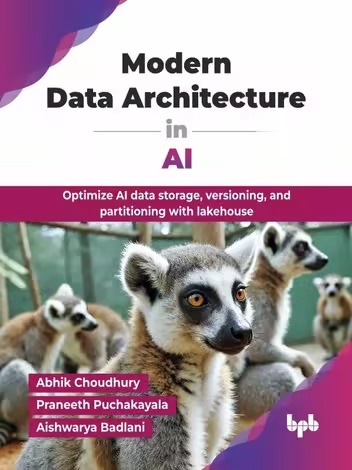
21 reviewsThe book starts by introducing fundamental concepts of modern data architecture for AI, laying the groundwork for understanding its importance. It then digs deep into the aspects of data ingestion and collection strategies. Subsequently, it discusses data storage and management techniques that cater specifically to AI workloads. Readers will understand the concepts of data processing, transformation, and building scalable and efficient data pipelines, and how to orchestrate interconnected processes. The book further explores the topics of scalable ML infrastructure and stream processing, concluding with insights into visualization, explainable AI, and future trends.
By the end of this book, the readers will have a comprehensive understanding and the skills to develop and manage scalable and efficient AI systems. They will have a firm grasp on the collection, storage, processing, and transformation of data, ensuring data governance and security. After reading this book, you will be well-equipped to design, build, and manage cutting-edge data architectures for diverse AI workloads, empowering your strategic initiatives.
What you will learn
● Build data pipelines with automated orchestration and monitoring.
● Design scalable data lakes and lakehouse architectures for AI workloads.
● Learn data governance, security, and compliance frameworks.
● Leverage emerging technologies like quantum and edge computing.
● Optimize infrastructure for distributed ML training and serving.
● Visualize AI insights and apply explainable AI methods for transparency.
● Understand LLMs, generative AI, federated learning, and their data architecture impact.
● Architect
…
5.0
20 reviews

5.0
25 reviews
4.6
23 reviews

4.7
16 reviews
4.4
38 reviews