logo
Product categories

EbookNice.com

Most ebook files are in PDF format, so you can easily read them using various software such as Foxit Reader or directly on the Google Chrome browser.
Some ebook files are released by publishers in other formats such as .awz, .mobi, .epub, .fb2, etc. You may need to install specific software to read these formats on mobile/PC, such as Calibre.

Please read the tutorial at this link.  https://ebooknice.com/page/post?id=faq


We offer FREE conversion to the popular formats you request; however, this may take some time. Therefore, right after payment, please email us, and we will try to provide the service as quickly as possible.


For some exceptional file formats or broken links (if any), please refrain from opening any disputes. Instead, email us first, and we will try to assist within a maximum of 6 hours.

EbookNice Team
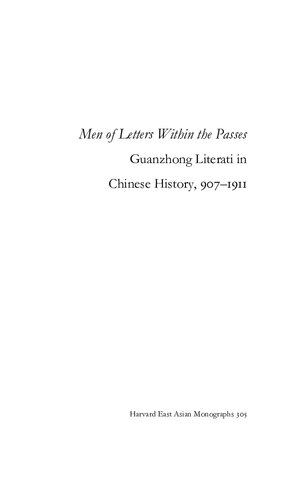
(Ebook) Men of Letters within the Passes: Guanzhong Literati in Chinese History, 907–1911 by Chang Woei Ong ISBN 9780674031708, 0674031709

  • SKU: EBN-34043154
Zoomable Image
$ 32 $ 40 (-20%)

Status:

Available

5.0

8 reviews
Instant download (eBook) Men of Letters within the Passes: Guanzhong Literati in Chinese History, 907–1911 after payment.
Authors:Chang Woei Ong
Pages:291 pages.
Year:2008
Editon:Illustrated
Publisher:Harvard University Asia Center
Language:english
File Size:2.02 MB
Format:pdf
ISBNS:9780674031708, 0674031709
Categories: Ebooks

Product desciption

(Ebook) Men of Letters within the Passes: Guanzhong Literati in Chinese History, 907–1911 by Chang Woei Ong ISBN 9780674031708, 0674031709

The main theme of this book is the interaction between two “places,” China and Guanzhong, the capital area of several dynasties. It addresses such questions as What do we mean by “local”? Did the inhabitants of a locality believe that being “local” required them to assume a certain identity? If so, how did they talk and write about it? Were there spatial and temporal differences in the representation of locales? This work examines how Guanzhong literati conceptualized three sets of relations: central/regional, “official”/“unofficial,” and national/local. It further traces the formation over the last millennium of the imperial state of a critical communal self-consciousness, the role of this consciousness in constructing a local identity and promoting an “unofficial” space for nonofficial elite activism, and the effect of the presence (or absence) of this consciousness on literati views of central-­regional relationships. The issue here is not whether there can be a shared national culture, but whether this culture can be perceived as having regional variations and therefore contributing to the formation of a local identity.
*Free conversion of into popular formats such as PDF, DOCX, DOC, AZW, EPUB, and MOBI after payment.

Related Products