logo
Product categories

EbookNice.com

Most ebook files are in PDF format, so you can easily read them using various software such as Foxit Reader or directly on the Google Chrome browser.
Some ebook files are released by publishers in other formats such as .awz, .mobi, .epub, .fb2, etc. You may need to install specific software to read these formats on mobile/PC, such as Calibre.

Please read the tutorial at this link.  https://ebooknice.com/page/post?id=faq


We offer FREE conversion to the popular formats you request; however, this may take some time. Therefore, right after payment, please email us, and we will try to provide the service as quickly as possible.


For some exceptional file formats or broken links (if any), please refrain from opening any disputes. Instead, email us first, and we will try to assist within a maximum of 6 hours.

EbookNice Team
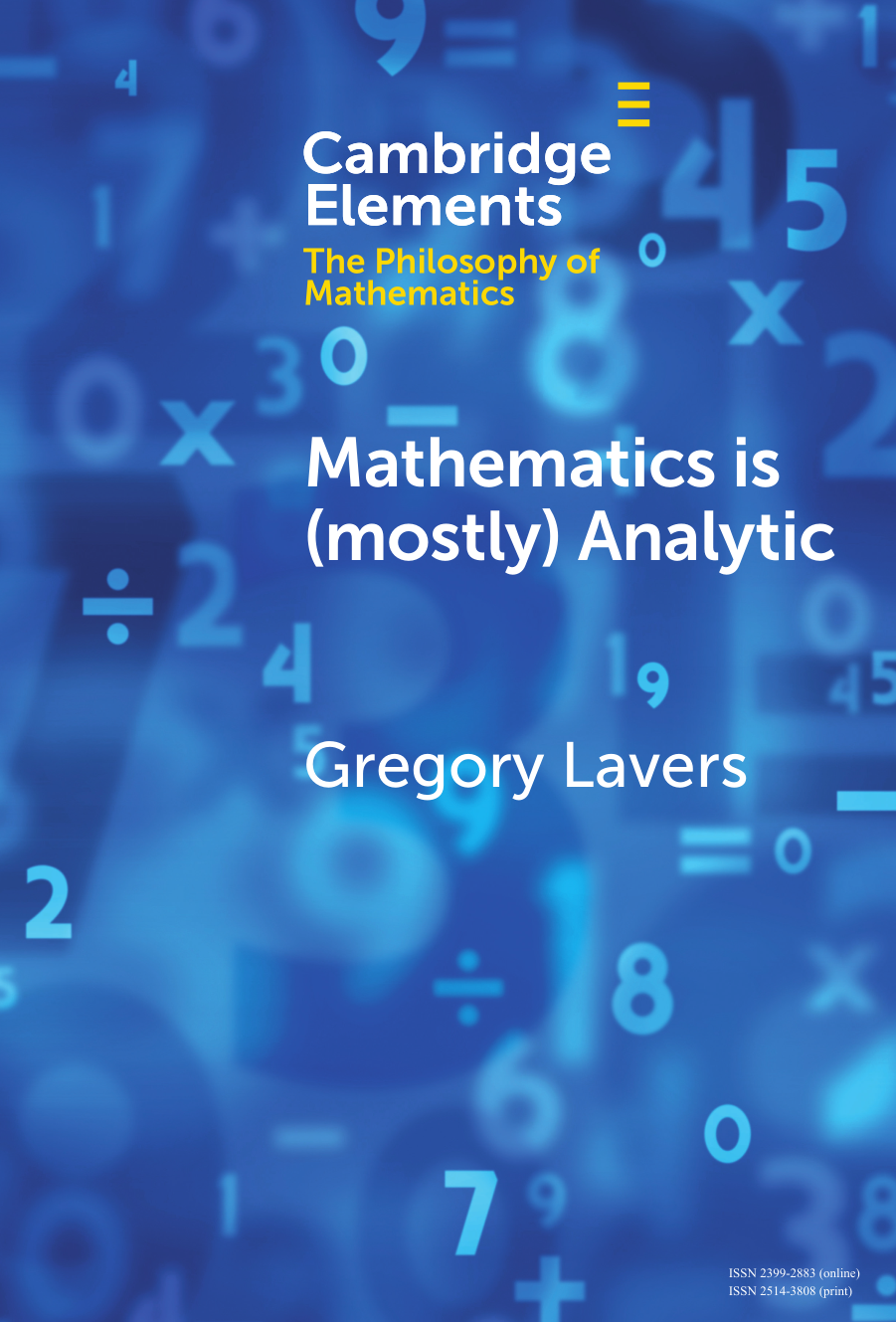
Mathematics is (mostly) Analytic (2024, Gregory Lavers) by Gregory Lavers ISBN 9781009109925, 1009109928 instant download

  • SKU: EBN-239958602
Zoomable Image
$ 32 $ 40 (-20%)

Status:

Available

4.6

9 reviews
Instant download (eBook) Mathematics is (mostly) Analytic (2024, Gregory Lavers) after payment.
Authors:Gregory Lavers
Pages:70 pages
Year:2024
Edition:2024
Publisher:Cambridge University Press
Language:english
File Size:1.72 MB
Format:pdf
ISBNS:9781009109925, 1009109928
Categories: Ebooks

Product desciption

Mathematics is (mostly) Analytic (2024, Gregory Lavers) by Gregory Lavers ISBN 9781009109925, 1009109928 instant download

This Element outlines and defends an account of analyticity according to which mathematics is, for the most part, analytic. The author begins by looking at Quine's arguments against the concepts of analyticity. He shows how Quine's position on analyticity is related to his view on explication and shows how this suggests a way of defining analyticity that would meet Quine's own standards for explication. The author then looks at Boghossian and his distinction between epistemic and metaphysical accounts of analyticity. Here he argues that there is a straightforward way of eliminating the confusion Boghossian sees with what he calls metaphysical accounts. The author demonstrates that the epistemic dimension of his epistemic account is almost entirely superfluous. The author then discusses how analyticity is related to truth, necessity, and questions of ontology. Finally, he discusses the vagueness of analyticity and also the relation of analyticity to the axiomatic method in mathematics.
*Free conversion of into popular formats such as PDF, DOCX, DOC, AZW, EPUB, and MOBI after payment.

Related Products