
Most ebook files are in PDF format, so you can easily read them using various software such as Foxit Reader or directly on the Google Chrome browser.
Some ebook files are released by publishers in other formats such as .awz, .mobi, .epub, .fb2, etc. You may need to install specific software to read these formats on mobile/PC, such as Calibre.
Please read the tutorial at this link. https://ebooknice.com/page/post?id=faq
We offer FREE conversion to the popular formats you request; however, this may take some time. Therefore, right after payment, please email us, and we will try to provide the service as quickly as possible.
For some exceptional file formats or broken links (if any), please refrain from opening any disputes. Instead, email us first, and we will try to assist within a maximum of 6 hours.
EbookNice Team
Status:
Available4.9
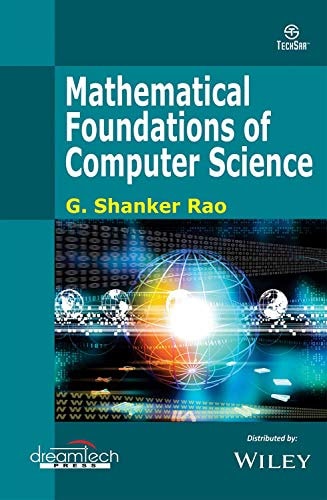
37 reviewsused by the students in computer science as an introduction to the fundamental
ideas of mathematics for computer science. The topics mathematical logic,
predicates, relations, functions, combinatorics, algebraic structures and graph
theory have been discussed in this book. Throughout, I have made an extensive
use of worked examples to develop the general ideas.
Chapter 1: Deals with mathematical logic. Propositions, well formed formulas,
logical equivalence, tautologies, fallacies, and duality principle were briefly
discussed in this chapter.
Chapter 2: This chapter provides an introduction to predicate logic. Rules of
inference and different methods were briefly discussed in this chapter.
Chapter 3: Deals with set theory. Properties of set containment, union of sets.
Intersection of sets, complement of a set, difference of sets and their properties
were discussed. This chapter presents the notions of relations and functions. It also
deals with partially ordered sets, lattices and Hasse diagrams.
Chapter 4: Deals with algebraic system. In this chapter we give the basic theory of
graphs. Semigraphs, normal subgraphs, cosets. Permutations. Groups
Homomorphism and Isomorphism were briefly discussed in this chapter.
Chapter 5: Covers elementary combinatorics. Permutations, Combinations and
Binomial theorem have been discussed in this chapter.
Chapter 6: Deals with recurrence relations.
Generating functions, and the methods of solving recurrence relations were
discussed in this chapter.
Chapter 7: It is devoted to graph theory. This chapter presents the terminology.
Connected graphs, bipartite graphs, planarity, trees, spanning trees and binary
trees were discussed.
Chapter 8: Deals with applications of graph theory. Euler’s, graphs and
Hamiltonian graphs have been discussed. Coloring of graphs, and Chromatic
polynomial have been explored in this chapter.

5.0
38 reviews
4.7
6 reviews
4.5
39 reviews
4.4
36 reviews
4.8
30 reviews
4.5
27 reviews
4.3
23 reviews
4.4
14 reviews
4.3
32 reviews