Most ebook files are in PDF format, so you can easily read them using various software such as Foxit Reader or directly on the Google Chrome browser.
Some ebook files are released by publishers in other formats such as .awz, .mobi, .epub, .fb2, etc. You may need to install specific software to read these formats on mobile/PC, such as Calibre.
Please read the tutorial at this link. https://ebooknice.com/page/post?id=faq
We offer FREE conversion to the popular formats you request; however, this may take some time. Therefore, right after payment, please email us, and we will try to provide the service as quickly as possible.
For some exceptional file formats or broken links (if any), please refrain from opening any disputes. Instead, email us first, and we will try to assist within a maximum of 6 hours.
EbookNice Team
Status:
Available0.0
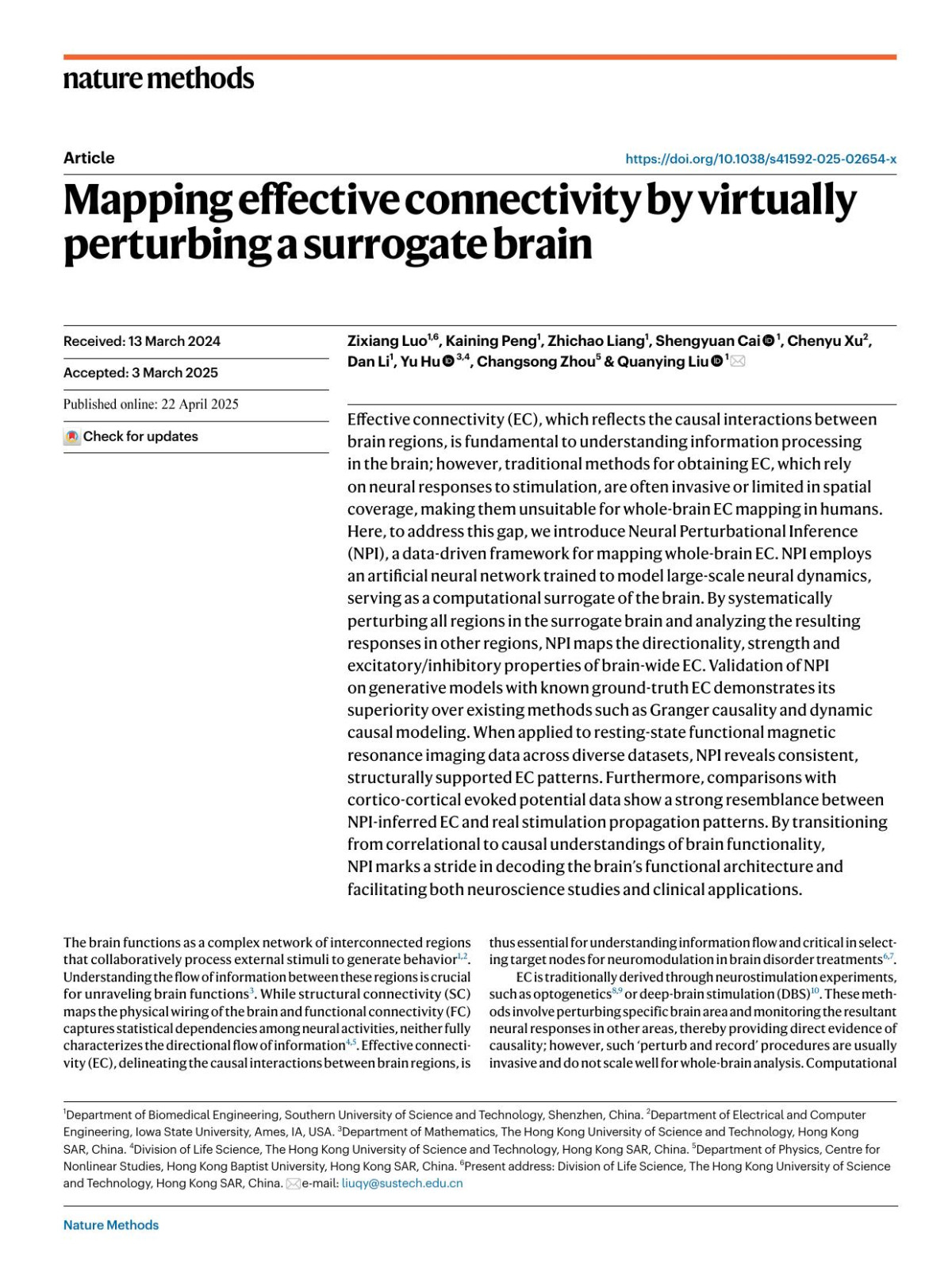
0 reviewsEfective connectivity (EC), which refects the causal interactions between brain regions, is fundamental to understanding information processing in the brain; however, traditional methods for obtaining EC, which rely on neural responses to stimulation, are often invasive or limited in spatial coverage, making them unsuitable for whole-brain EC mapping in humans. Here, to address this gap, we introduce Neural Perturbational Inference (NPI), a data-driven framework for mapping whole-brain EC. NPI employs an artifcial neural network trained to model large-scale neural dynamics, serving as a computational surrogate of the brain. By systematically perturbing all regions in the surrogate brain and analyzing the resulting responses in other regions, NPI maps the directionality, strength and excitatory/inhibitory properties of brain-wide EC. Validation of NPI on generative models with known ground-truth EC demonstrates its superiority over existing methods such as Granger causality and dynamic causal modeling. When applied to resting-state functional magnetic resonance imaging data across diverse datasets, NPI reveals consistent, structurally supported EC patterns. Furthermore, comparisons with cortico-cortical evoked potential data show a strong resemblance between NPI-inferred EC and real stimulation propagation patterns. By transitioning from correlational to causal understandings of brain functionality, NPI marks a stride in decoding the brain’s functional architecture and facilitating both neuroscience studies and clinical applications.
4.9
19 reviews
4.4
7 reviews
4.7
9 reviews
4.9
22 reviews
4.8
5 reviews
4.3
33 reviews
4.5
26 reviews